Archive

Monthly Archives: December 2014

An effective spy thriller, in keeping with the post-Watergate cynicism and paranoia of so many American films (The Parallax View, Executive Action, The Conversation, Winter Kills). Robert Redford is a lowly CIA analyst at a New York City agency front (a historical society) who comes back from lunch one day to find all of his co-workers gunned down.  Redford goes on the run, commandeering Faye Dunaway, and as he flees the hitmen (led by Max Von Sydow) and negotiates with the Agency rep (Cliff Robertson), he woos Dunaway and uncovers the reason for the murders. Needless to say, that reason is of the times.

There are problems. Redford can be intense, but he cannot be harried or excitable. As such, he handles some pretty shocking developments in a discordantly world-weary way. As far as the plot, despite all the cloak-and-dagger, it’s very bare bones. The film is also horribly scored, sporting a 70s saxophone that makes the dullest love scene ridiculous. Redford and Dunaway don’t seem to be having sex so much as playing the “who blinks first” game.

Dunaway, however, is quite good, managing to convey a captive’s ability to bond with her captor, and as an Agency “contractor”, Von Sydow is understated and interesting. Robertson is also given respect, even though he’s ostensibly the government baddie. His speech to Redford at the end is a fair defense of the dirty tricks spy trade:

As Director Sydney Pollack noted about Robertson’s character, “I’m much more interested in the CIA guys who are trying to help us and do something [widely considered] immoral than I am about guys who are just immoral because they want to sell dope and make money. That’s boring to me. It’s much more complicated to say, here’s a bunch of guys whose job it is to protect us and they’re saying there’s no way we’re going to sell the fact that the Middle East [states] control the oil and if we don’t get control of the oil and they [seize its production], we’re going to end up with what we have now.”  Now, juxtapose Pollack’s view of Robertson with Oliver Stone’s Wall Street creation, Gordon Gecko, who at the height of his megalomania, answers a question as to why he wants to wreck a company with, “Because it’s WRECKABLE!” and you’ll understand why that film travels so poorly.

Pollack also makes great use of grimy 70s New York City – the World Trade Center figures very prominently in the film. More Pollack: “I was looking for the logic of where the [Central Intelligence Agency (CIA)] might be [located]. I didn’t want to have a building that said CIA on it because I didn’t think that would exist. I figured they would want some kind of anonymity and that the best kind of anonymity are these two massive buildings with thousands of offices and you wouldn’t know who’s where.”



After a promising start, this picture spins so wildly out of control it is almost impressive. Mild mannered Texas picture framer Richard Dane (Michael C. Hall) shoots a home intruder, earning the enmity of the intruder’s fresh out of prison father (Sam Shepard), but they soon learn there is something bigger than the both of them connected to the killing. The first half of director Jim Mickle’s movie is tense and effective. But then, the picture abruptly shifts course, veering into the implausible. Hall and Shepard improbably team up together with the assistance of Don Johnson as a Houston private investigator (Johnson delivers a jokey performance that undercuts the film’s dark feel) and we get a bit of a buddy movie. The awkward shift in tone is accompanied by nonsensical plot points and an ostentatiously arty, bloody end that utilizes slow motion and a synthesizer rich soundtrack reminiscent of The Terminator without a hint of irony.

Post Dexter, Hall is as good as he can be, but the writers give him absolutely no real reason to become a confederate with a man who not only threatened his life, but that of his wife and child. The critics gave this 85% on rottentomatoes.com while the audience posted a 69%. The audience got it right.

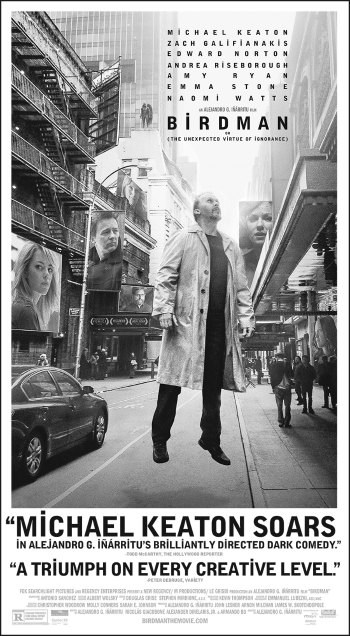
Birdman is so visually audacious you almost lose focus on its engrossing performances, cutting sense of humor and ambitious breadth. It is Rope on meth, tracking, almost hounding, with very few cuts, our tortured protagonist (Michael Keaton) in, through and around Broadway’s St. James Theater as he seeks to revive an acting career defined by his iconic role as a movie superhero. His fortune and name are on the line, and he is beset on all sides by family (fresh out of rehab daughter Emma Stone, ex-wife Amy Ryan), his jittery manager (Zack Galifianakis), his needy female co-stars (Andrea Riseborough, Naomi Watts), his antagonistic male co-star (Edward Norton) and a vicious and even more antagonistic New York Times reviewer (Lindsey Duncan).

One other character gives him some trouble as well.  His alter ego, who at first is a voice in his head but soon appears in person, telling him that all this stage acting bullshit is just that, he needs to get his ass back in a Birdman movie, and he must “shave off that pathetic goatee. Get some surgery. Sixty’s the new thirty, motherfucker!”

Director Alejandro Gonzalez Inarritu collaborated with three others on the play-within-a-play script, which is a satirical series of verbal jousts on the topics of sex, relationships, acting, the stage versus Hollywood, machismo, art versus commerce and the impact of social media.  The clashes between Keaton and Norton (sell-out v. artiste’) and Keaton and Duncan (the sell-out virus stinking up the hallowed stages of Broadway v. the Lord Protector of those stages) are particularly sharp, but the entire screenplay is chock full of gems.  My favorite is Keaton explain how he is holding up under the strain:  “”I’m broke, I’m not sleeping and this play keeps hitting me in the balls with a tiny little hammer.”

The frenetic, adrenaline rush style of the film heightens the tension (the cinematographer, Emmanuel Lubetzki, was the mastermind behind the dizzying tracking shot in Children of Men). The manic shooting makes the performances all the more impressive.  Keaton is superb.  His early trademark (ironically, before he became Batman) was a fevered, riffing style of acting, which could be spellbinding or just exhausting.  Older and more world-weary, Keaton internalizes his frenzy, struggling to bottle it in just as he struggles to keep Birdman at bay.  It’s a riveting turn.  Everyone else is excellent, and Norton deserves special mention.  As an actor with a history of being temperamental, Norton’s performance as a condescending, difficult, self-loathing actor is canny and knowing.  He damn near steals the film, which again, mirrors what is going on in the story.

Gonzalez Inarritu also gives the actors a great deal of space.  In Boogie Nights, Paul Thomas Anderson filmed a solid chunk of a drug deal going bad solely on the face of Mark Wahlberg.  The effect was powerful because in Wahlberg’s eyes, the audience could register the disaster unfolding before him.  Whenever I think of that classic film, I first remember that scene.  Of all the memorable parts of Birdman, there is a scene when Stone lashes out at her father, purposefully trying to hurt him.  In one of the few times the camera isn’t moving, Gonzalez Inarritu holds on Stone’s face as she delivers the cut and then as she sees its effect.  It’s a captivating moment in a film full of them.

Thus far, the best film I’ve seen all year.

I am seeing Birdman tonight. But I have to keep this blog energized, so I present, from Vulture. . .

The 30 Most Important Sex Scenes in Movie History.

I was surprised three movies were excluded: James Spader and Maggie Gyllenhaal in Secretary; Kris Kristofferson and Sarah Miles in The Sailor Who Fell from Grace with the Sea; and Angie Dickinson in the shower in . . .

Dressed to Kill.

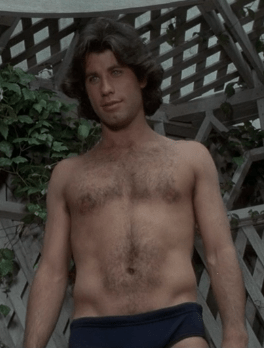
As far as the worst, it’s hard to beat John Travolta and Lily Tomlin in Moment by Moment, a truly disturbing scene

 “Please, God, don’t come in here.”

“How can you resist?”

[Moment3.jpg]