The Duchess. A lush period piece marred by further establishment of the fact that Keira Knightley, as beautiful as she is, has two stock acting moves – radiantly proud and quiveringly proud (the latter is an indication that she is in some manner of emotional upset). That said, Ralph Fiennes, as her abusive husband, the Duke of Devonshire, steals this movie as the nuanced tormentor of the duchess. The more annoying she becomes, the more you sympathize with her husband.
Monthly Archives: February 2012
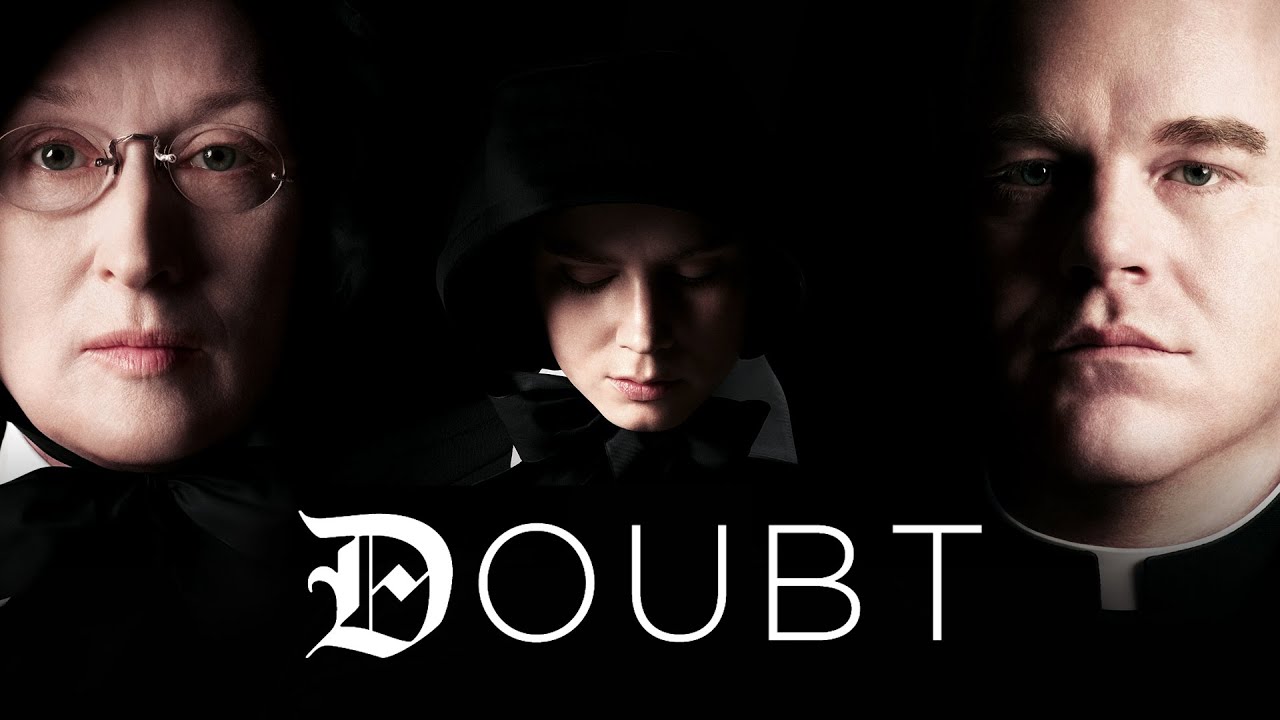
Doubt – 5 stars

John Patrick Shanley adapted his stage play for the screen, both writing and directing, and as a product of Catholic schools born the year the picture is set, boy does he nail the look and feel. From the severity and sweetness of the nuns (the way they care for an older nun who is losing her sight is exactly how I saw nuns care for a clearly senile sister when I was in grade school) to the imbalanced hierarchy between nun and priest (servants to gods) to the design and feel of the Brooklyn grade school, cookie-cutter in many ways to my old Blessed Sacrament parish, it’s clear Shanley has been here.
Philip Seymour Hoffman, Meryl Streep and Amy Adams serve and teach at a Catholic grade school in the Bronx the year after the Kennedy assassination. Hoffman is the “new church,” Adams is the young nun who wants to believe in his less strict methods, and Streep is the principal of the school, the resolute conservative hammer (her attack on “Frosty the Snowman” is worth the price of admission alone). A concern over Hoffman’s behavior toward an 8th grade boy, the only black kid in the school, drives the plot, but Shanley uses the crisis to have his characters exchange views on faith versus acts, modernity, religious liberalism, raising children and tolerance. As someone who was schooled by nuns in 8 years of Catholic elementary school, and by the Jesuits in 4 years of high school, I came into the film with certain presumptions that were difficult to stow away. Some of my nuns appeared to loathe children, and one of my priests clearly behaved inappropriately (and it turns out, criminally) with students, but neither of these realities marred what was essentially a happy and more simple time of childhood. At the time, we knew this Jesuit was problematic and it strangely seemed just part of the deal, a simple hurdle or punchline (“Don’t let yourself be alone with Father Bradley” or “Christ. He’s in the locker room again””) You knew to steer a little clear, even if you weren’t really sure why. For ones who were vulnerable and thus not insulated by a casual, “he’s a little strange so watch yourself” attitude, however, Father Bradley was a more menacing and destructive force. But he was also charismatic and he was impressive, much like the priest in this picture, adding to the lethality.
I offer my reminiscence because my background likely colored my judgment of the picture’s central conundrum, but the film is riveting no matter your background. All the principal actors are fantastic; there is not a time I see Hoffman and do not mourn his pointless and untimely demise. And Viola Davis should have earned an Oscar for her one scene as the mother of the boy, putting her in the ranks with Beatrice Strait (Network), William Hurt (A History of Violence) and Judi Dench (Shakespeare in Love) for greatest impact in shortest screen time.
Frost/Nixon – 3 stars
Frost/Nixon. Expertly acted, well-paced, and ultimately, pat and unsatisfying. Screenwriter Peter Morgan takes the characters of Frost (Michael Sheen) and Nixon (Frank Langella) in a manner that mirrors his treatment of Tony Blair and Queen Elizabeth in The Queen — the upstart versus the titan, with a quest for moral concession at the end of the saga. For Queen Elizabeth, she had to change with the times and accept the sorrow of the British people over the death of Diana, and Blair helps her achieve this trek into modernity, in the process, gaining great respect for her. In Frost/Nixon, Nixon has to accept responsibility for his crimes and thus, help the American people heal, and Frost has to trap him in interview to wrangle the confession, which, of course, ultimately lessens the psychic burden both Nixon and the nation carry. For dummies in the audience, this theme is explicated by a drunken call from Nixon to Frost on the eve of their last interview (set up as an interview version of a heavyweight bout, The Thrilla’ in the Villa), a wholesale fabrication.
But Nixon had a 20% stake in the sales of the interviews. And Nixon knew as well as Frost that they couldn’t be a love letter to himself, that there had to be a draw, a teaser, a hook. So, in the interview on Watergate, he apologizes, though in dramatic, stubborn style. But he does not, as the film depicts, concede. And in the end, through their own conspiracy, Frost is lionized, Nixon starts a second comeback (as opposed to the laughable postscript of the film’s closing lines — “[Nixon] never achieved the rehabilitation he so desperately craved. His most lasting legacy is that, today, any political wrongdoing is immediately given the suffix ‘-gate'”), they both make buckets of dough, and television wins! A much better story, but also much harder. Much easier and more crowd-pleasing for Howard and Morgan to revise the impact of the interviews themselves, to make them a definitive win in a titanic battle of wits that finally earned Nixon the calumny he so richly deserved.
Which is nonsense.
This is not a terrible film. It’s fine. It is at about the level of a solid TV movie and about as ambitious. Moreover, the interviews themselves as depicted curiously lack the crackle of some of the better moments of the real ones, and unfortunately, offer a somber, sonorous Nixon.
I don’t want to come off as some sort of niggling prig. My discomfort with Frost/Nixon is not predicated on the fact that it is historically inaccurate. My concern is in the manner in which the writer and director chose to be historically inaccurate. For example, the fabricated drunken phone call from Nixon to Frost seems to fall within the reasonable artistic license. But the problem is that the movie created a pat, simplistic morality tale, distorting history so egregiously in service of that dramatic aim that it exceeded the admittedly blurry lines in place.
It would be akin to a writer of Bobby/Lyndon penning a script geared toward Bobby being the driver of the civil rights movement, finally impressing upon Lyndon (also drunk on a call – it’s always the old man who is drunk) the importance of completing his brother’s legacy. It could play well, it could be beautifully acted, but the historical point it serves is not only false, but utterly contradicted by the actual facts.
Indeed, a great interview with Frank Langella shows that he gets the problem:
Q. The movie does make you sympathetic to Nixon, this monster. It really makes you feel sorry for the bastard.
FL: Well, in one sentence you’ve called him a monster and a bastard. You see how totally and completely prejudiced you are?
Q: Well, you said “these two epic monsters.”
FL: Well, I meant monster in the larger sense. But that’s ingrained in you to think that way, and you don’t have any right to judge him that way. You’re not walking in his shoes. If you think Nixon is a monster and a bastard, what do you think of the presidents we’ve had since? That’s the thing: it’s very easy to use these words about this man, and very facile, because we live in a time where it’s sound-byte time. Let’s see… Richard Nixon? Monster, bastard. Anna Nicole Smith? Dumb, blonde. We just do it. We just narrow everybody down to a tiny little spectrum, and you really can’t and you really shouldn’t. I do it too, though, because it’s really fast, and it’s really quick. It would’ve been totally uninteresting of me to play him as a drunk, or as a crook. Those were two facets of a very, very complicated man, and we mustn’t forget that he was a brilliant statesman. [Nixon] was an extraordinarily intelligent man. I spent hours and hours of reading his books. His hopes and dreams for this country in foreign policy were extraordinary, and what he did in China and other places was wonderful. It would be a shame to let all that [go to waste] — history has done it, and he brought it on himself. Nixon was not destroyed by anything or anyone but himself.

Sherlock Holmes – 4 stars
Sherlock Holmes. I expected to be underwhelmed and perhaps even dispirited as the Holmes character was “re-envisioned” for a new generation. What a pleasant surprise. Robert Downey, Jr. and Jude Law are effortless in their banter and prove a great, smart duo (equaling my favorite, Christopher Plummer and James Mason in Murder by Decree). The story moves, the visuals are impressive. The weak spot is Rachel McAdams. She’s beautiful and wholly overmatched. Fortunately, she is required to do little more than fear for her life.
Humpday – 2.5 stars
Humpday. A sometimes clever but unsuccessful spin on the “bro-mance.” Two heterosexual old friends reunite, one is recently married and on the baby track, the other is an artist “less Kerouac than he likes to think.” They booze it up, hang with bohemian free-love, dope smoking cool cats and the staid friend becomes wistful for the free life. Here it is – they agree (or challenge each other) to have sex on camera as part of a Seattle art project (“Humpday”).
I know, I know. And it is such a large hump to get over that the first 15 minutes are hard to endure. But it gets better, especially as the dynamics are juiced by the utterly baffled wife. Then, the last scene – the hotel room where they are to film their sex act – becomes interminable.
A noble failure.
State of Play – 2 stars
State of Play. A Russell Crowe Washington D.C. political potboiler. Crowe sports impressive weight gain to flesh out his frumpy D.C. reporter, and there are very strong supporting turns by Jeff Daniels as a corrupt congressman and Jason Bateman as a slimy P.R. flack. The film also moves like the wind, but dewy-eyed cub blogger reporter Rachel McAdams is horribly miscast (she looks like she belongs at the Lancome’ section at Macys), and Helen Mirren as the tough editor is loaded with too many hackneyed lines. Finally, Ben Affleck plays the congressman in the middle of scandal and his quivering lip and waterworks are being worked much too hard. Pretty pedestrian.
Up in the Air – 4.5 stars
Up in the Air. Critically acclaimed and rightfully so, Jason Reitman (Juno, Thank You for Smoking) adds to his impressive resume’. George Clooney is so deft and smart he veers into Cary Grant territory, and when you are looking for sexual chemistry, the definition is Clooney and Vera Farmiga. The message, about disconnectedness and love, is ready-made for debate over drinks after the movie, while the dialogue and the performances are uniformly crisp.
In a sea of asinine “I always get the bridesmaid dress, I’m a wacky misunderstood gal, hey, there’s my Romeo and whoda’ thunk I fall for such a Neanderthalic misogynist,” Up in the Air is a refreshing comedy about adults. One other note, in what is becoming a hallmark of Reitman’s, there are 3 or 4 moments in the film where a lesser director or writer might have done something different and more obvious, and it would have been understandable, but Reitman does not and the film is much better for it.
Minor nits – the idea of outsourcing firings to a company specializing in same, including using them in face-to-face “we’re letting you go” encounters, seems contrived, and Anna Kendrick gets by with one too many facial tics (oh, that’s surprise!, of, that’s hurt!).
Funny People – 4 stars
Funny People. A Judd Apatow (Knocked Up, 40 Year Old Virgin) dramedy, I was surprised at how much I liked it given its length (almost 2 and a half hours) and a certain maxed-out sense with regard to “bro’ mances.” But this one delivered both laughs (Adam Sandler plays a wildly successful comic, dying and friendless, who takes on Seth Rogen, a nobody comic, as a personal assistant to help him through the medical ordeal) and a bit more, reminding me of James L. Brooks, in that Apatow delivers a story that is universal while using Sandler’s job and surroundings for texture, ala’ Broadcast News. Better, as Sandler showed in Punch Drunk Love, he can be a good actor. Finally, there is a scene with Sandler, Rogen and Sandler’s German doctor (no physical comedy) that is a worthy entry to funniest scenes of all time.
Trick ‘r Treat – 4 stars

A clever horror film that is closer to camp and spooky than terror, this is a fun frolic intersecting Halloween night vignettes, refreshingly free of the Saw/Hostel gore porn now in vogue. Currently on MAX.
Anvil: The Story of Anvil! – 2 stars
Anvil: The Story of Anvil! This is a rock-umentary about a Canadian heavy metal band that never made it. It is understandable why they didn’t make it, and though there are a few interesting moments, this has already been sent up in This is Spinal Tap, so seeing it in reality, without the great writing, and without campy songs but straightforward metal death, is boring.