

Archive

Tag Archives: nicholas-hoult

A straightforward procedural based on a true story, broke-down and ailing FBI agent Terry Husk (Jude Law, as unpretty as you’ll find him) arrives at his new desk in Idaho only to stumble upon the rise of The Order, an “action, not words” offshoot of The Aryan Nations in the early 1980s. The Order is led by the charismatic Bob Matthews (Nicholas Hoult), who guides it from counterfeiting to bank robbery to assassination to planned insurrection. As Matthews rises, Husk and the Feds close in, amidst a backdrop of the majestic and haunting Pacific Northwest.

There is nothing new here save for restraint, but restraint is in awful short supply these days. The pace is taut, the acting largely superb, and the photography memorable. In the hands of a lesser director or writer, the temptation to weigh in on the philosophy of The Order, and to jam it into whatever current bugaboo is in fashion, would be too much to resist. Here, writer Zach Baylin shows you what The Order believes and how, attenuated or not, those beliefs are connected to their criminal endeavors. To Law, who we learn has worked undercover on cases from The Klan to The Mob, the “the” doesn’t really matter. They’re all the same. And that keeps the story from stalling on the anticipated wordy handwringing that you expect.

As one article observed, “Ultimately, the hope of slipping an unsparing portrayal of domestic extremism—produced outside of the Hollywood studio system—into the December award season is to reintroduce a discussion of radicalization to American society. ‘If you don’t learn from history, you’re doomed to repeat it—how a guy that, in the way Nick depicted him, could live down anybody’s street,’ says Haas. ‘There are lots of people right now who are hurting and struggling and looking for answers.'”

Thankfully, this kind of easy, didactic tripe is little found in the actual picture.

We also aren’t loaded down with Law’s past. There is a medical issue and familial distress, but Baylin explains just enough to give you a sense as to their effect on Law’s nature and psyche. Husk is not out here for redemption or revenge. Even his obligatory “Let me tell you about this one horrible thing” speech is muted, his explanation almost perfunctory. Much like the father of one of the young men who joined The Order, a man who resignedly tells Husk, basically, “you do the best you can with your kids, but it’s a crapshoot.”

The film could have used a little more exposition (particularly with the doomed local deputy, Tye Sheridan), the tough gal FBI supervisor (Jurnee Smollett) is hackneyed even with the gender change, and maybe there should have been one more turn before reaching resolution.

But otherwise, very solid, entertaining crime flick. Reminded me of the equally impressive Under The Banner of Heaven.

On Hulu.
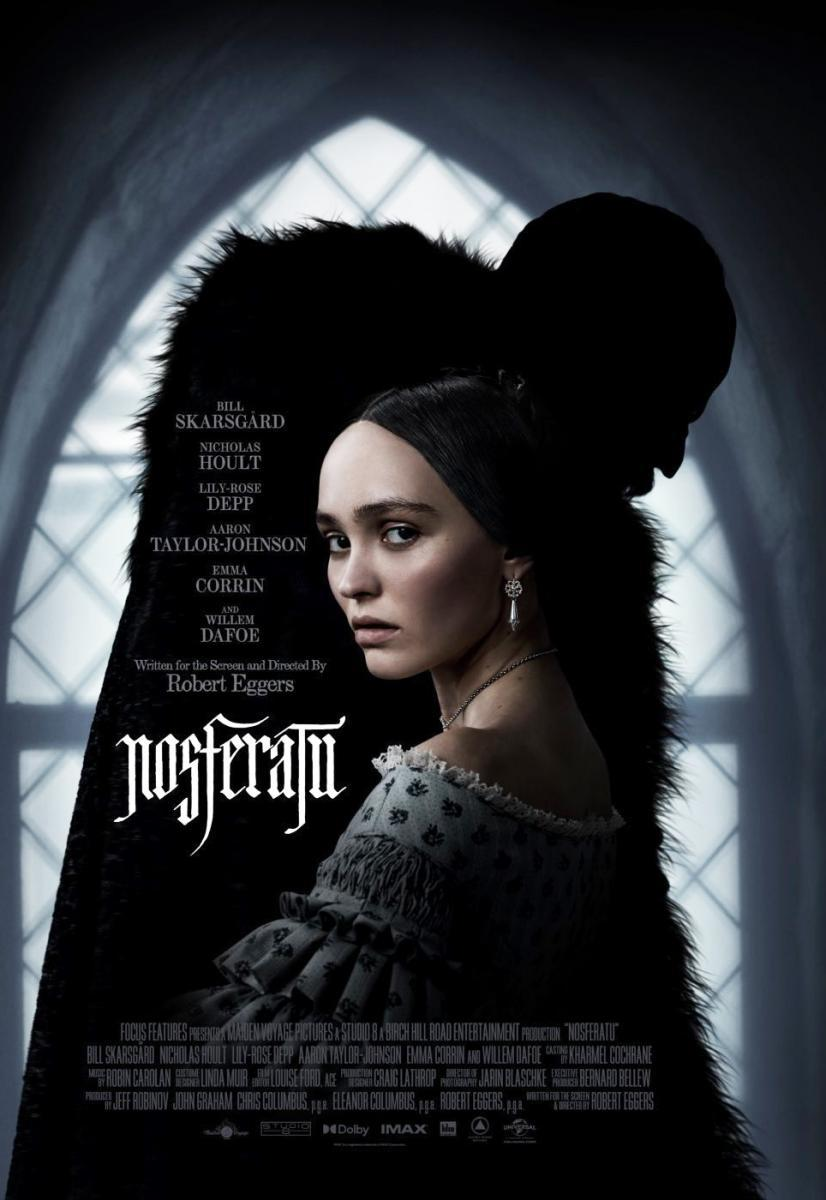
Upon their reunion, Count Orlok/Nosferatu (Bill Skarsgard) tells his intended Ellen (Lilly Rose Depp) that his well-planned travels to capture her are borne of a simple credo: “I am nothing but appetite.”  All the impressive visuals, haunting tableaus, and carefully crafted hues in Robert Eggers’ (The Witch, The Northman) bag of tricks, however, cannot make mere “appetite” all that interesting.

In the modern vampire films, there are rules. When the  creatures are plentiful, they must feed to survive. They are appetite and we are prey and their backstory is subordinated to our survival. But when the film has fealty to Bram Stoker, at center is the relationship between the monster and his beloved, always a doomed romance. In Francis Ford Coppola’s Dracula, Gary Oldman tells Winona Ryder that he has “crossed oceans of time to find you.” Why? Because his damnation as a vampire came at his rage and anger at the death of his true love, whereafter he forswore God himself, and now he has found her again in the present day Ryder. 

Here, the monster just seems to be hungry for an old meal. The two are connected by a cosmic carnal desire that goes way back but is unexplained. It allows for evocative scenes of fever dream passion, spurting and oozing blood, horror, masochism, and even a toe into exorcism. But this isn’t an art gallery, nor a meditation on how far one might go for the most extreme of sensual pleasures. It’s a film, and as gorgeous as it may be, it is also dull and dark and too often not very interesting.  

For example, when the major characters (Nicholas Hoult as Ellen’s betrothed and Willem Dafoe as the Van Helsing stand-in) have sussed out that evil has come to town specifically for her, Nosferatu finally appears to Ellen, and he is quite clear. If you don’t succumb to me in three nights, I will wreak havoc on everyone in your life and then kill your husband. Of note, Nosferatu has also brought plague to the city, so the havoc is widespread. Ellen seems unsympathetic from the get go – jittery to tortured to the throes of near-possession – and though it becomes clear she alone can end the plague, her selfish reticence is unfortunately in keeping with her character.

[Spoilers – as it turns out, Ellen destroys the monster and herself by inviting him to bed on the third night, which makes you wonder, “why the hell did everyone else have to die on nights 1 and 2?” As for the end of that night, it seems a stab at romantic, but boiled down, it has a “You’re gonna’ have to let Nosferatu feed on you so good that he loses all track of time and you literally metaphorically fu&% him to death.”]

There is no doubt, Eggers knows what to do behind the camera. But he is not adept at narrative, and you really don’t invest in any of his characters, who make it worse by over-emoting blocky dialogue. No one seems like a real person, much less a real person who is facing the undead.

Eggers adds little new to the canon but prettier visuals.