
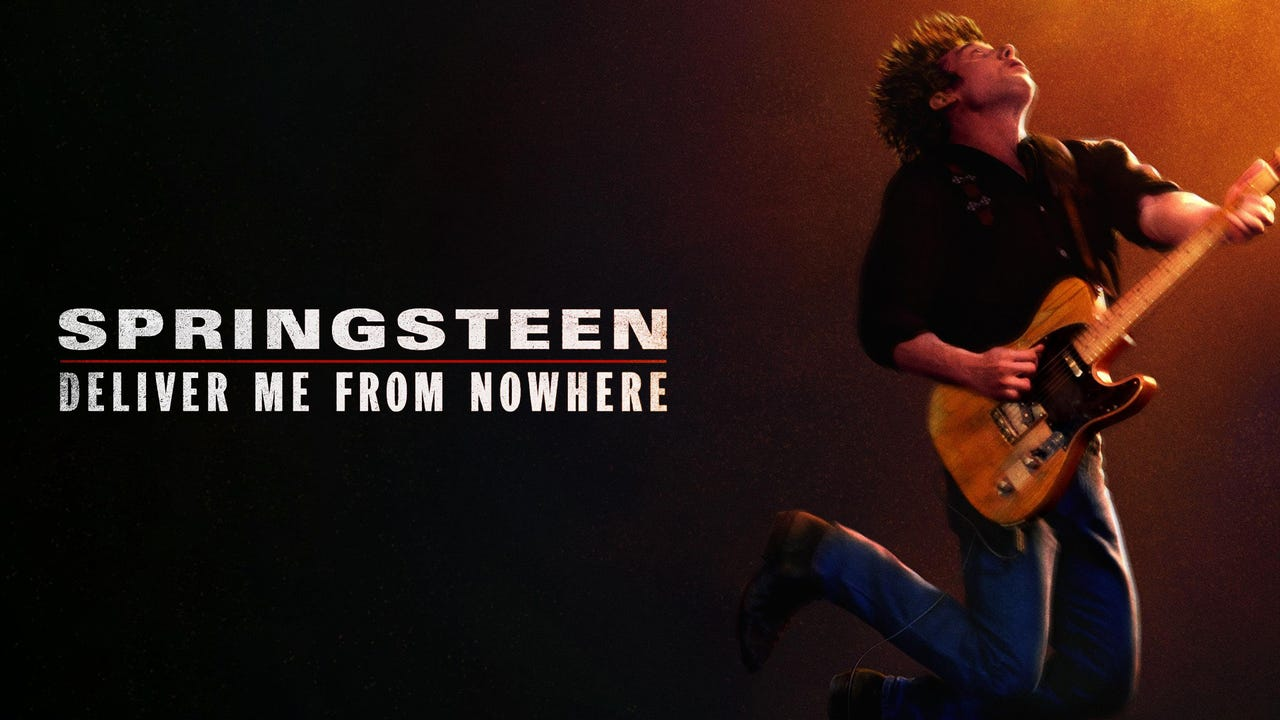
At the outset, we meet Bruce Springsteen (Jeremy Allen White) as a little boy, hearing his father (Stephen Graham) coming up the stairs, drunk, to spar with him. Bruce catches a slap, and we know it’s gonna’ be these two guys the whole picture, as the shy, depressed superstar makes his most personal, least commercial opus, Nebraska, while grappling with his troubled upbringing.
I read Bruce’s autobiography and was impressed with its honesty, charity, and equanimity. There was little, however, about his abusive father. Maybe Bruce wasn’t ready to share. But the point is relevant because in the film, while his father seems to be a handful, he is not portrayed as such a monster so as to justify the depths of Bruce’s torment. In fact, when Bruce is writing Nebraska, he seems more influenced by Terence Malick’s Badlands than Daddy issues.
In the midst of his struggle, Bruce has a relationship with a single mother (Odessa Young). Their union is supposed to be simple, earthy, a local rocker and a “heart of gold” fan who sees through The Boss’ facade. Mind you, this is post The River. Bruce is massive. He’s been on the cover of Newsweek and Time.
No matter. The picture persists in the massive conceit of Bruce the regular guy. When Bruce drops his waitress gal off, because of course she’s a waitress (in a diner, no less), it is in a blue collar row house, oil storage tanks in the background. Her father comes out and says, in a hackneyed, suspicious New Jersey small townie way, “is that the … uh … guitar player fella’?” Dad then sneeringly brings up Uncle Dave, who also “played guitar” and presumably, was not much of a success.
Oof.
Worse, the relationship doesn’t add much if anything to the story. Given the woman didn’t exist, one would expect writer/director Scott Cooper (Hostiles) to do more with the character. But she is there solely to be dumped by the angsty Bruce and to utter pap like, “if you can’t be honest with yourself, I don’t know how I can expect you to be honest with me.”
Holy Moses.
The second half of the film goes straight into the ditch. Bruce is struggling to present Nebraska in his stripped down vision while fending off the mildest of pressure to release Born in the USA. In the doing, he engages some more with his father while struggling with depression. It’s a long slog, with Bruce upset his cassette tape sound cannot be replicated in the studio, a struggle treated as if we were watching Oppenheimer and his team of scientists making Fat Man. In these moments, the film has absolutely no sense of proportion and lapses into the ridiculous.
The Boss’ head is in his hands. A lot.
Another negative is the Jon Landau character (Jeremy Strong). As Springsteen’s manager, Landau is supposed to provide some obvious tension between the Boss’ failure to follow up The River with something more commercial than his sparse, acoustic passion project. But there really is no tension at all because Landau is first and foremost an acolyte, and an uber reverential one at that. If Bruce said he wanted to follow up The River with hand puppetry, from this Landau, we’d get: “Hey [deep soulful look into Bruce’s eyes, hand on shoulder]. I Iove you. You do you.” When Landau and his wife discuss the Nebraska demo, their conversation is the most elemental exchange you’ll hear in film, as if Cooper fears the audience is so stupid it must be painstakingly explained just what a departure this record is and just how “dark” it seems. When Bruce plays the hit Born in the USA, Landau says, “I think a Muse came down and kissed you on the mouth.”
Sweet Mother of Jesus.
Ultimately, Cooper cannot land on any one thing for very long, and it is just not very cinematically interesting to watch a film about a guy writing a personal solo record.
The resolutions at the end are brutally maudlin, shield your eyes syrupy.
“You need therapy man.”
“You did the best you could. You had your own battles to fight.”
This while Bruce, an adult who just finished a concert, is sitting on his father’s lap.
There is a positive. Jeremy Allen White is really quite good as Springsteen. One has to be really careful with such a mythic figure, and White does a very understated job while still capturing the persona. The script calls for him to be perpetually tortured but he pushes back with a refreshing natural humanity. This is no small thing given how humorless and dour the script portrays him.
It’s not grotesquely terrible. But it’s pretty bad, hopelessly muddled and much duller and pedestrian than it had to be.
 filmvetter