Judge Dredd is a mix of Soylent Green,Robocop, Escape from New York, and Assault on Precinct 1 – minus the scripts. A nuclear, environmental disaster has reduced American society to one massive city, spanning from Boston to D.C. Crime is rampant and police officers act as juries and executioners at the point of arrest, if warranted. Judge Dredd (a wasted Karl Urban, who played McCoy in Star Trek) and his new rookie partner (Olivia Thirlby), are called to a triple homicide in a massive skyscraper, public housing structure run by ex-prostitute turned drug dealer mogul (Lena Headey, the villainous Queen Cirse in “Game of Thrones”).
Her newest narcotic is slo mo, taken via inhaler, and it alters time for the user. Better, for the director, we get to see bullets slowly enter and exit flesh through the eyes of the drug users. Pretty cool.
I presume this picture is derived from a comic book or graphic novel and that the producers figured 90 percent of the audience would have some idea of the backstory or would not care. So, we learn nothing of Dredd (though human, he is less expressive and fleshed out than Peter Weller’s Robocop or even Schwarzenegger’s Terminator). Heady is cruel (she skins rivals and slaughters innocent bystanders). The partner lost her parents to nuclear-related cancer and she is nervous, this being her first day on the job. This is dystopia Okay. No chit chat. Let’s start shooting everything up.
Other than a brisk pace, nifty action, Avon Barksdale from”The Wire” (Wood Harris) and a few snappy lines, there’s not a lot to this movie, but it’s a worthy shoot ’em up.
There is no more overrated talent in Hollywood than Oliver Stone. His career is supported by the twin pillars of excess and machismo, encased in a childish political ideology that reveres Chavez and Castro but reviles Bush. Three of his films – U Turn, Alexander and W – are mind-numbingly awful, The Doors ends up, like its protagonist, a bloated mess, and even some of his more solid films (Platoon, Wall Street) age very poorly with the simplicity of their characters and binary nature of their struggles. Born on the Fourth of July has its moments, but it’s propelled by Tom Cruise’s sweat glands more than anything else. JFK and Nixon are better, but they are no more than historical cartoons and do not wear well with time either. And why Stone is lauded for the abattoir that is Natural Born Killers has always escaped me.
So, where can a garish, shallow auteur obsessed with manhood and devoid of nuance find his milieu? Professional football.
Al Pacino is the coach of the Miami Sharks, world-weary and past his glory (in Any Given Sunday, you win Pantheons, not Super Bowls, and Pacino has won 3). His mentor, the team owner, is dead, and the franchise is now run by the owner’s daughter, Cameron Diaz. His star quarterback, Dennis Quaid, is breaking down, and after a mid-season injury, Pacino must rely on a selfish, gifted third stringer (Jamie Foxx). Pacino must teach Foxx how to run the team, to leeeaaaaaddddddd, and in the end, how to become a better man. As he does it, a whirlwind of images (Lebaron, Lombardi, Tittle, Unitas) whoosh by, and then there is lightning and thunder claps. It’s pretty heady and kind of exciting if you don’t dwell on how stupid this all is.
Stone doesn’t give you much time to dwell because the picture moves like a freight train even while capably handling numerous subplots. There’s the star linebacker (Lawrence Taylor, who does a fine job), literally one hit away from paralysis, yet one tackle away from a $1 million bonus. There are the team doctors (James Woods and Matthew Modine) who square off because Woods lets the players play with dangerous injuries and Modine objects. There is Quaid and his driven wife (Lauren Holly) who will not give up her throne as the quarterback queen, even slapping Quaid when he suggests he might have to retire because of injury. LL Cool J is a the selfish RB, all about “getting mine” and Aaron Eckhart is the whiz kid offensive coordinator, stunted under the old school style of Pacino.
We get games in monsoons, whiz-bang on field collisions, gruesome injuries, frenzied and ferocious linemen, hot Miami chicks galore, perfect spirals, and more. There is also a hell of a pep talk by Pacino, alternately absurd and inspiring–
Beyond the speeches, there are nice exchanges in the script, such as this one between Foxx, who is just starting to show his chops, and Pacino, where Foxx explains the other side of the schmaltzy, “no I in TEAM” crapola
FOXX: You can feed the press that whole sacrifice and glory-of-the-game crap. But I been there. I seen a long line of coaches… with that same old bullshit halftime speech … You know it’s bullshit because it’s about the money. The TV contracts, fat-cat boosters in the skyboxes. Coaches trying to up their salaries. You looking for the next black stud to take it to the top 10. Get you in a bowl game. It’s the same way in the pros. Except in the pros, the field hands get paid.
PACINO: Don’t play that race card on me, kid. 25 years I work with men of your color.
FOXX: Maybe it’s not racism. Maybe it’s placism. Brother has to know his place. Right, boss?
PACINO: I don’t understand what you’re talking about. You don’t trust anybody because of what happened in college? You knew the rules. You were the one that broke them.
FOXX: How did I break them? How? I lost a million-dollar signing bonus because I took a $300 suit from a booster to go to a wedding. What’s a brother supposed to do in college? He ain’t got money. He wants to go out on a date. Wants to get some nice clothes. Everybody had their hands out but it was me they suspended. I dropped six rounds in the draft because of that. The coaches labeled me: “He’s trouble. He don’t wanna play ball.” You talk about sacrifice. I sacrificed $10 million because dumb rednecks like the coach in San Diego made me a cornerback because I got quick feet. He separated my shoulder tackling 250-pound motherfuckers. I don’t do that! I was a great football player. But nobody let my shoulder heal, and they traded me out of there.
PACINO: You go ahead. Blame everybody but yourself.
FOXX: Whatever.
PACINO: Because that’s what a leader’s about. Sacrifice. The times he’s gotta sacrifice because he’s gotta lead by example. Not by fear and not by self-pity.
FOXX: Who you think you’re talking to? Half my career is over and you want me on the bench.
So, I like this film very much, and I like it even more every time I see, which never happens with Oliver Stone flicks. That does not, however, mean it is a good film.
For example, Oliver Stone cannot write women who aren’t whores or connivers, but at least here, he concedes the point and just makes Diaz a mannish ballbreaker. Her character is the most macho one in the film, which is not a good thing.
Stone also could not or would not get the rights to use actual NFL franchises/logos. I’m sure the cost was prohibitive or perhaps the NFL didn’t really want its brand tarnished. But if you’re going to make up teams, the Dallas Knights need to have uniforms a little less ridiculous than this:
“I shall tackle thee, m’lady”.
Stone also casts himself as a sports announcer so he can say “Holy Cow!” or “What a play!” But Stone does not have “the voice” and he sounds like he’s eating sunflower seeds. It’s not as bad as Spike Lee playing a reporter in Summer of Sam but it is pretty bad.
The theme is also oppressive. Men and lost fathers are everywhere. Foxx is fatherless, Pacino lost his in WWII, Quaid is a little boy in Pacino’s hands, Diaz was the son her father never had. All of this is served in one big syrupy ladle.
Last, in the final game, a dude’s eyeball is knocked out of his head. Come on.
William Friedkin is apparently “back” with his black crime picture Killer Joe, but he never really went away. I suppose what critics mean about Friedkin’s return is that he’s “back” in his 1970s The Exorcist and The French Connection form, the one-two punch of Friedkin’s career. These films are nothing to sneeze at, the former being the greatest high-brow scare flick ever made, the latter number 93 on AFI’s top 100, but since those halcyon days, Friedkin suffered his Heaven’s Gate (Sorcerer); helmed some off-kilter duds (Deal of the Century, a black comedy about arms dealers with Chevy Chase (?)) and Bug (here’s the IMDB set-up so you can run quick to your Netflix queue — “An unhinged war veteran holes up with a lonely woman in a spooky Oklahoma motel room. The line between reality and delusion is blurred as they discover a bug infestation”); and delivered a gripping, underappreciated crime picture that utilized the musical stylings of Wang Chung for the score (To Live and Die in LA).
Rules of Engagement, an effective, thoughtful, political potboiler about a Marine officer (Samuel L. Jackson) tasked with protecting an American embassy under siege in Yemen. In extricating embassy staff, the ambassador (Ben Kingsley) and the ambassador’s family, Jackson gives the order for his men to fire into a crowd that includes women and children. For that act, he is brought up for court martial and must rely on his Vietnam pal (Tommy Lee Jones) who is squaring off against a tough, determined prosecutor (Guy Pearce). The shooting is recapitulated from various vantage points, the characters compellingly provide their assessment of what happened (of particular note, Blair Underwood, who was probably too good looking to be a bigger star, is excellent as part of the Marine contingent), and political skulduggery is uncovered.
The picture moves fast, alternating between flashbacks of the shooting, courtroom drama and a sojourn back to ‘Nam. It is also topical and adult, reluctant to direct us to any pat conclusion (Stephen Gaghan wrote it, and followed it up with the Academy Award winning Traffic and the Academy Award nominated Syriana). Jackson and Jones are not exactly breaking new ground here, but they are very good actors who know what to do with the material. Finally, with the exception of Kingsley (whose imperiousness and cowardice are cartoonish), all the characters feel real. Roger Ebert disliked the film, noting, “At the end we have a film that attacks its central issue from all sides and has a collision in the middle.” That’s exactly true, and it is the movie’s strongest attribute. There is no assured resolution of many of the issues it raises, but the story at the center holds you to the point where you can come to your own conclusions. The political shenanigans at the end feel very tacked-on, but otherwise, this is a strong movie.
Of course, anything less than a full filmic indictment of the Jackson character was enough to send some reviewers into apoplexy. Hence, Michael Atkinson from The Village Voice: “William Friedkin‘s bathetic flag-fucker Rules of Engagement is as dogged and concise an apologia for using militarist might to control civilians as any City Hall publicists could ever concoct . . . . Who’s talking this neo-con psycho-talk, exactly”? Given that, as noted, Gaghan wrote it and was pilloried later by the right for his allegedly lefty take in Syriana, consider Atkinson’s broadside a strong recommendation indeed
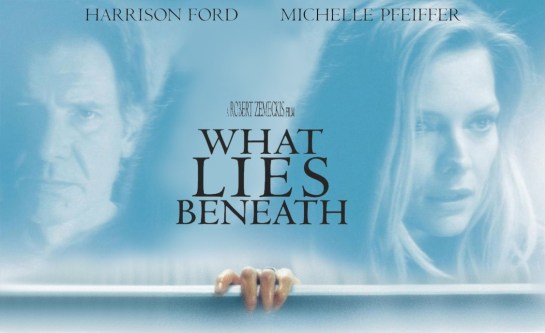
Robert Zemeckis’ ghost story is both an homage to Hitchcock and a vehicle for the director’s visual audacity (or, if you’re harder on Zemeckis, gimmickry). There’s little new in this old-fashioned haunted house tale, but what is presented is solid and entertaining.
A beautiful, vulnerable Michele Pfeiffer lives with her researcher/scholar husband (Harrison Ford) in a New England college town, their home a picturesque waterfront exemplar from Architectural Digest. Pfeiffer has just dropped her only child off at college and is in the midst of an empty nest crisis. Worse, she’s recovering from a car accident a year prior and she believes her new neighbors’ marital woes have escalated to the husband killing the wife (she even believes she sees the husband disposing of the body, much as Jimmy Stewart saw Raymond Burr covering up his foul deed in Rear Window). What better to harass this fragile woman than a spirit attempting to communicate with her?
Zemeckis does a nice job of interweaving a few plot lines, and he produces some genuinely creepy moments. But the film has flaws. First, Zemeckis so distrusts the audience’s ability to follow the plot he over-lingers to focus our attention on a fact or clue. So, in his work, Ford is working with a drug that immobilizes while the subject maintains consciousness. I wonder if that will come into play later? Second, Hitchcockian is one thing, but a replica is quite another. By the end of the film, the score is a mash of Bernard Hermann and the tribute so unrelenting, Mel Brooks’ High Anxiety comes to mind. The movie is also overlong, piling reveal scenes on top of each other, replacing tension with exhaustion.
The virtues, however, outweigh the negatives. The film mostly moves briskly, there are genuine scares, and the characters, while a tad humorless, are engaging. Pfeiffer is an effective mix of emotional fragility and upper class angst, and Ford is a surprisingly sympathetic villain. Indeed, Pfeiffer comes off as spoiled and becomes so unstable, you find yourself siding with the seemingly reasonable Ford, who fairly suggests his wife is punishing him in a passive aggressive manner with all the ghost nonsense.
In my house, we have a few Christmas rituals, including a slate of television shows and movies we must watch on or near the holiday. The shows are sacrosanct; “A Charlie Brown Christmas” and “The Grinch.” The movies have always included such staples as A Christmas Carol (the George C. Scott version) and A Christmas Story. It’s a Wonderful Life tends to be seen bi-annually, and it can be watched at Thanksgiving. The most recent additions have been Elf and, of course, that holiday heartwarmer, Die Hard.
My boy and I gave A Very Harold & Kumar Christmas its audition. Harold and Kumar are much funnier than Cheech and Chong, and in this third installment of their stoner oeuvre, a baby gets stoned, does coke, and ecstacy; Neil Patrick Harris attempts to pleasure himself on an unsuspecting chorus girl who he is massaging (the joke? Doogie’s Howser’s homsexuality is really just a ruse to take advantage of vulnerable women); the 3D is used mostly for the shooting of bodily fluids at the screen; Harold gets his penis stuck to a cold pole ala’ A Christmas Story; and then he shoots Santa in the head.
Downfall, but instead of Hitler and his bunker, it is Versailles and the French Revolution. Marie Antoinette (Diane Kruger) is pampered by a coterie of attendants, including her reader and our protagonist (Lea Seydoux) a quiet but determined girl who adores her queen. Her adoration never wanes, even after the queen asks her to take flight and pose as a more favored courtier, Gabrielle de Polignac (Virginie Ledoyen) with whom the Queen has developed a near romantic attachment. Seydoux knows this could be her head, but out of a childish need to please, a desire for purpose, and ultimately, the chance to at least play both above her station and the queen’s favorite, she agrees.
Shot at Versailles, the film is beautiful, even as it deglamorizes its locale (mosquitos, rats, vicious gossip, heat, and dank cellars take precedence over finery and gold). The depiction of life at court from the vantage point of rank-and-file staff has an “Upstairs, Downstairs” feel. Kruger plays Marie with the right mixture of caprice and entitlement. Seydoux is a bit tedious, however, because she is written as little more than a teen with a crush. Though her scene in the carriage as she pretends to be Polignac is moving (she waves to the peasants, one of whom makes a throat-slitting motion and even that does not dissuade her from fully indulging in her moment of glory), following a teen with a crush for an entire film can be a little boring. At its most dour, I yearned for Sofia Coppola’s dizzying and silly Marie Antoinette.
Romantic. Comedy. Can one be successful with only a little bit of both? The Jennifer Aniston-Vince Vaughn vehicle, The Breakup (2006), fell into the category, as it depicted the deterioration of a relationship primarily built on convenience and a shared apartment. The scenes between Vaughn and Aniston were so arch and cringe-inducing you wondered, ‘where the hell is the ‘rom’ much less the ‘com’?'”
Friends with Kids makes The Breakup seem like Love Actually. Three couples form the center: the unmarried, platonic sister-brother like duo (Adam Scott and Jennifer Westfeldt); the canoodling, just pregnant, earthy types (Maya Rudolph and Chris O’Dowd);and the sizzling, “just had sex in the bathroom” couple (Jon Hamm and Kristen Wigg). We meet them at a fancy dinner in Manhattan and then fast forward four years to a second meal at the home of Rudolph and O’Dowd. Scott and Westfeldt are unchanged, but Rudolph and O’Dowd are now sloppy, harried and laden with kids (she screams at him for doing nothing, he does less, and their kids scream all around them). Hamm and Wigg bring their own newborn, who appears to be just one source of tension in their quietly crumbling relationship. Scott and Westfeldt survey the wreckage, determine they can do it better, have their own baby while maintaining their independence (and separate apartments in the same building) and live happily ever after.
Well, no. Westfeldt is in love with Scott, and Scott has absolutely no clue – he’s bought into their experiment. In the meantime, they go on a ski trip with their friends, each bringing a new beau (Megan Fox and Ed Burns). Hamm and Wigg implode, and Westfeldt realizes that her love for Scott is so strong she must profess it.
So, let’s tally. The first scene of mayhem and bitterness (the four years later dinner) is depressing. The scene of Scott and Westfeldt trying to make years of friendship square with sex to conceive is uncomfortable. The scenes of Scott casually mentioning how awesome Fox is to Westfeldt are brutal. The ski trip is akin to the dental examination in Marathon Man. And Westfeldt’s profession of love, which is spurned by Scott, will open the vodka.
I liked the picture, but it ain’t no rom-com. Scott, as always, is perfect, both wry and when it is called forth, impressively anguished. What is funny in the picture is largely due to the crude banter between Scott and Westfeldt. The other characters play well, save for Westfeldt, who also wrote and directed. She is so pitifully earnest, it didn’t seem a fair fight. And the exchanges between the couples are often illuminating.
The film is also quietly traditional. Scott and Westfeldt do appear to be doing well on the outside with their arrangement, but as the fissures show, during the ski trip from hell, Hamm, in his own deteriorating marriage with Wigg (note: the mastermind of Bridesmaids provides not one single laugh in this picture) delivers an angry, vicious broadside against their hubris.
Scott delivers an effective rebuttal, which, of course, cements Westfeldt’s love for him:
You think that we don’t love each other? You know, I have loved this girl for nineteen years, Ben. That is fully half my life. I know everything there is to know about her. I know the mood she’s in when she wakes up in the morning – always happy, ready for the day. Can you imagine? I know that she is honest; she won’t even take the little shampoo bottles from the hotel room, or sneak into the movie theater for a double feature. She always buys a second ticket. Always. I know that we have the same values, we have the same taste, we have the same sense of humor. I know that we both think that organized religion is completely full of shit. I know that if she is ever paralyzed from the neck down, she would like me to unplug her – and I will. I know her position on just about everything, and I am on board. I am on board with everything about her, so you tell me, Ben. What better woman could I have picked to be the mother of my child?
Nonetheless, the film culminates in Scott’s realization that Hamm was right – you can’t just craft a perfect bubble of domestic bliss by jettisoning the inconvenient parts, such as “’til death do us” and fidelity.
Still, this movie can be a trial. And the picture is not too traditional. It is probably the only film to conclude with the line, “Fu** the sh** out of me.”
My boy Will got back from camp yesterday and while he was away, I DVRed Spielberg’s War of the Worlds (2005). I’d forgotten how scary the first half of this movie is. I’d also forgotten how effective Tom Cruise is as the “in over his head” father of two who must escape the aliens while protecting his children (Dakota Fanning and Justin Chatwin). Cruise has always infused a little of Risky Business in all his roles, hindering his ability to play period or even mature. That bright smile is too youthful and winning, and Cruise as a weathered or dispirited character seems both a stretch and a waste. Even his Ethan Hunt in the Mission Impossible movies is always kept running at full clip lest we realize he’s having too much fun to be such a serious international spy.
Here, however, Cruise plays weary, completely out of depth and even selfishly beleaguered in being stuck with his two children at a moment when the world is being ravaged and dominated by aliens. His performance is riveting and is enough to overcome some clunky father-son, “why weren’t you there for me?” dialogue with Chatwin.
As the family wends its way from New Jersey to Boston, where Cruise hopes to reunite the children with their mother, massive Imperial Walker-like monsters emitting ominous foghorn sounds vaporize some people, and collect others for extraction of their blood, for fertilization. I think. This is where the movie gets weaker. Since the alien invasion is so unexpected, we have no clue, no Jeff Goldblum scientist, to explain what is happening. Like Cruise, we can only guess. I respect the bravery of the decision with regard to the narrative, but after all of Spielberg’s set pieces are finished (the initial appearance of the aliens, the aftermath of the crash of a jumbo jet, the alien attack on a ferry crossing the Hudson), one starts to wonder why the aliens are so meticulous about finding Cruise and Fanning, who, after surviving the ferry attack, are hiding out in the root cellar of an unstable Tim Robbins. Thus far in the picture, the m.o. of the aliens had been indiscriminate and brutal, yet near the end, they send a snake-like probe into the basement, followed by an investigatory party of 4 aliens, followed by yet another probe. The only reason for this deviation in behavior is to create a very tense scene that seems out of place when, flushed out, Cruise and Fanning are merely scooped up. The extended sequence also allows for some tiresome back and forth between Robbins (let’s fight) and Cruise (let’s not).
The ending is also a let-down. The aliens get sick and die. Movie aliens have many of the same problems we do as an occupying force, but we look much better in comparison. If you thought it took us some time to get our footing in Iraq or Afghanistan, at least we figured out we could breathe the air in those places before undertaking the endeavors. The ultimate fault of the aliens in War of the Worlds seems a little rudimentary, though not so stupid as the aliens in Signs, for whom water was acid, making Earth a strange choice for colonization.
One other complaint. For all of Spielberg’s gifts and power, he can be gutless in his presentation of popcorn fare (see another Cruise vehicle, Minority Report, a film noir spoiled by Spielberg’s constitutional inability to have the audience walk away sad). There is no way Chatwin survives this picture. But not only does he survive, he beats Cruise and Fanning to Boston for a family homecoming and a stirring end.
I watched Thor with my son on Father’s Day (we trolled Netflix streaming for choices). Thor (Chris Hemsworth) is cast from the heavens, in part for his hubris and in part due to the machinations of his conniving, “why does Daddy love you more?” brother Loki (Tom Hiddleston). Thor ends up near Area 51 sans power, and while here on earth, gets shamelessly mooned over by Natalie Portman (she’s supposed to be the geeky, withdrawn scientist type – riiiiiiiiight), learns the meaning of humility and heads back to the heavens to settle somie scores and show some sacrifice. I should have seen this before The Avengers for absolute continuity but no matter – neither film suffered for my error. The action sequences are brisk but not so overhwelming as to cause fatigue and there are some good lines. Portman is ridiculous in her portrayal of a women of science made weak in the knees. She positively swoons. Still, It was good, clean, mindless fun.
Of course, Thor has some issues with protocol here on Earth:
I did that last night at dinner with my water but it wasn’t as funny. Father’s Day can only forgive so much.
The pushback on the gore porn of Saw, Hostel, etc . . . is in full swing. The Paranormal Activity flicks, TheWoman in Black, Trick ‘r Treat, The Last Exorcism, and now, The Innkeepers all fall in a sub-genre that emphasizes pace, suspense and the little things that do not require splatter, chunks of flesh and no possible hope of escape.
The Innkeepers is about a haunted Connecticut inn on its last legs. Two slacker employees (there are 3 guests and the workers can’t manage to have clean towels for any of them), one of whom is working on a website trying to trumpet the inn as a haunted locale, do 12 hour shifts on the inn’s last weekend in operation. Bored, and stoked by a guest (Kelly McGillis) who is some sort of amateur medium in town for a convention, the duo pass the time filming and recording the inn in an attempt to engage its ghost. They succeed, and the patience director Ti West exhibits in getting to a truly scary payoff is impressive.
It’s not flawless. The principals are a bit stilted, though they warm to their roles; the humor is not always humorous; the character development is not super; and I wish we were given a little bit more on the history of the ghost. But the strength is the feel and that feel is well-represented in the trailer.
Also, one caution – remember Kelly McGillis from Witness?





 filmvetter