Archive

3 stars

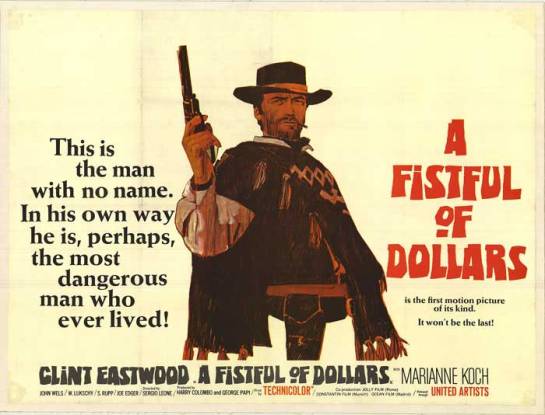
The first of Sergio Leone’s “Spaghetti Western” trilogy with Clint Eastwood’s “Man with no Name”, A Fistful of Dollars was actually shot in Spain.

I guess “Paella Western” wasn’t an option.

Eastwood comes to a town at war. Two families seek the upper hand, and Eastwood shuttles between one and the other for the cash.

As fun as it can be, the movie is stilted. Leone’s visuals are ambitious but his sweep is not yet broad, and like Sean Connery as James Bond in Dr. No, Eastwood is still working on his persona and lacks gravitas (interestingly, Eastwood was Leone’s eight or ninth choice, behind Henry Fonda, Charles Bronson, James Coburn and others). The entire cast, Eastwood excluded, is foreign and the dubbing is spotty (in the case of a crying child, I was immediately reminded of the dubbing in the Japanese animated series, Speed Racer).

This film ends up being a critical warm-up to the better For a Few Dollars More and its classic follow-up, The Good, the Bad and The Ugly.

George Miller’s frenetic, creepy vision of a future where a version of The Wild Ones terrorizes the roads is a confident, distinctive picture made all the more impressive by its paltry $400,000 budget. Miller went on to make The Road Warrior, cementing Mel Gibson as the most bankable of stars, but in Mad Max, Gibson barely resonates until he is transformed, ala’ Charles Bronson in Death Wish, into a silent, dispenser of retributive violence. His payback is gripping, played out on a widescreen lens at high speeds on the desolate roads of Australia. Still, the picture stops dead in its tracks halfway through as we wait for the brutal thugs of the road to incur Gibson’s rage. It is also the worst scored film in the history of movies, a blaring and bizarre Bernard Hermann knock-off.

Flight – review | Denzel Washington | The Guardian

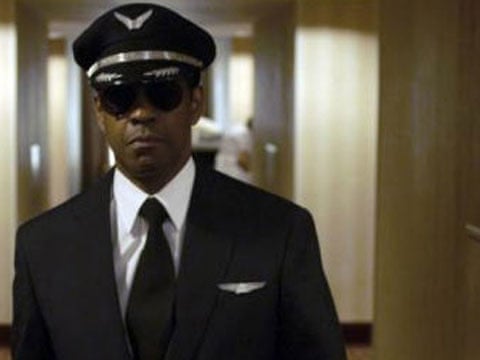
Denzel Washington has earned his best actor nomination. His performance as an addict pilot who saves a plummeting passenger jet while it and he are loaded is riveting. His character covers the gamut, from stoned to heroic, solemn to terrified, brash to impotent, but unlike other aging, iconic actors, Washington is toning down his idiosyncrasies. The scene where he learns that 6 of the 102 passengers did not make it, including a flight attendant with whom he was intimate, is a study in restraint. One shudders to think what Pacino would have done with such a role. While Tony Montana scarred that actor permanently, Washington was able to accept his best actor Oscar for Training Day without making excess his trademark.

Washington’s multi-faceted and powerful performance takes us through what is otherwise a confused film by Robert Zemeckis. The opening scene is a skillful, harrowing recreation of an incredible crash and what follows looks to be somewhat of a procedural, as the defense lawyer (Don Cheadle) is introduced and the airlines, the union and the government take their positions. Before you can settle in, however, Zemeckis pivots, and you’re watching a film about addiction, replete with a whore (well, a heroin addict) with a heart of gold (a wan Kelly Reilly). Okay. Fine. Will Washington’s valor be sullied by revelation of his intoxication? Will his heroism be overridden by his own self destructive tendencies?

As the film’s day of reckoning approaches, the picture reaches for the spiritual, and the final trials become ludicrous. Will he drink? Will he lie? Has he hit rock bottom? Before we find out, enter John Goodman, as the drug dealer who must get Washington straight via cocaine after an all night bender, in a wacky, comic turn.

What the hell is going on here?

In parts, the film is moving. In others, it is muddled or plain awkward, but Washington pulls you through what eventually morphs into a redemptive weepie.

The fourth of the series, it is the weakest entry, but it still delivers a double threat: gore-free chills and inventive use of a series of cameras allowing us to be voyeurs to the terror. The cast is a little less compelling, though one of two boys being possessed by a demon is pretty creepy. With no name stars to pay, no real location budget, and more of the story to tell, we can expect these for some time.

This documentary chronicles the work of Act Up in the fight against AIDS and in combat with the government, drug companies and the Catholic Church.  It is comprehensive, informative, and fleshed out by contemporaneous film and video.  As a historical exemplar, the documentary is important, and it establishes the heart and success of the group, especially in the fight to expedite the testing of drugs and application to lower their cost and expand accesss. Unfortunately, the documentary lacks introspective moments save for internal strife on drug approval speed after one of the first therapies, AZT, turned out to be a mixed bag (a splinter group, TAG, resulted).  There is a moving but very brief depiction of a schism in the organization, punctuated by Larry Kramer boiling over at a particularly contentious and petty meeting.  Still, the primary goal is as a testimonial. At no point does a participant say, “yea, that was a mistake” or “it turns out that protest was self defeating or counterproductive.”

There is plenty of video of protests and emotional speeches, as well as Reagan hung in effigy, Bush golfing, Anthony Fauci being cavalier, it being beyond discussion that these men are to some extent murderers all. While the work of Act Up was critical, and the documentary is inspiring, ultimately, this film is a little monotonous and reverential. This oral history project of Act Up, particularly the interviews of Mark Harrington and Kramer, serve as an accompaniment while underscoring some of the stories left untold and themes left undeveloped. Perhaps it is Kramer’s Hollywood background, but his interview is chock full of nuggets, greater exploration of some of which might have made this good documentary great:

(on GMHC) There had to be – you had to take people whether they were good or not, because they represented certain genders or certain colors.

* * *

Yes. There was a lot of flak from people like Maxine [Wolfe] about going inside, when we were finally able to go inside. And I said, “Are you crazy? Of course, you go inside! They let you inside! What can you do from the outside?” You can only go so far on the outside. I’m convinced that the destruction – well we can get to that later, but – the destruction of ACT UP was the severing of this dual nature. What destroyed ACT UP was when Treatment and Data picked up their marbles and went somewhere else, leaving only the bad guys, so to speak.

* * *

(on the schism of Act Up and TAG) LK: Because they became drunk on hubris – drunk on their brains, drunk on the very things Maxine predicted, I might add. They were drunk on their power. They could sit down with the head of Bristol-Myers or the chief scientists. They could call all these people up and they could do it on their own from then on, and they didn’t need anyone fighting on the outside for them. And perhaps they became a little ashamed of us, I don’t know. But I will never forgive them for it. I feel that strongly about it – to this day. Mark and I don’t talk – haven’t for years. I don’t know. I don’t know. You don’t know how close I came to dying a couple of years ago because of the Hepatitis B in my liver. I was given six months to live. I don’t know if you remember – I looked like this. And, I had no energy. And they told me – that was the end, because livers were not available. And the days were ticking away. Just prior to that, Dr. Fauci – the man I had called a murderer many years before – has become one of my closest friends. Talk about a moving story of irony. He saw me somewhere and he said, “You look terrible.” And they put me in the NIH hospital, and they discovered a lot of this shit, that had not been discovered in me before.

* * *

SS: Which one of these drugs do you feel exist as a consequence of ACT UP? LK: All of them. I have no doubt in my mind. Those fucking drugs are out there because of ACT UP. And that’s our greatest, greatest achievement – totally.

* * *

You’ve got Koch in New York City, you’ve got Krause at the head of NIAID, which is the most important institute at the NIH for looking after infectious diseases, and we’ve got this prick in the White House, who’s got a supposedly gay son. It’s a famous story. All the heads of the various institutes can live in their own houses. It looks like a college campus – it’s very pretty. And the head of NIAID was a guy called Richard Krause, and he invited me out to lunch, and his assistant was a guy called Jack Whitescarver, and they gave me all this bullshit about – there was money for this, and money for that, and this is happening and column A, and column B – and I called him on everything. And he had to leave and the dishes were all there, so Jack Whitescarver and I washed the dishes in this house. And I had to go to the john, and I went upstairs – there was only one john on the second floor. And coming out of the john I look into this bedroom, and there are bookcases and things and photos all around. What writer isn’t nosy? This one certainly is. So, I go in the bedroom and on Krause’s bureau are pictures of him with all these guys in bathing suits. And I say, “Holy fucking shit, this guy is gay!” And I go downstairs and I say – Whitescarver whispers to me, “I want you to know that my friend and I just loved Faggots.” So I looked him in the eye and I said, “Jack, is Krause gay?” Not a sound.

* * *

SS: Larry I forgot something that I wanted to ask you, and this is just a personal question. I remember at Vito Russo’s funeral, you made this speech where you said, “We killed Vito, don’t you know that? Can’t you see that?” And I remember feeling as I was sitting there, that I was not the appropriate target of that speech. That was just a personal reaction that I had, sitting there. And I’m wondering if you have had any hindsight on that kind of rhetoric or that sort of approach? LK: You’re too sensitive. I have tried, in my time, many kinds of rhetoric – you read Reports from the Holocaust and there are many attempts at different tactics and voices. Sometimes you need one, sometimes you need another. You keep looking. You make it up as you go along. When Vito died, everybody was dying, and there still weren’t that many people out there fighting, so we did kill Vito. And yes, you were a target – everybody was a target – as many people that were in that room, it didn’t equal the membership of ACT UP. I yell at gay people, still.

Quentin Tarantino’s Achilles heel is his immaturity and obsession with genre.  Be it Japanese ninja films or 70s drive-in schlock, his bad pictures (and the Kill Bills and his contribution to Grindhouse are bad pictures, “fear of not being hip” critical acclaim notwithstanding) are foreordained by his choice of an homage to shit, which merely produces higher caliber shit.

Hence, my trepidation walking into Django Unchained.  Fortunately, spaghetti westerns are stronger source material than Japanese ninja crap and American drive-in crap, and Tarantino doesn’t become engulfed by this particular genre.  Sergio Leone is ever present, but the picture does not attempt to ape or glorify his work.  Tarantino also adds humor with a very modern sensibility.  Finally, Christoph Waltz, who electrified Inglorious Basterds and collected a well-earned supporting actor Oscar for his work, and Leonardo DiCaprio, who embodies oily, smooth charm and venom, elevate the material, so much so that when they are absent from the film, you can hear it leaking air.

Django (Jamie Foxx) is a slave freed by a bounty hunter (Waltz) who needs Django to identify some targets.   A partnership develops and soon, the duo endeavor to retrieve Django’s wife (Kerry Washington) from Mississippi slavemaster DiCaprio and his conniving house master (Samuel L. Jackson).  Cartoonish, bloody, often wildly funny, and fast-paced, Django would have scored higher save for a tacked-on ending that adds a wholly unnecessary 25 minutes to a film that was satisfyingly concluded.  Worse, it is in these 25 minutes that Tarantino the actor appears, with a befuddling Aussie accent, to jerk the picture to a standstill.  From there, surreal becomes outrageous and outrageous becomes boring.

Still, what precedes the unsatisfying ending is a blast, part blaxploitation revenge fantasy, part loving tribute to Italian westerns, and part sly, broad comedy (the scene where a posse of pre-Klan night riders argue over the utility of their white sheet hoods is more Blazing Saddles than Once Upon a Time in the West).  Best, professional scold and Knicks fan Spike Lee, who I understand used to have something to do with filmmaking, is not amused by the melding of a slave story and a western  When Lee is up in arms, it is a strong endorsement indeed.  Lee’s criticism is almost as stupid as the Village Voice‘s defense of Tarantino’s use of the word “nigger” (over 100 times) on the grounds of historical accuracy.  Even if that word hadn’t been used in the Mississippi of 1858, Tarantino would have used it nonetheless, for two reasons.  First, he loves that word, and he loves it most when uttered by Samuel L. Jackson.  Second, just to spite Spike.

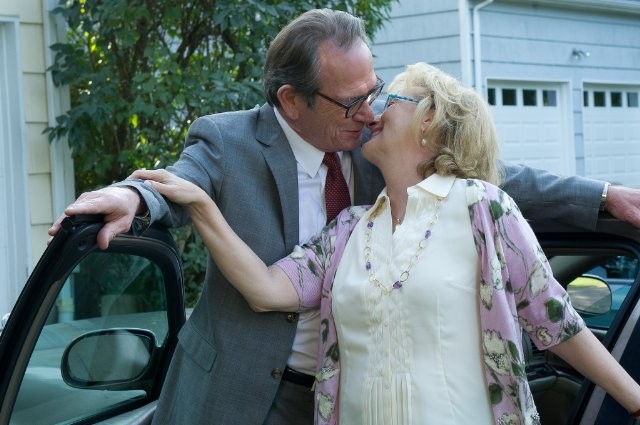
Meryl Streep is incredible, as always, flawlessly and effortlessly inhabiting the character of a repressed, unhappy Nebraska housewife, married to a removed, cantankerous Tommy Lee Jones.  She signs the couple up for a week of couples counseling in Maine under the tutelage of Steve Carell, during which their marriage is analyzed in order to fix it.

Most of their problems stem from intimacy issues.  They haven’t had sex for 4 years.  So that’s where Carell focuses.

The performances are uniformly good and the interplay between Streep and Jones is often genuinely affecting.  The film, however, becomes repetitive and ends in a cloying renewal of vows that is much too much.  The movie also features some of the worst, most intrusive and blaring pop songs to accompany emotional stretches.

Be prepared.  As I said, the central problem for Jones and Streep is sexual.  Which means frank talk about and between people I’d prefer not to think about in sexual situations.  It also has a scene of Streep trying to give Jones a blowjob in a theater, a failed endeavor. Sure, there is some humor in Streep purchasing “Sex Tips for Straight Women by Gay Men.” But watching her put those tips into practice?  Sorry, kemosabe.  Deal me out.

https://i0.wp.com/3.bp.blogspot.com/-mFvHmYCWyDo/T-NFPL6w4pI/AAAAAAAACmk/W1uhlxULVuA/s1600/Abraham-Lincoln-Vampire-Hunter.jpg

Spielberg’s film was more authentic, but not as much fun.  The plot is simple.  Abe’s mom is killed by a vampire, he vows revenge, is tutored by a vampire hunter, and thereafter lives a double life, rising to power in the day while hunting vampires at night.

It’s a big, flashy, superficial comic book, but it moves, and when Lincoln’s political ambitions intersect with the battle against the undead, the Lincoln story gets going.  If there is to be a war over slavery, it will be brutal and vicious, because, in the words of Lincoln’s mentor, the blood of the slaves “is the only thing that has kept [the vampires] sated for this long.”  Their feed stock threatened, the vampires step up the game, kill Willie (Mary Todd’s insanity is better explained) and bolster the ranks of the Confederates.  Lincoln, however, shows great ingenuity and the tide is turned.

I saw this film’s lead blow the crowd away in Broadway’s “Bloody, Bloody Andrew Jackson” and in his second turn as an American president, Benjamin Walker remains compelling. But this is a broad action pic, heavy on CGI.  The actors aren’t pressed.

The film is also the appropriate length.  Whereas The Avengers has the temerity to run 2 hours and 35 minutes, this popcorn flick is a swift 1.45, which is still a tad long but fine.

It falters when it approaches seriousness.  The writing can also be pedestrian and it lacks a needed sense of humor.  The picture also steals its ending from The Road Warrior.  But when Abe starts swinging that axe, it regains its footing.

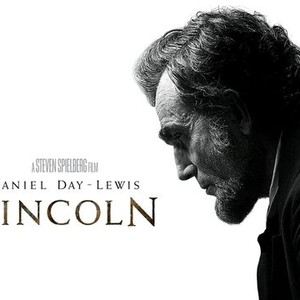
Lincoln - Rotten Tomatoes

The previews for Lincoln filled me with ambivalence.  Stephen Spielberg is a gifted filmmaker, yet his penchant for the glib and over dramatic is well-established, and what was presented in the trailers seemed overly earnest and self-important.

The first scene of the film did not help.  President Lincoln surveys the troops.  Two white soldiers (including, inexplicably, the peculiar looking Lukas Haas from Witness) unconvincingly quote the Gettysburg Address to him while a black soldier ahistorically makes demands on the president, such as equal pay for equal work.  As the white soldiers fail in recitation, the black soldier delivers the full verse.  And courtesy of John Williams, stirring horns blare.

The exchange feels wholly unrealistic.  I was reminded of the great scene in Frost/Nixon where Sam Rockwell, playing the Nixon-hating James Reston, Jr., practices excoriating Tricky Dick upon their meeting, and then when his big moment comes:

Richard Nixon: [Reston swore to Zelnick earlier he would never shake Nixon’s hand] Pleasure to meet you. [Offers Reston his hand]

James Reston, Jr.: [after a pause, he shakily extends his own hand] Mr. President…

Bob Zelnick: [after Nixon leaves] Oh that was devastating, I don’t think he’s ever going to get over that.

James Reston, Jr.: Fuck off.

There’s none of that here.  The black soldier is as comfortable as if he were speaking to his city councilman in 1987.

But Christy Lemire of The Huffington Post gets it right: “For anyone who cringed just a little while watching the trailer for ‘Lincoln’ and worried that it might be a near-parody of a Steven Spielberg film, with its heartfelt proclamations, sentimental tones and inspiring John Williams score, fret not.”

After its inauspicious start, Lincoln settles into a proficient, if overlong, political potboiler having more in common with Advise and Consent than grand, gauzy history.  Lincoln needs to get the 13th Amendment passed in the House, but he is squeezed by moderate Republicans (led by Hal Holbrook as Preston Blair) who seek a negotiated peace with the South; radical Republicans (led by Tommy Lee Jones as Thaddeus Stevens)  who distrust Lincoln’s expedience; and fiery Democrats who look for every advantage to stymie the bill.  Lincoln works the room and the town trying to thread the needle of events and demonstrating not only his keen intellect and gift for homespun stories but a progressive mind that regularly churns.

As Lincoln, Daniel Day Lewis is masterful.  The weight of his worry and the tragedies that have befallen him are etched in his face, yet his Lincoln is not merely an icon.  Day Lewis communicates Lincoln’s anger, his canny sense for politics, his exasperation at his unstable wife (Sally Field), and his physical nature, not only with his children but with others to whom he instinctively feels fatherly.  Field is also noteworthy, fleshing out Mary Lincoln and capturing her irrationality as well as her cunning.

There are some problems.  While the history feels right, and most of it is indeed accurate, some of it is not, and in ways that matter.  For the final vote on the amendment, free blacks pack the galleries and Mary Lincoln observes with her personal dressmaker, played by Gloria Reuben (who I have not seen since ER).  This did not happen and it feels cheezy, part of a clear effort by the filmmakers to give agency where none existed.

Sometimes this works, as when Lincoln has a White House porch discussion with Reuben about the fate of blacks after the war.  It is clearly a concoction but feels legitimate, especially when Lincoln says, “I don’t know you.”

Sometimes it doesn’t work, as in the opening scene.  But you can feel Spielberg and screenwriter Tony Kushner trying mightily, mainly by use of the ennobled, stoic black.

They had to know Kate Masur’s New York Times op-ed about the film’s depiction of the the passivity of its black characters was coming (Masur suggests that perhaps the director could have shown Reuben and Lincoln’s black butler “leaving the White House to attend their own meetings”), but they did the film no favors in trying to head it off.

Tommy Lee Jones is also all wrong as Pennsylvanian Thaddeus Stevens.  He’s either too Western, too Southern, or simply too rugged to play this man in this time.  When he brings home the actual version of the final bill to read to his housekeeper and lover in bed, it was hard to stifle a groan.  And the ending, where Appomattox, the assassination, and an inaugural speech flashback are quickly tacked on, is unwieldy.

Finally, it is time for Williams to hang it up.  The score is a lazy rip-off of his work on Saving Private Ryan.

Criticism aside, The New Yorker dubs the film a civics lesson for children, and indeed it is (I brought both of mine to the movie and we had a great discussion afterwards).  As one of my professors told me, history is in many ways the stories we tell about ourselves, and this is a story about ourselves told fairly well.

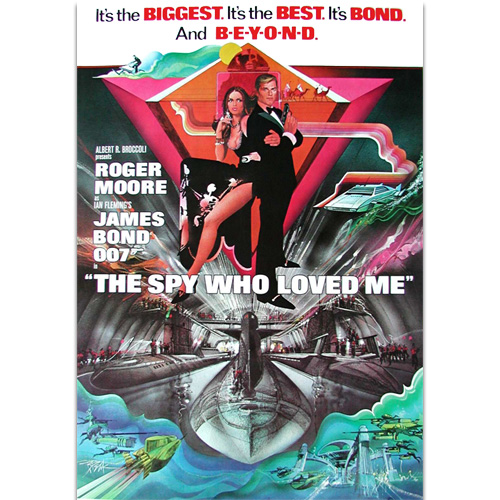
This is the second Bond film I saw in the theater, after Live and Let Die, and it is probably the last of the series that gave us a youthful Roger Moore.  By the next installment, Moonraker, the lines had gotten deeper, the hair higher yet thinner, and the bones creakier.

Billionaire Kurt Jurgens (Karl Stromberg) seeks to start a nuclear war between the Soviet Union and the United States, so he can rule a post-apocalyptic world from the sea.  Jurgens steals a Russian and American nuclear submarine to his purpose, and Bond and his female Russian counterpart Anya Amasova (Ringo Starr’s gorgeous but not particularly talented Barbara Bach) are dispatched to get to the bottom if it.  Unbeknownst to Bond, in one of the few Bond ski sequences that work, he killed Amasova’s love, and she has vowed to kill Bond – when the mission is over.

Many of the hallmarks of a good Bond film are here – exotic locales (such as Asgard Peak in Austria; Egypt, including the Giza Necropolis, Great Pyramids and Great Sphinx; and the cliffs of Sardinia), a first-rate Bond song (“Nobody Does it Better”), and several beauties, including  a favorite, the lethal helicopter pilot Caroline Munro-

The Spy Who Loved Me review - Moore's best Bond - Lyles Movie Files

The film also has an interesting and grandiose villain and a serviceable script.  The action sequence when the Soviets and Americans join forces to take on Stromberg’s army is also very exciting and novel.

However, the warning signs for the series first appeared in The Spy Who Loved Me.  The pun and snappy rejoinder quotient increased markedly.  The use of the cheezy, roving sax to denote the funny or the fanny is prevalent.   The introduction of the villain Jaws (Richard Kiel) pushed the story further, into slapstick.

There is simply too much of that and not enough of this:

(though, even here, a meaner Bond is compelled to drop, “You shot your bolt” into the action)

The changes, however, could in no way be challenged at the time.  The film cost $14 million to make and grossed $185 million worldwide.