Archive

0 stars

What to say about Ti West? I quite liked The Innkeepers, an old school, throwback ghost story and was happy to see he’d gotten bigger budgets and a broader canvas.

He’s done little with it.

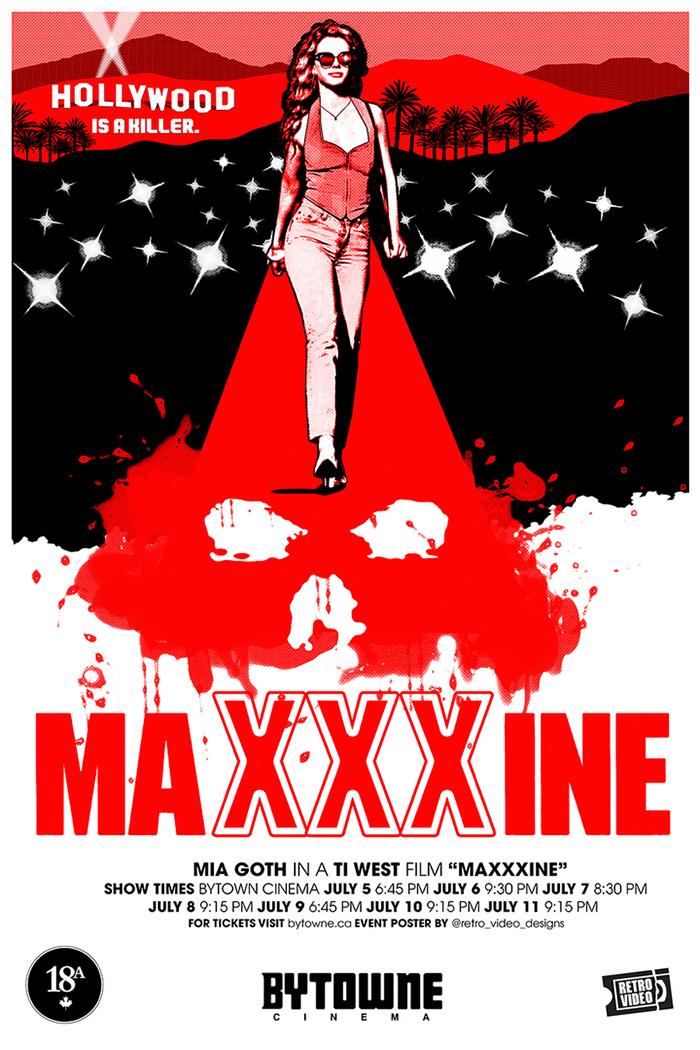
MaXXXine’s predecessor flick – X – modeled Texas Chainsaw Massacre in set-up (group of young folks go to the wilds of rural Texas where they rent a property on a farm to shoot a porno and are picked off one by one). Charmless, boring, and not even ingenious in how the characters meet their end, the fate of the players was more serial than momentous. The movie also seemed confused. X was not really funny or even ironic, ala’ Scream. It was certainly not scary (there’s a gator in the pond, so, uh … look out). It had the feel of schlock but was not really an homage to drive-in trash. It was just “steady as she goes” vanilla.

One character makes it out of X alive and we find her in MaXXXine, where it is 1985. She has become a porn queen in LA, trying to crossover to serious roles, which ends up being a whole lotta’ nothing in terms of plot development.

As Maxine aspires, her survival in Texas and her trauma catch up with her, the former in the guise of blackmailing private detective Kevin Bacon, and the latter in the form of flashbacks as to what happened that fateful weekend back in Texas.

Meanwhile, Maxine’s friends start dropping like flies.   

Bacon is so over the top Tex-anny – toothpick and drawl and gold orthodontics – he annoys rather than amuses, and Maxine’s flashbacks seem hubristic, an assumption that anyone watching this picture was hanging on the edge of their seat to see what happens to her now.

What does happen to Maxine is so disjointed, disinteresting, and cheezy, you’re tempted to fast forward. There is no reason to care, and with a film as predictably preposterous as this, one cannot be manufactured.

Worse, the look and feel are cheap. How do we know this is 1980s LA? Pointless news clips referencing The Hillside Strangler, a lot of smoking, shiny suits, and men wearing earrings. I guess wardrobe was out of piano key ties.

But West even bollixes up the scenes where he seemingly is trying to take care. For example, our killer visits one of his victims – another porn star – by visiting her performance at a peep show. So, he drops a quarter in the slot and there she is, in an outfit and a room that is $100 bill, not a quarter-a-minute worthy. It seems small but is emblematic of just how lazy the entire endeavor feels.

Most unforgivably, West takes a run at enveloping Maxine’s fate in a parable as to the hypocrisy of Tinsel Town and moral majoritarian finger-waggers.

It falls as flat as everything else in this dog.   

On MAX.

Elliott, a vacuous, self-satisfied, snarky Canadian teenager (Maisy Stella) is visited by her 39 year old self (Aubrey Plaza) during a mushroom trip. Plaza’s old ass has much to say to Elliott’s young ass, much of it a violation of the Prime Directive, the guiding principle of Starfleet that prohibits its members from interfering with the natural development of alien civilizations.

Yes. I watched Star Trek. What of it?

The set-up is well worn. Elliott wants to get off the family cranberry farm and find herself in the big city of Toronto. She is meant to be celebrated for her freedom and grab-life-by-the fistful approach. She’s gonna’ shake the red juice off her small town boots and let loose before global warming interferes with her cell service. She’s a rebel. But she’s also a loudly stupid and narcissistic rebel, and all the soft piano, oboe, and terrible acoustic dirges cannot make her interesting.

With a lead who could act and a less obvious, smarter script, My Old Ass could have been a clever twist on the coming of age flick, Freaky Friday meets A Christmas Carol.

Stella (member of the music duo Lennon & Maisy), however, cannot act. She is one-note, snotty, and charmless. She makes Disney Channel kids seem method. 

The film has a few genuine moments where Plaza, Elliott’s mother, and her would-be first boyfriend all present Elliott with a remembrance, a well-rendered insight, a moment of tenderness. In response, Elliott – not allowed to say “dude, what the fuck? for the umpteenth time- offers a “dude, what the fuck?” countenance. Any expressed emotion crashes into her stubbornly smug visage, where it thuds. Such that we are thinking, “Miley Cyrus could have really done something with this role!”

Worse, no one has bothered to make the trick explainable. After the drug trip ends, inexplicably, Plaza still texts and calls and visits Elliott. Tripping as portal to an Apple data plan? This is lazy mush and indicative of the ragged nature of this endeavor. 

The script is mostly middling sitcom. Plaza and Elliott say cool stuff like “when do we …?” Followed by “oh my God. This happens …” Plaza says to Elliott: “Moisturize!” Elliott replies with a form of “What the fuck? Dude!???” Elliott to Plaza: “Can I kiss you?” Plaza replies with “ewwwwwwwwwwww!” or some derivation of same. Stella says “fuck” and “dude” and “like” and “sick” a lot. She spouts hip cliche’-ridden observations that may tickle the fancy of an 18 year old peer, but test the patience of anyone who has read a magazine. Or a cereal box.

When we get to the meat, Plaza reveals a particular thing Elliott must prepare for, something so obvious, it seems a perfunctorily preordained. It is asked to serve as the emotional linchpin of the movie, yet the most Stella can muster is the disappointment of a girl who pours a bowl of Lucky Charms only to find a low marshmallow count. 

Sometimes, in these flicks, you get some funny, well-drawn secondary characters who maybe could drag Stella along. But everybody is pretty vanilla and meh. When they have something to say, it is leaden with announcement and unforgivably banal. 

The film might have been saved if Plaza told Elliott not to take a particular hike and she did it anyway and then she was almost murdered by the Green River killer.

Missed opportunity. 

Last point. Yes, teens say “like” and “fuck” nonstop, like men in war curse beyond any comprehension. But to actually let characters lapse into this doggerel in a script? Jesus. It may as well be serial farting. 

The picture was on a few top 25s and 50s and very highly rated on Rottentomatoes.com.

Undeservedly so. Like dude, what the fuck. 

On Amazon. Thankfully, for free. 

The umpteenth remake of Stephen King’s classic tale of a town feasted upon by a vampire.

A sickness borne of a haunted house in an isolated New England hamlet, a pre-COVID parable for an existential plague, and Halloween approaching? I’m in. I mean, it’s Stephen King, fer crissakes!

Plus, the story lies deep within me. When I saw the original Tobe Hooper miniseries as a kid, it was at my friend Joe’s house on a school night. I had to ride my bike home in the dark alone right after the episode where the first victim – a boy – is killed. I was more than freaked out. I was terrified.

Well, had I seen this version, it would have been me whistling zip-a-dee-doo-da. Not a care in the world.

Hard to settle on any one fault. Just riddled with nonsense and idiocy throughout.

Off the bat, the vampire familiar (a Renfield stand-in) who brings his master to the town is so laughably sinister he should be twirling his mustache. When he steals a little boy to feed him to the Nosferatu, he tells the kid what’s going to happen, so we, the morons, are not confused.

“Master!  Dinnahhhhhhhhhhhhhh!”

And when the little boy goes missing, all signs point NOT to the mustache-twirling Renfield character but to the famous author from New York who has come back to his hometown. Sure, let’s definitely not look at the weirdo who just opened a creepy antique shop and had a big coffin shipped in. What would be the point of taking a closer look at the new guy who also follows kids slowly in his stupid old car practically handing out Werthers? The guy who also bought the old Marston house, which has been haunted for 40 years?

No. It couldn’t be him.

Must be the aaaaaahhhthaaaaaaaah from New York.

Another. When they try to convince the doubting town priest of the infestation (we know he is doubting because when someone asks if he knows the time, he says, “There is no God” and when someone asks when Mass is, he says, “I’ve lost my faith”), they bring him a book.

Dracula.

Swear to God.

Okay. One more. When they try to get at the vampires, it is always-

A) 7:30 am
B) 9 am
C) 10:30 am
D) 6:54 pm

Guess!

The flaws of this execrable flick aside, like a lot of movies based on Stephen King’s work, it also sports the same lazy hallmarks. A town of bullies, dimwits, busy-body caricatures and Baaaaaahhhston accents. A school principaaaaaaaahl who knows the bully but appears powerless to do anything about him. A sheriff who calls pernicious anemia persimmaaaaaahhhn. A place that does not like outsidaaaaaaahhhhs. Everyone just this side of cartoon.

In the original mini-series, there is a beautiful scene between a loner teen son (Lance Kerwin) and his father, the latter unable to connect with his geeky boy who is so into monster mags and magic and all that is spooky. It sets up the later relationship between Kerwin and the returning author (David Soul), who as a little boy was also fascinated and traumatized by the Marston House. The characters have a connection and a backstory and as the town degenerates, they cleave together as, at first, the only two believers.

Here, the Kerwin “character” is an Urkel knock-off able to suss out the vampire infestation with a quick read of a comic book (presumably, because the priest had the sole town copy of Dracula) who is given nothing to work with other than moxie. In fact, everyone kind of lands on “vampire” pretty quick. So quick, I expected someone to say, “Hey, isn’t this what happened to a town in an old Stephen King book?”

Basically, there are no characters. Just targets for the night feeders.

Bad, through and through. Depressing.

On MAX.

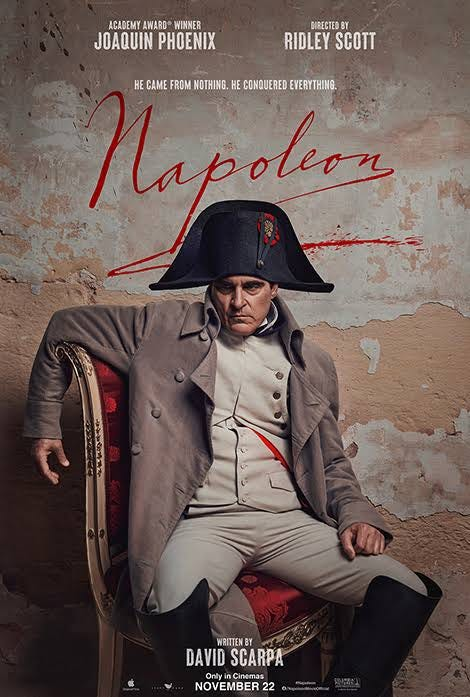
What can one say? Ahistorical, pointless, very near to spoof, it feels like an expensive practical joke. Napoleon is just . . . there.  Quiet, behatted, very dull, and you have no inkling as to what makes him special.

His torrid love for Josephine is perplexing – she spreads her legs to give him a look see, and he is forever entranced, even after he has to divorce her because she is barren.

That was the first half, before I took a gummie and got to The Battle of Austerlitz, and then, the film was more of a gas. Still terrible, but better attuned to my state.

Joaquin Phoenix gives one of the funniest, most wretched performances I’ve ever seen, defensible only because it seems justified, given director Ridley Scott’s recounting:

 “He’ll come in, and you’re fucking two weeks’ out, and he’ll say, ‘I don’t know what to do,’” Scott said about Phoenix. “I’ll say, ‘What?!’ ‘I don’t know what to do.’ Oh God. I said, ‘Come in, sit down.’ We sat for 10 days, all day, talking scene by scene. In a sense, we rehearsed. Absolutely detail by detail.”      

I kind of doubt there was any rehearsal.  Phoenix did not bother with a generic classical accent, nor Brit nor, God forbid, a French lilt, so he sounds like an assistant manager at the Petaluma Best Buy.

He is either heavy-lidded to the point of napping or he’s gonzo.

Destined to become a cult classic.

Very similar to The Talented Mr. Ripley, but without any of the care, build, patience, intelligence, or style of that flick. In Ripley, we are wary of yet sympathetic to Tom (Matt Damon), the working class nobody who insinuates himself into the shine of the rich and beautiful. When the tanned god Dickie (Jude Law) casts him aside, we feel for Tom. We don’t endorse the sociopath’s actions, but as Tom grows closer to capture, we guiltily root for him. When Tom’s desires draw him into greater malfeasance, against our judgment, we thrill to see if he will actually get away with it.

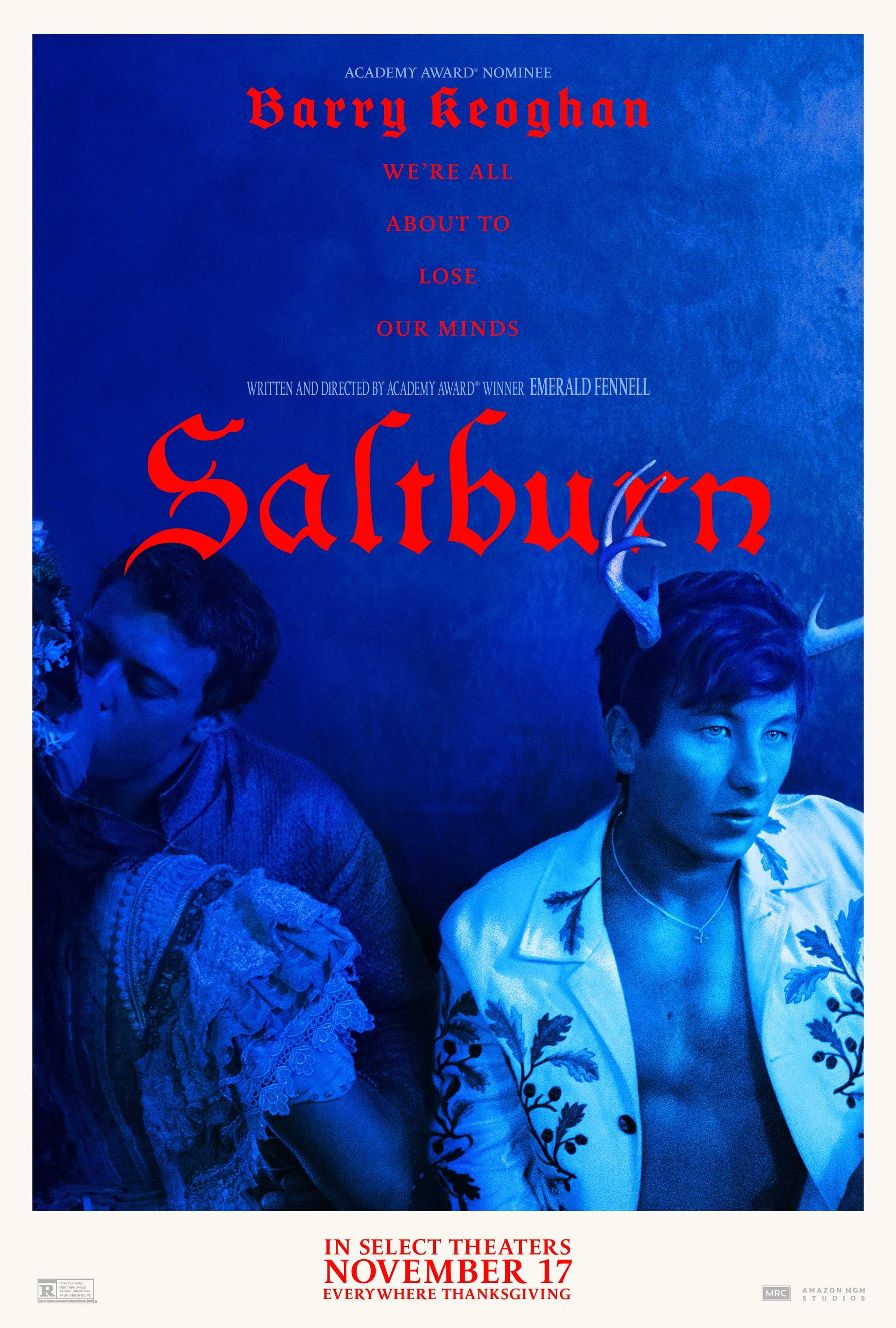
Here, our new Tom Ripley is Oliver Quick (Barry Keoghan), a modern day loser at Oxford who gloms on to his own Dickie, Felix (Jacob Elordi), a rich kid whose monied and titled family lives in a castle on Saltburn estate. After ingratiating himself with Felix, Oliver is invited to Saltburn where he negotiates Felix’s ridiculous caricature of an upper-class family, his own increasing desire for Felix, and the fact that he is disposable to these people when, like Ripley, he is trying to make himself indispensable.

Unlike Tom, however, we don’t root or care for Oliver. He’s a furtive creep. Even when he overhears the rich kids at school or Felix’s family malign him, our natural pang of sympathy immediately gives way to caution. The guy smells of wrong from the get-go and because of it, we have no skin in the game, either about Oliver’s fate or the cartoon characters around him.

What follows is a wretched flick infatuated with its own provocativeness. It’s not very funny, though it is labeled a black comedy. It’s not very edgy, though it is sexually perverse. It’s not very smart, unless rich people one level removed from The Howells on Gilligan’s Island saying grotesque things is your idea of smart. In Ripley, the rich were dazzling. Any condescension was barely perceptible, and accordingly, all the more cutting to Tom. You can see why Tom wants in and how much it stings. Here, Oliver yearns for a world populated by dolts and cretins, so, who cares?

The picture is also repetitive in the extreme. Basically, every scene is Oliver made uncomfortable until he becomes morose. When Oliver gets a win, another cliché rattling his/her jewelry reminds him for the umpteenth time that HE DOES NOT BELONG.

After running the tired plot into a very tight and boring corner, the end lapses into inanity (SPOILER: Oliver kills them all in a manner a mall cop would suss out as foul play inside of a minute; apparently, the British police force is trained by Magilla Gorilla).

But no one is on to Oliver because it’s a shit screenplay so far up its own ass that it need not deign to generate interest, draw characters, or construct a sensible narrative.

The near-end, where we flashback to Oliver’s machinations previously hidden to us, ala’ M. Night Shymalan, is such a clumsy and pathetic attempt at bringing order to this mess I almost felt for the creator.           

But then, I realized Saltburn is from the writer director of Promising Young Woman (Emerald Fennell), another infantile, impossible crapfest which got the critics to swooning.

On Amazon Prime.

In a year when Andrew Dominik thudded with a Hollywood fable, Blonde, Damian Chazelle, who was on a three picture heater for the ages (Whiplash, La La Land, First Man – yes, people, that’s three 5 star pictures), also crashed and burned, bigly and badly. But where you can see that Dominik’s failure was easier to hide in the making, Chazelle’s epic expanse of shit seems so obviously terrible in its awful construction that you hold everyone involved responsible, for any of them could and should have struck Chazelle hard across his face and said, “What the fuck are you thinking!”

The film, set in Hollywood in the silent to sound era, mistakes bloat as grandeur, Looney Tunes-level excess as glory, and crassness as knowing cynicism. Chazelle’s monstrosity has nothing to say or offer though what the picture does provide is a lot, and loudly. Then, unforgivably, it closes with paeans to the magic of the movies, gaudy testaments as they live in the hearts and hearths of the little people. Chazelle has the audacity to attempt to transform two sybaritic simps (up and coming ingenue from the wrong side of the tracks Margot Robbie and drunken leading wreck Brad Pitt, who fared poorly from the silent to the talkie) into the nostalgic wreckage of TinselTown.  And if that wasn’t enough, a racial parable is tacked on in the story of a jazz trumpeter who crosses over to the screen (Jovan Adepo). He is given just enough of a story to feel both insufficient and patronizing.

The movie is not a takedown of old Hollywood or an homage or even a madcap celebration of the hedonistic heyday. It’s just a boring, overlong freight train that supplants story and motivation for one spectacle after another, mainly in distractingly dizzying and ostentatious tracking shots. Then, after treating the characters as little more than CGI, they are destroyed amidst an ill-considered lecture about the perils of fame, the fakeness of it all, and the fact that Hollywood, as a Hedda Hopper type (Jean Smart) relays to Pitt, “is bigger than you.” But, she promises, you will … live on … forevah, on celluloid, “with angels and ghosts.”

Retch.

The performances are necessarily cartoons. Robbie, in particular, is obscenely over-the-top and nearly abused. As I said, you don’t care about her, you don’t care about anyone. Unless you care about Wile E. Coyote.

So bad you feel a little sick at the end, following a grotesque foray into the truly seamy underbelly of the town (think Freaks-meets-Carnival of Souls).

This was all done better by the Coens in Barton Fink and a heckuva lot better in Hail, Caesar!

Treacle and cornpone to its very core, an exercise in nostalgic tedium. Reese Witherspoon loved the book, a story of murder and mystery and coming of age in the swamps of a North Carolina small town. So the movie got made, in exactly the vein and manner of this vacuous and generic interview with the producer

Daisy Edgar-Jones (Normal People, Under the Banner of Heaven) is Kaya, one of a kabillion kids living in the marsh with her abusive father and helpless mother. Soon, the mother ups and leaves (Kaya yells “Mommy, Mommy” but as is the style in this type of Southern gothic turdpile, Mom sleepwalks down the misty driveway, never looking back). Kaya’s siblings soon follow (one of whom basically tells 9 year old Kaya “stay low” to survive just before he abandons her). Then her father splits, and Kaya is consigned to a life alone as the spooky swamp girl. Mind you, for the rest of her life (and when we leave her, she is in her mid-twenties), not one of her siblings circles back to see if, maybe, their little sister is ok. Her serviceman brother does a perfunctory drop-in later, when she is on trial for murder, meaning he was an adult for 12 or so years and couldn’t be bothered.  

The film’s version of 1960s rural poverty is to the real McCoy what the Disney ride is to actual pirates in the Caribbean. You soon suspect the swamp girl is derided by the locals not for her foreign and mysterious ways, or any class condescension, but rather, for her stunning cheekbones, luminous skin, and pearly white teeth.

The entire feel is inauthentic, as if brought to you by Loew’s or Home Depot. The swamp feels more like a fern bar, the town like Smallville, the characters every single archetype you’ve seen before.

We even get Kaya’s ponderous voiceover telling us things we can plainly see, half Marlin Perkins, half Judy Blume.

Kaya grows up and is caught in a tepid love triangle between two disinteresting homogenous actors with the mien of reality tv star brothers who macrame.

Could this be a double murder? Oh to dream!

Sadly, no. Kaya goes on trial for the murder of only Siegfried, not Roy, and perhaps the most boring legal drama in filmic history ensues. The case is so weak, you expect the actor playing the prosecutor to turn to the camera and shrug in apology. Kaya’s defense attorney (David Strathairn) shreds all witnesses with easy politeness, stopping just short of patting them on the head at the conclusion of his cross examination.

With the verdict a foregone conclusion, the reveal (she did/did not do it!) is anticlimactic in the extreme, made worse by the filmmakers’ decision to withhold “how” she did or did not do it.  

It’s all clearly too much for director Olivia Newman, who had some TV episodes on her resume’, to handle. She can’t settle in on any one aspect of the story (the disconnect between town and swamp, the thriller, the abandonment and solitude, the love stories) with any depth so we get a steamed, soggy pu pu platter of platitudinous porridge. The fact that the dull screenplay was written by Beasts of the Southern Wild co-writer Lucy Alibar is both confounding and depressing.

In the end, Kaya becomes a big star. Music swells. Crawdads sing. Cursing of Reese Witherspoon’s reading habits follows.  

On Netflix.

I regularly monitor the streaming services for late 60s and 70s flicks. I may have seen them on regular rotation growing up on the 4 o’clock movie. Or my father may have taken me to the theater on his semi-regular weekend visits. Some are solid pictures, enhanced by my own nostalgia. Some are complete and utter poop. Mr. Majestyk is in the latter camp.

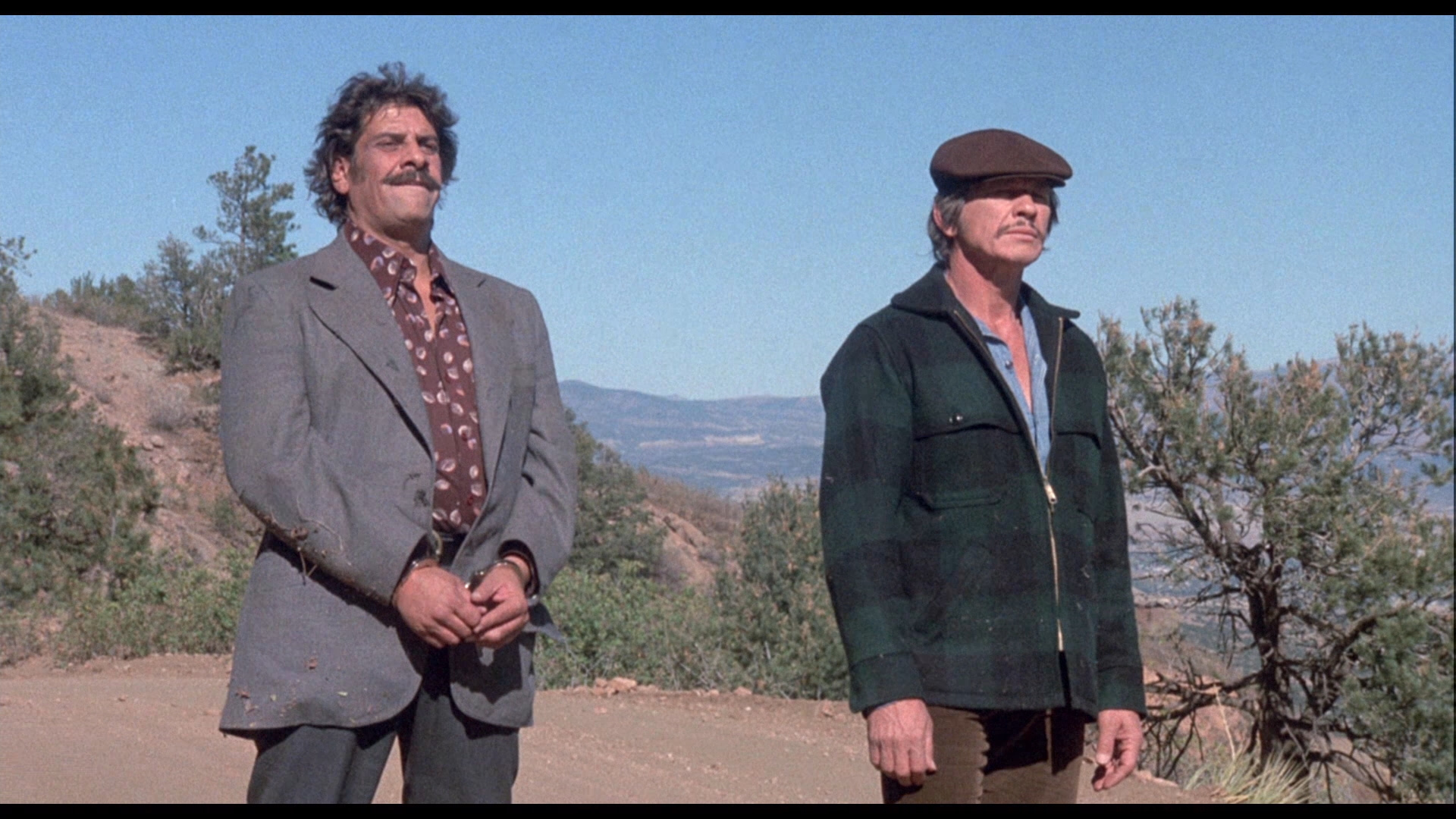
Charles Bronson, who squinted through an inordinate amount of theses paychecks through the 70s (Telefon, Breakout, Love and Bullets), plays a Vietnam Vet who just wants to be left alone to chisel the hourly wage down for his immigrant work force and pick watermelons. Alas, local Colorado thugs who want the work for white bums (so they can take a portion of their wages) intercede, Bronson messes them up, and soon, he’s in jail, where he meets and elicits the ire of a hitman (The Godfather‘s own Virgil Solozzo, Al Lettieri, who overacts inversely proportional to Bronson’s napping). Leaden car chases, nonsensical shootouts and wooden dialogue (penned by Elmore Leonard, no less) ensue.

The picture is clearly influenced by Billy Jack, the independent film made a few years prior on a shoestring which racked up a surprisingly healthy box office. Billy Jack is also not very good, but at least it had some camp value and the virtue of originality.

Charles Bernstein’s score is an elongated intro for a Mannix or Banacek. Maybe a McCloud. Gruesome horn, spinet and wah wah guitar. I suppose it is fitting because there is not an episode of one of those shows that is as dumb and listless as this picture.

Though if machine-gunning watermelons is your thing, this one is for you.

Don't Look Up (2021) - Spoilers and Bloopers - IMDb

Alternate title.

“I Am Smarter Than You.”

Adam McKay, the talent who brought you Anchorman and Talladega Nights, is indeed smarter than you and the cross he must bear is that he is cursed to live in a nation of Luddites and buffoons. If you chortle and nudge your partner knowingly during this ball of crap, and maybe even raise an “it’s funny because it’s so true” eyebrow, there is an 87% chance you have a “ If you are not appalled, you are not paying attention” bumper sticker on your car.  So, if you sport that message, or its kin (“Hate Has No Home Here”), this is a must watch!

Added bonus with McKay? Now, he’s not funny.

Two scientists, a clueless Leonardo DiCaprio and a droll Jennifer Lawrence, learn that a meteor is hurtling to earth. When they sound the alarm, every caricature of the fevered dreams of a rich Hollywood do-gooder is introduced, each dumber or more racist or venal or crass than the next, all in service to an obvious, endless sermon poorly masquerading as a black satire.

McKay is the whingy douchebag who used to tack on political messages to films like The Campaign, where Will Ferrell punched a baby and a dog, and The Other Guys, where Will Ferrell played a fastidious NYC detective who was given a wooden gun. It was a fey conceit you could overlook because it occurred during the credits and you were walking out of the theater after watching some boffo fart humor (and here, I kid not – McKay’s Step Brothers is a modern classic, and a lot of McKay’s earlier stuff is the creme de la creme of fart humor).

But now, after some success outside the realm of farts (The Big Short, Vice), he’s made his hobby the main course.

Cringe bad. On Netflix.

De Palma a la Mod

A behind-the-scenes vignette from this film distorts its true putrescence. As the story goes, before scenes, serious actor Sean Penn kept whispering to the out-of-place and in-over-his-head small screen star Michael J. Fox the words “television actor”, to either torment him or to rally him.

It didn’t work. 

That said, while there is no question Fox is terrible, his awful performance serves the purpose of obscuring a host of other faults in this debacle.

There are, for example, hideous performances all around. Penn is execrable, delivering a turn of overacting so extreme you can almost smell it. He’s like a whirling dervish of beef, brew and Old Spice. Young John C. Reilly, John Leguizamo, and Ving Rhames are near incompetent and, like most everyone, entirely unconvincing.

But no one was given anything very good to say anyway. The script by playwright David Rabe is so overt it hits like an ABC “After School Special.” A stagey “What are we doing here, Sarge?” is pretty much every line of the picture.

Rabe served in Vietnam as a medic, which just goes to show that experience isn’t always the best progenitor of art.

Watch and see if you can hold your breakfast. 

Brian De Palma’s direction is self-indulgent. I can think of few auteurs less suited for the verisimilitude of a period war picture than a guy who fetishizes Hitchcock. There is a scene where Fox’s fellow soldiers attempt to frag him by putting a grenade in the latrine where, for no reason other than an ostentatious build-up similar to the baby carriage in The Untouchables or the bucket of pig’s blood in Carrie, Fox has gone to attempt to light a cigarette, interminably. Because, when you want to smoke, no place is better than a Vietnam shithouse surrounded by big pails of excrement to enjoy it. His lighter won’t work and after trying it for the umpteenth time (maybe more than 15, he really wants that smoke), Fox drops it, and lo and behold, the grenade is reflected off of the lighter’s stainless steel.

A Vietnam picture is no place for this sort of arty playfulness.

It gets worse. When Fox survives, he sees one of his tormentors, Reilly, peeking at him from behind sandbags, and all I could think of was– 

The film also sports terrible art direction and location scouting. Vietnam looks like Disney’s Jungle Cruise, an incredible feat given some of it was shot in Thailand. Wherever they were, the actors were serviced by some of the best spas and salons available to them. I just never knew the combat experience in Vietnam was so tidy. Fox in particular looks like he was steam cleaned in every scene. Even when he has a head wound, his bandage is so brilliant white, it almost looks like a headband missing a feather. 

Finally, there is Fox’s height. In the old days, an actor’s short stature was taken into consideration. They’d put him on a hidden box, or shoot him from an angle that would favor him. Hell, in a tracking shot, they’d even build a trench for his leading lady as they ambled down the street.

Most film actors are short. 5’7″ seems to be the norm , but at 5’4″, Fox is diminutive, near tiny. Yet De Palma offered him no help. In the scene above, when Fox grabs a taller soldier, a “cherry”, by the lapels to chew him out, he looks like a toddler clinging to an adult’s overalls. Which is fitting, because for most of the film, with his childish, plaintive-comic mien, Fox presents like he lost his Mommy in aisle five of the Long Binh PX.  Yes, he’s short, but that’s not the whole of it. There is not an ounce of gravitas in the actor. “Oh, Jeez” sounds perilously close to “Oh Jeez, Mallory.”

The film is based on an actual war crime. What a woeful remembrance.