Archive

Drama

Unfaithful. Diane Lane received some buzz as a best actress nominee for her portrait of a lustful suburban housewife in Adrian Lyne’s film. She is excellent, but the film is unconvincing, for several reasons. First, before Lane begins her tryst with the French hunk book seller who sweeps her off her feet, we are given a glimpse of her home life. It seems pretty nice. Not that we need to have a bad home life to presage her immersion into a lustful, dangerous affair, but some indication of wanderlust or dissatisfaction is called for. Second, her paramour is attractive but no great shakes. With a home life that seems healthy (both sexually and otherwise), it might help to give us an irresistible draw – say, a Jude Law in The Talented Mr. Ripley. Instead, we get a bland French model straight out of a GAP commercial. Third, Lane is so incredibly stupid that you lose all sympathy for her plight and just feel bad for her husband (Richard Gere), who may be so distressed because his wife is cheating on him AND she’s so bad at it.

An amusing, sweet story about a young NYC writer (Sandra Bullock) who is forced into rehab in Tennessee after her alcoholism accompanies her on a car ride. The film is essentially about her stint there, and while predictable, it is moderately affecting and consistently funny. Bullock is also a surprise. While her range is not exactly expansive, she plays a damaged daughter of an alcoholic mother (who eventually died and abandoned Bullock and her sister as children) with some skill. Better, her part is loaded with wry rejoinders, her strength. A lot of good supporting turns, including Viggo Mortenson as a baseball pitcher working on a coke addiction; Steve Buscemi as Bullock’s counselor; Dominic West as her charming boozehound lover; and various other characters. This is not heavy lifting, and it is very AfterSchool Special, but it is well done.

Before I saw Castaway, I was assured that if I had to spend time on an island with a major male film star, Tom Hanks would probably be a good choice.  He seems affable, neat and even-keeled.   I was not disappointed.  His Fed-Ex plane goes down in the South Pacific, he is stranded on an island, and he combats the elements and his various misfortunes while making attempts to escape to civilization.  The time spent with Hanks is well worth it.

The problem with Castaway, however, is that director Robert Zemeckis tucks a love affair between Hanks and Helen Hunt (Washington, D.C.’s City Paper correctly observed that Helen Hunt was again cast as Helen Hunt) pre-stranding that is mundane and equivocal; post-stranding, it is confused and drawn out.  While Hanks is on the island, out of necessity, he strikes up a relationship with a volleyball.  Unintentionally, this relationship towers in depth and complexity in comparison to the one depicted between Hanks and Hunt.  So, when Hanks gets back to civilization, the meat of loose ends and forged relationships and a changed world are not there to greet him, or us. Rather, the only thing we get to see him confront is the bland Hunt, and her on-again-off-again Tennessee drawl.

Side note:  Tom Hanks is given the worst maladies in movies.  In Philadelphia, it’s AIDS.  In Castaway, he has to give himself what appears to be a root canal.  In The Green Mile, he has a urinary tract infection that has him peeing what appear to be razors.  What the hell?

You can only go so far with Oliver Stone’s antics behind the camera.  But sometimes, it gets you 3/4 through a movie.  Watchable, occasionally engaging, and always stupid, anything of value from this movie comes from Stone’s eye on the speed and madness of professional football.  His frenetic editing and jump-cuts to varying film stocks keeps you watching, plus the fact that it is football, it is glitzy, it is steamy, sultry Miami, and Dennis Quaid, Jamie Foxx and James Woods provide some surprises to their hackneyed personas.

All of which helps you forget that Al Pacino, as the gruff ole’ coach, is mailing in his 76th lousy post-Tony Montana performance; Stone’s tried-and-true preachy and over-the-top screenplay of (you guessed it) man stuff and redemption; Stone’s excesses, borne of a director who simply won’t take “Um, Oliver, isn’t that a little much?” for a question; a high cheesiness factor, as Stone (unlike Cameron Crowe in Jerry Maguire) apparently wouldn’t pony up to pay for NFL rights, so we are left with the Dallas Knights and the Miami Sharks; and, an embarrassing turn by wide-mouth bass-headed Cameron Diaz, as a supposed ball-busting owner of the Sharks (it appears she just misses her Daddy, the former owner, who wanted a boy).

Boys Don’t Cry is a picture about an unfortunate Lincoln, Nebraska woman (Hillary Swank) with gender identity issues.  She wants to be a boy, so she crops her hair short and poses as a boy.  In those moments, where she has “passed” and tasted affection from the vantage point of a male, the film works.  We see the fearful life Swank leads, how her surroundings and her gender conspire against her desire to express what she feels and who she thinks she is. Swank has you share her exhiliration as she ends an evening with a kiss from a unknowing date.  Her performance is justly praised.

Swank soon falls in with a motley crew of losers, including an ex-con, a self-mutilator who has burned his own family out of house and home, and a girl who aspires to leave her job canning broccoli so she can get paid as a karaoke singer (Chloe Sevigny).  Swank falls in love with Sevigny, and a white trash Romeo and Juliet ensues.

Director Kimberly Peirce has a firm grip on the picture when she is depicting Swank’s acceptance into this group.  It plays as a more rough-hewn American Graffiti where the gang eschews the strip for the highways of Nebraska, and malts become beers and bong hits.  Peirce shows a group moving fast (she uses the effect of fast speed highway lights, super slow-motion shots of the gang getting high in the back of a car, and a police chase off-road in the dust) and going nowhere.

Unfortunately, in real life, the Swank character was murdered, and the second half of the film grounds to the halt of numbing, repeated brutalization of Swank.  Director Peirce pours it on at the end, with 4 scenes of debasement and cruelty.  Swank is so dehumanized that any emotional power is drained from the film.   I suppose the end is defensible on grounds of reality, but it saps the early beauty of the film and worse, it blots out Swank’s singular character until she is just another unrecognizable victim of senseless American violence.

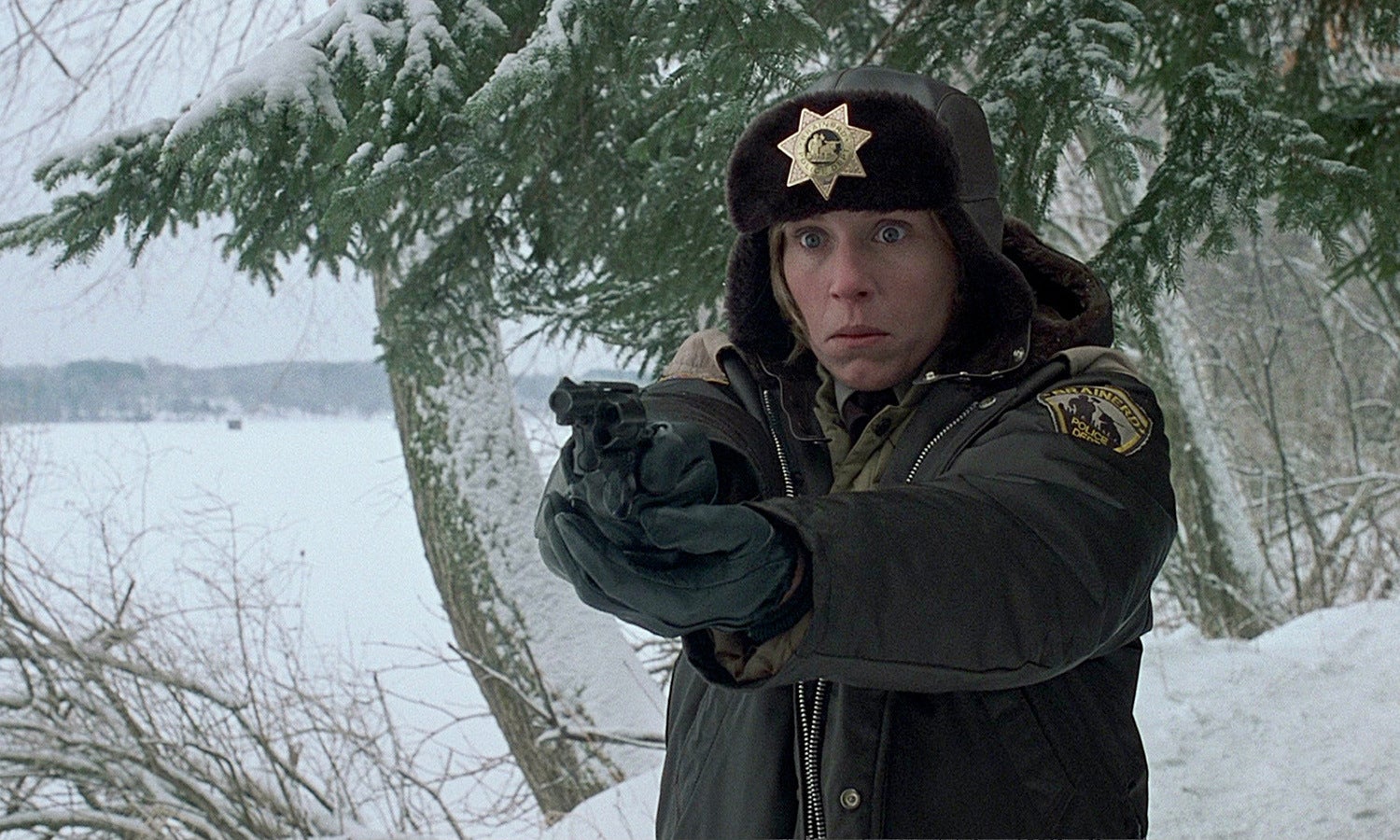
Coen brothers confirm Fargo is a true story after all, or at least based on  some | The Independent | The Independent

One of the best crime movies ever made, deservedly on AFI’s list of the top 100 films (no. 84). This is the Coen film that brought flesh-and-blood characters and a cinematic theme eclipsing their technical skills.

Fargo is about American crime. The ridiculous crime you read about in newspaper blurbs. The Coens offer a rich explanation behind “Man Found Shredded in Wood Chipper” or “Couple Carves Fetus out of Young Woman.” But while the story is mythic (aided by Carter Burwell’s memorably dark score), the characters are not mythical. William H. Macy is a scared, little man who wants to make his mark, gets in hock, and cooks up a scheme to have his wife kidnapped and ransomed. The kidnappers (Steve Buscemi and Peter Stormare) are ignorant and brutal, sharp, cunning animals who subsist on the reticence of victims to respond. That they will resort to violence is never in doubt. They are criminal through-and-through, of the type depicted in In Cold Blood or One False Move or, for a truer example, in occasional “Real Live Video” shows. The killers in Fargo remind me of a true video I saw of a carjacking, which was filmed from inside the car. The “carjackee” is an undercover cop, and he tries to calm the carjacker down to give the police time to swoop in. The carjacker will not be assuaged.  He is a vicious animal, constantly pointing his gun at the undercover cop, threatening to blow his head off. Up until the moment the police swoop in and disarm him, the criminal is a beast. Immediately upon being disarmed, however, the carjacker is all, “It’s cool, it’s cool.” He’s smiling. He’s reasonable. He’s a completely different person, almost in a prep mode to appear more deferential and misunderstood.

Here, the Coens show something rare in crime films – they show the killers in everyday, mundane life, as driving companions, as drinking buddies, as guys picking up chicks at a bar, or holed up watching TV and waiting for the money. Then, after we laugh at or with them and become more comfortable with their demonstrated incompetence, the directors show us their vicious sociopathy. Quickly, their first instinct when pressured is to kill, and they do it without remorse or reflection. They eventually turn on each other, and it is Macy who let loose these furies through his mind-numbing weakness.

Their foil is Frances McDormand, a pregnant sheriff who has a simple uncomplicated sensitivity and a very clear, tough line of right-and-wrong. She still doesn’t understand Stormare, who, at the end, sits forlornly in her squad car:  “There’s more to life than a little money, ya know. Don’tcha know that? And here ya are. And it’s a beautiful day. Well. I just don’t understand it.”  That’s enough for her.

What McDormand exudes, unlike the tortured Sheriff played by Tommy Lee Jones in the Coens’ bookend film No Country for Old Men,  is that she really doesn’t care to understand it. She’s not interested in giving a Stormare the time to think about his motives, his beginnings, his modified persona as a captured animal. He’s an animal, she knows it, and she moves on.

In this way, I also think Fargo is a uniquely American movie, a window to a culture that champions individual rights yet accepts the death penalty. That’s nifty work, one that keeps you interested in the criminals, but does not elicit anything more than the most base sympathies (though it is hard not to feel somewhat bad for the hapless Buscemi as he tries to hide money with a bullet in his face).

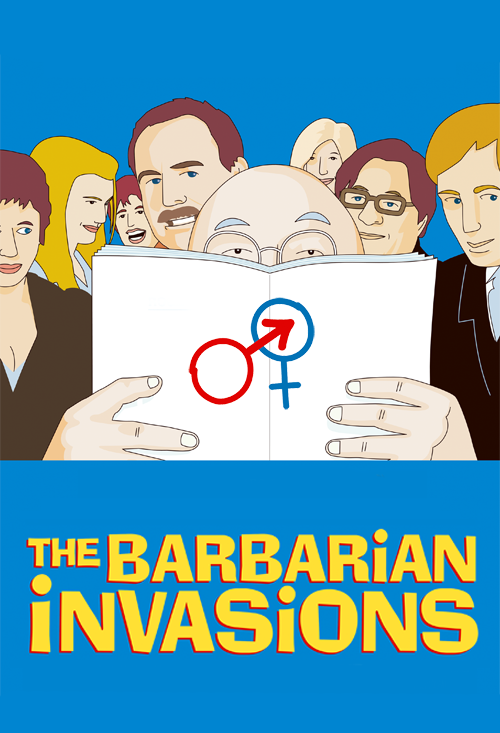
The Barbarian Invasions ("Les Invasions Barbares") - Official Site - Miramax

The story of a sensualist, leftist, Canadian professor who abandoned his family. He lays dying in the misery that is a hospital in the Canadian health system (“I voted for Medicare, and I’ll accept the consequences,” he declares). His money-trading capitalist son flies from London to ease his father’s death, bribing the inefficient hospital staff (while one floor is Calcutta, the one below is empty), its corrupt union, and anyone else who can make his father more comfortable. The son gathers the father’s friends and procures him heroin for pain medication. He does it without a whisper of his method, and the father feels free to casually dismiss his child’s success.

In the midst, planes strike the World Trade Center and a television commentator proclaims that it is the first of the barbarian invasions.

Why this image in what is otherwise an affecting and funny family drama? Because the film has more than political overtones and jabs.  David Edelstein writes that the director’s first film, The Decline of the American Empire (1986) suffered from “neocon gloating.”  I haven’t seen it, but The Barbarian Invasions plays as a wholesale assault (by velvet glove) on the excesses of modern liberalism. Socialized medicine is a hell. The union is a crime syndicate. Sexual expression and lack of fidelity breed disaffected children (the London son was estranged, as was his sister, who is away on a boat in the Pacific, and the daughter of a another sexual libertine is a heroin addict who does not speak to her mother). The father’s professor friend boasts of his trophy wife, but that trophy shows its sharp stripes when she angrily objects to the lending of their cabin for the father’s last dying days because it was made part hers after her endless suffering “at the Ikea.”

Yet, when death knocks, the family, such as it is, coalesces, almost in spite of the blows it has taken through the years. Family is family, the bedrock, and there is refreshingly not one, “You weren’t there for us, Daddy!!!!!” extended rant, though an American equivalent would have ten such scenes. Once, upon arriving from London, the sons snaps. It is portrayed as his weakness, and it lasts the 5 seconds he needs to compose himself in front of his ill father (even then, he does not know the father is dying).

Two vignettes are the heart of the film.  First, the father’s coterie are all academics, and they reminisce at how many “isms” they embraced and discarded. The father then tells the story of his trip to China, where he relayed his respect of the Cultural Revolution to a Chinese academic he hoped to bed. She froze, and the father recounts how she relayed the deaths and tortures suffered by her family in that glorious revolution. 

Second, the son’s wife, an art dealer, is sent to a church to inspect religious artifacts.  She declines (the Americans have taken all the good stuff) and a forlorn priest motions to figurines of Mary, Peter, and Christ, in a dusty, cobwebbed basement, asking “So, this is all worthless?”

Capitalism, however, is by no means faultless. The son buys everything, including the attendance of his father’s former students to pay their respects. But the film is political, a strong denunciation, not just of the excesses of modernism, but of leftist, Western liberalism.  And even if you don’t get that message (I can’t imagine the Academy, which nominated the picture for Best Foreign Film, did), it still triumphs as a beautiful story of family and friends re-converging for a humane goodbye to a flawed man.

Babel.  A self-important message picture, the message being, “If you are an illegal alien, you shouldn’t take your employer’s kids into the Mexican desert” or “If you’re having trouble with your wife, don’t think a tour bus trip through hot and unpleasant Morocco will help matters” or “You are so hot when you pee in a bucket.”   The picture is boring and over-hyped, ostensibly about big issues, and therefore, the Oscar nomination is explained.

The Wrestler.  Depressing and not really much above a standard “I’m just a broke down piece of meat so I need to re engage with my daughter and dance with the stripper with a heart of gold” tale.  It’s gritty, bloody and dark, but not really all that interesting.  Darren Aronofsky (Requiem for a Dream, Black Swan) has carved a real niche’ of making viewers physically uncomfortable.   That said, Mickey Rourke is excellent, and his performance was rightly lauded. He does the little things well.

Sean Penn notwithstanding (it’s a genuine and moving performance), I don’t think it is a good sign when you begin to hope for the assassination just to break the monotony of The Life of Christ in the Castro.  Harvey Milk was a much more fascinating and human figure.  He deserved better than this gauzy, hackneyed, preachy tribute.  And why they gave a best supporting actor nod to Josh Brolin for his portrayal of assassin Dan White is a mystery.  Brolin was very brief on screen and when he appeared, he essentially played like a man with a migraine.