Archive

Documentary

I watched this documentary on Monday night, after Anthony Weiner’s final on-line transgression resulted in the announcement of his separation from his wife, Hillary Clinton handler and confidante Huma Abedin.  The documentary shadows Weiner during his run for the New York City mayoralty, a run he made after resigning from Congress when he was busted for sending a dick pick to a young girl.  The ignominy of that act was exacerbated by the facts of Weiner’s lying about the incident (he was hacked, it might not be his junk, forces opposed to him were at play, “”Maybe it did start being a photo of mine and now looks something different or maybe it is from another account”) and his unfortunate name.

But come back he did, and as relayed by the documentarians, he returned with verve and passion.  Until he got busted again, this time sexting under the nom de plume “Carlos Danger” with a sad, grasping, soon-to-be porn star named Sydney Leathers (the scandal is notable as much for its bizarre nature as the silly names of its participants).  This unfolds before our very eyes, and it is often difficult to watch.  After this second humiliating revelation, Weiner opts for an aggressive, charge forward “this is what we do“ approach, as if to keep moving is to delay facing up to the consequences of his actions.   But you can see him harden and crack, in contentious interviews and encounters with voters.  Abedin, a beautiful, stoic woman, also becomes more brittle, but she retreats inward.  When the camera catches her watching Weiner desperately prattle on, a look not so much of disgust as disbelief is on her face.  The campaign staff, all young and committed to Weiner, are rattled, and you feel for their predicament.

The documentary also illuminates a few other aspects of this entire farce that merit comment.  First, even with all the drama and pain of Weiner’s relationship with Abedin, there is an intimacy between the two that is undeniable, making this national joke a bit harder to laugh at.  The revelation of real love in what you cynically presume is a marriage of convenience is quite unexpected.  Additionally, Weiner and Abedin evince a certain cynicism of their own in the way they operate politically.  It seems perfectly natural to them when Weiner monitors her fundraising calls to friends or uses their child as a shield-in-a-stroller, or she engages in strategic musings to keep his campaign afloat.  But it feels grubby and sad.   Also, the media comes off as nothing short of vile.  Their glee and faux moralizing actually engenders sympathy for Weiner, which, given his hubris and recklessness, would seem impossible.   When Weiner becomes unspooled after being baited by the likes of MSNBC dimwit Lawrence O’Donnell, it’s hard to determine who comes off worse.  At least, for me and Weiner.  There is a  charming moment when Weiner looks back at Abedin after re-watching his interview with O’Donnell and imploringly asks who got the worst of it.  She replies unequivocally that Weiner was loser of the exchange, a fact he can’t quite grasp.   Frankly, to me, it was a close call, but the unctuous O’Donnell was not running for office.   The crazed Weiner was.

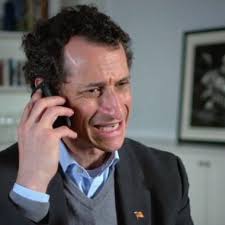
Ultimately, what I liked most about the documentary is it didn’t portray Weiner as tragedy.  He is not presented as some promising wunderkind undone by his excesses and a vicious press corps.  While in post-campaign crater sit-down interviews with the filmmakers, Weiner looks beaten, emaciated, like a recently released hostage . . .
image

. . . sad as he looks, you don’t feel that something grand has been lost.  He’s just a guy with a persistent fetish in the wrong business.


I was in school in Philadelphia from 1982 to 1984, during the mayoralty of Wilson Goode, who had taken over from the dictatorial former police commissioner and mayor Frank “I’m gonna’ be so tough as mayor, I gonna’ make Attila the Hun look like a faggot” Rizzo (Rizzo had once bragged that his police department could invade a country, and having seen them in action, I believed it). At that time, the Philadelphia police department was in an intractable standoff with a weirdo cult – MOVE – a back-to-nature, but armed-with-guns, community-based but plague-on-the-surrounding-community organization that melded hippie-life, black militancy and making their neighbors (largely, middle class blacks) miserable. The cops and MOVE had tangled once before, in 1978, leading to a siege where a police officer was killed and numerous cops and fire fighters wounded. Nine MOVE leaders and other disciples received life sentences as a result, but the remainder of the organization’s adherents moved to another neighborhood in West Philadelphia, where the entire scenario played out again years later. I clearly remember the local news reporting on police-MOVE clashes when I was in Philly, but until I saw this documentary, I had actually convinced myself I was in the City of Brotherly Love for the final confrontation.  I was wrong. By then, I had transferred schools and sat in Harrisonburg, Virginia, where the only assault was olfactory, a combination of a dog food plant and turkey slaughter.

Mayor Goode decided he’d had enough of MOVE plaguing yet another neighborhood (MOVE’s parenting was questionable, they had built a row house on Osage Avenue into a fortress, they menaced the neighbors and in particular, blasted obscenity from loudspeakers with regularity at all hours).  The cops came in to serve warrants on several MOVE members, they resisted, gunfire ensued (MOVE shot, and the police responded, if not in kind, as they unloaded 100,000 rounds into the house), another siege ensued, only this time, after a long period of time where they doused the MOVE house with water hoses, the police dropped an incendiary device on their house. And they let it burn. And it did, eventually engulfing the neighborhood, destroying 65 houses and killing 11 of 13 MOVE members, including 5 children.

This documentary is comprised solely of archival footage from the news, the public hearings that took place after the events (two of my former law partners were involved, one as the then-D.A. and the other as a member of the commission), and depositions taken in connection with litigation.  It is riveting, almost dreamlike, and you can’t even imagine that what you are seeing could possibly occur. But it did (and actually, again in the 1990s with the Waco stand-off), and the rendition is gripping, With the exception of some discordant editorializing at the end of the documentary in the aftermath section, it is also fair. On Netflix streaming.

It’s difficult not to compare this Academy award-nominated documentary about singer Amy Winehouse with Montage of Heck, the documentary on Kurt Cobain. Both tell the stories of young popular artists who were undone by drug abuse and depression. Both individuals suffered childhood ruptures and significant medical problems (Winehouse suffered from bulimia while Cobain had serious stomach issues). Both killed themselves, Cobain actively, Winehouse as close as you can without actually pulling the trigger.

The comparisons, however, end there. Cobain’s raw talent was nowhere near that of Winehouse. Winehouse’s voice was so powerful, nuanced and unique, it was staggering, and as evidenced by the documentary, she was a beautiful lyricist as well (thankfully, as she sings, we get to see her lyrics in print). Winehouse also comes off as extremely sympathetic, a sweet and vulnerable girl too fragile for this world (pardon the cliché), someone desperately looking for unconditional and protective love in the hard environs of celebrity. Conversely, Cobain was angry, spit at his success and pretty much made drug addiction a career goal, a decision very difficult to pigeonhole into tragedy.

Director Asif Kapadia uses the ample footage of Winehouse to guide us through her rise and fall (the advent of camera phone video gives us the paradox of Winehouse plagued by paparazzi but constantly videotaped even in private), and while he maintains a veneer of dispassion, he ties her self-destruction in part to a passive mother, an absent and then craven father (it is almost unbearably painful to watch him arrive in St. Lucia as she convalesces from an overdose with a camera-crew for his own reality TV show), an opportunistic boyfriend (if you have even an atom of chivalry in your bones, the moment you meet the creepy, clingy Blake Fielder is the moment you want to beat him senseless) and the cruelties of the press. Indeed, Kapadia is so skillful in communicating his thesis that my own bullshit meter senses oversimplification, and in pressing his case, he flirts with casting Winehouse as victim, when, in fact, she was a willing driver of the ills that befell her (she died of alcohol intoxication at 5 times the legal driving limit). Still, the film as portrait of an artist remains vibrant even if the thesis is hokum. Winehouse’s unfairly or accurately maligned father may have said it best, “Half of me wants to say don’t go see it. But then the other part of me is saying maybe go see the videos, put your headphones in and listen to Amy’s music while they’re watching the videos. It’s the narrative that’s the problem.”

I loved Tower Records and so did my father, a classical music nut.  His apartment was littered with the ubiquitous yellow bags and his visits to its D.C. location (the store was a few blocks from his apartment) were long meanders through the aisles and aisles of inventory.  Colin Hanks has done an admirable job of evoking the nostalgia of Tower, which rose from a small shop selling singles in Sacramento to an international conglomerate in a matter of thirty years.  In the process, he recounts not only an incisive story about the music business from a retail and merchandising standpoint, but of a family business, where all of the early stock boys and clerks who got stoned and drunk in the back grew to become VPs and store and district managers.  The fall –  a combination of technology, overreach and a bit of profligacy – is sad, but not tragic.  Every one of the individuals interviewed extols the organization, its singularly decent and quirky founder Russell Solomon, and the positive impact working there had on them.

image

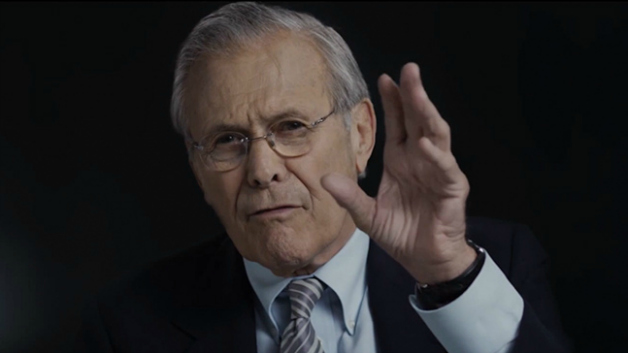
Not an apologia, nor a self serving justification, but rather, an opportunity to listen to the methodology, nuance and capacities of one of the more influential policymakers of our generation. Documentarian Errol Morris is astute enough to let Donald Rumsfeld roll with little interruption, with only occasional prodding, to attempt to reach his core. Unlike with Robert McNamara in The Fog of War, who eventually reached an acknowledgment that seemed near confessional with regard to his failures in Vietnam, Rumsfeld is not of the same mindset. He is not prideful in his cheery resistance to apology: he’s quite capable of admitting error and does so often. But he refuses to accept the premise that in the commission of error, there necessarily lies moral failure or self-serving, political calculation.

Morris is a little cheap on occasion, and with someone who is as careful with his words as Rumsfeld, it is problematic. For example, Morris goes “gotcha!” when he juxtaposes Rumsfeld’s denial that the Bush administration cast Iraq as a major player with al Qaeda in the direct planning of the 9-11 attacks with his statement in a press conference that al Qaeda and Iraq certainly had a relationship.

Mostly, however, Morris is flummoxed by Rumsfeld, which is actually a good thing. Morris approaches Rumsfeld as a provocateur, asking “why obsessed with Iraq?” and “why not just assassinate Saddam?”  He receives answers, albeit answers you can tell he feels are not deception so much as unsatisfactory.

There is no neat wrap-up, no target hit, no successful gotchas, but rather, just a rumination on Rumsfeld’s peculiar process and recollection.

There is a nifty exchange where Morris advances that Shakespeare wrote about large personality-filled power struggles; Rumsfeld replies that those struggles are really just people with different perspectives; Morris counters, “Did Shakespeare get it wrong?”; and Rumsfeld thinks about it, shrugs, and suggests maybe Shakespeare got it right . . . for his time. In that same vein, Morris pushes Rumsfeld for lessons between Vietnam (the end of which Rumsfeld oversaw serving President Ford) and Iraq, and Rumsfeld parries that while one hopes to heed lessons in history, the primary lesson is “some things work out and some don’t.”

Morris wants Rumsfeld to answer, “How do you know when you are going too far?” and Rumsfeld is literally the last person on this earth equipped or inclined to provide him a satisfactory response.  Are you saying, “Stuff just happens?”, Morris asks in exasperation.  Rumsfeld looks back at him with the look of someone who has just been asked “Are you saying you breathe air?”

Morris conceded his agenda, and perhaps the thwarting of same, in an interview: “You’re left with a strange anxiety about [Rumsfeld].  I suppose if I was Mike Wallace or David Frost or whoever, I’d back [him] into a corner. But I love those moments, because I don’t even know where I am anymore. I don’t know whether he’s in any way self-aware, whether he is lying, whether he’s just in some strange alternate universe, the Rumsfeld universe. . . . There’s a ‘j’accuse’ there, but it’s my ‘j’accuse’.”

The consensus from the dummy contingent of film critics is that Rumsfeld was given the rope with which to hang himself, or his artful dodging is in and of itself proof of the indictment as to his treachery, but what Morris has actually accomplished is a demonstration of the incongruity between the needs of artists, or those who see the world through a Shakespearean lens, and policymakers, who take it one memo at a time.


About halfway through this dour documentary about Nirvana front man Kurt Cobain, his widow Courtney Love reveals that at the advent of their courtship,  “I had already done heroin, beat the thing, had a rule.  I loved it still, but I didn’t have a fantasy that he had. He had a fantasy. His fantasy was, ‘I’m gonna get to $3 million and then I’m gonna be a junkie.'”  Nirvana bassist Krist Novoselic echoes Love, observing that drug use was “all part of the package of building a home” for Cobain.

So, halfway in, you learn that the subject of the documentary is a putz, and much to your dismay, he took a crapload of home video in the last few years of his life demonstrating his putzitude.  What follows is a lot of dismal footage of a bedraggled, strung out Cobain and Love spouting banality (either under the influence of heroin or not; it’s hard to tell) while holding their baby, which is like watching two winos toss a crystal vase.

Director Brett Morgen does his best to jump up the material, creatively using all of the detritus of Cobain’s life (scribblings, drawings, home movies, cassettes, paintings) to tell his story, but the story is just not that compelling.  Troubled kid, broken home, hates “the man”, puts it all into his angry band, big sound, superstardom which is near immediately resented, and then, the repellent creation of a sneering, condescending persona that presents as tortured and deep only by the efforts of rock critics who use phrases like “voice of a generation” (a moniker lobbed up solely to be spit upon by the acid Cobain) and a shotgun.  And at the end, Nirvana really was about a sound.  It was a helluva sound, I will grant that, but Cobain only made one record that lyrically matched that sound (Nirvana’s last, In Utero).

For the most part, a whole lot of nothing, though for fans, there’s a lot of good early footage.

Watch Best of Enemies | Prime Video

This documentary chronicles the rise of William F. Buckley and Gore Vidal – two highly esteemed public intellectuals and failed political candidates from distinct ideological poles – culminating in their televised debates during the Republican and Democratic conventions in 1968. It was at one of these debates that they got into it, bigly.

There is so much that is absolutely riveting about this exchange: Buckley’s barely contained fury, Vidal’s delight at having gotten under Buckley’s skin, its utter authenticity. The documentarians do an excellent job at placing these debates in the proper contexts, including the rise of Buckley as a conservative founding father and Vidal as a brilliant novelist and libertine, and the effect on these two combatants. Vidal almost fetishized the exchange, having guests view the debates at his villa in Italy in a Norma Desmond-like manner, and saying of Buckley upon his death “I thought hell is bound to be a livelier place, as he joins forever those whom he served in life, applauding their prejudices and fanning their hatred.” Conversely, Buckley was horrified at his loss of control and regretted it for the rest of his life.

The documentary also chronicles how the debate changed television coverage for conventions (no longer would there be gavel-to-gavel coverage) and alludes to the debate’s impact on televised political discussion thenceforth, but, thankfully, doesn’t attempt to press home a full argument.  It is enough to watch the sewer that is political commentary on FOX, MSNBC, CNN juxtaposed with the clips of Buckley and Vidal, even at their worst, to get the point.  Best, the documentary utilizes individuals who were present at the debates as well as authors and commentators like Christopher Hitchens, Sam Tanenhaus and Dick Cavett, all of whom have very interesting rather than obvious observations.

The documentary is, however, a little thin. In particular, it glosses over the post-debate exchange the two men had in Esquire magazine, where Vidal cut as deep as he could, suggesting a calumny about the Buckley family that does not bear repeating here. This more so than the exchange engendered litigation, as Buckley sued Vidal and Esquire. That suit was settled, under the following terms: Esquire would publish a statement in its November issue disavowing “the most vivid statements” of the Vidal article, calling Buckley “racist, anti-black, anti-Semitic and a pro-crypto Nazi”, and the magazine paid $115,000 for Buckley’s legal expenses. Buckley said of Vidal, “Let his own unreimbursed legal expenses, estimated at $75,000, teach him to observe the laws of libel.” Interestingly, in 1995, Esquire re-published Vidal’s essay in an anthology, Buckley again sued for libel, and Esquire again settled for $55,000 in attorney’s fees and $10,000 in personal damages to Buckley.

Great time capsule piece. Available on Netflix streaming.

The documentarian, David Thorpe, opens up at the outset explaining that he’s not in a relationship and then focusing on his lilting voice as somehow responsible. Whether that is the case is hardly proven, but it is clear that Thorpe is not happy with the way he talks. This commences his journey to speech therapists, gay icons (David Sedaris, Dan Savage, Tim Gunn) and his family and friends in a search to discover the genesis of the gay voice and in particular, when he started to sound gay (the title is a bit of a misdirection: he sounds gay; there ain’t no “Do I?” about it). What follows is a mostly interesting if occasionally duplicative meditation on one man’s gay voice.  In the case of Thorpe, he was a quiet closeted kid in South Carolina, perhaps knowing exactly what was in store for him if he was labeled a “fag” in the pitiless halls of high school. But to his credit, he doesn’t leave off there. His old friends affirm that his “gay” voice was a relatively quick change, occurring when he came out, and Thorpe explores the bravado of that act, as well as the influence of gays in pop culture when he was growing (who knew Paul Lynde, Charles Nelson Reilly and Rip Torn were so influential?) The documentary also shows a certain group speak at play, as anyone can attest when they spend an appreciable time in the South and a drawl develops. What is abundantly clear by the end of this film is that Thorpe’s never getting rid of the voice. When he tries, he just sounds like a baritone gay dude. But in cataloguing his attempt, he’s made a witty, watchable picture. Currently on Netflix streaming.

When my grandmother started to lose it, she was ingenious in masking it. If you asked her who was president, she’d say, “that fool in the White House.” If you asked her about something topical, she’d reply, “Who has time for such things?” It was her game face as her memory began to fail her.

At the beginning of I’ll Be Me, this is where we find Glen Campbell, recently diagnosed with Alzheimer’s. He is vague, folksy and stubborn in attempting to defend himself from a world ever more foreign to him. He leans heavily on his wife, who acts as his lifeline to his past, but we see his true state when he watches old home movies, and asks “who is that?” It’s achingly painful to hear his wife’s reply, “That’s you, silly.”

Campbell’s diagnosis came on the eve of his final tour, and in an effort to increase awareness about the disease, he went public and allowed a documentary crew along for the ride. The result is a bittersweet retrospective of his work (I had no idea just how big a star he was) and an examination of what it is to suffer this disease through the eyes of his family (three kids are in his touring band). I feared that this might become exploitative and was heartened to see that not only was it not, but that Campbell’s wife acknowledged the concern, explaining that they weighed the costs and benefits and decided to go forth. I also feared that it would be altered to create a “triumph of the spirit” vibe, but director James Keach (an actor in his own right and Stacy’s brother) presents Campbell and the disease in sober fashion; when Campbell’s issues become acute, it is almost too much to bear, and when they evince on stage (as is shown on the clip above), it is not sugar-coated. But the audience is with him, so are we and the fact that his music is so ingrained in him it triumphs over the disease, for a time, is a wonder to watch.

Currently on Netflix Streaming.

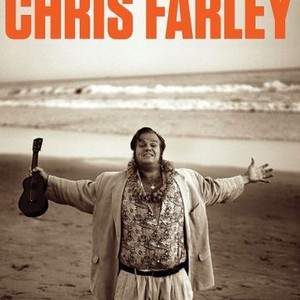
I Am Chris Farley - Rotten Tomatoes

Slapdash, clunky and almost obstinately uninteresting, this 90 minute documentary (of which I watched about 64 minutes) tells us nothing about the comedian that we didn’t already know. He was funny, crazy, sweet, insecure and had a large appetite for drugs and alcohol, which led to his untimely death. He was also surrounded by family, friends and colleagues who I am sure had much more interesting things to offer about him than what was presented here, which comes off as generic or even dull. Some amusing childhood remembrances and cuts of some great Saturday Night Live clips don’t make the effort a total disaster, but it’s a tough slog nonetheless. There is not one anecdote that meets the quality of the dozens reported in Live from New York: An Uncensored History of Saturday Night Live. Worse, the quality of the documentary is shoddy. There is a persistent and annoying background musical track, interviewees are filmed in unnatural poses (Farley’s sister gets a side view that is both unflattering and bizarre), and when we see Adam Sandler, the filmmakers find it necessary to remind us in writing the next time he is shown that, in fact, it is still Adam Sandler.  Poorly done all around.