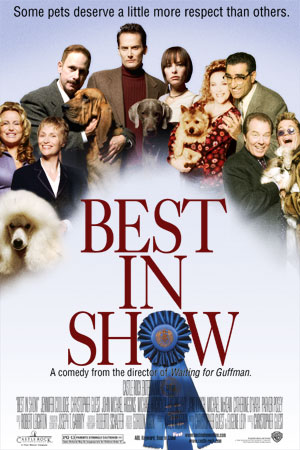
I caught this the other night and of the mockumentary films written and/or directed by Christopher Guest – This is Spinal Tap, Waiting for Guffman, A Mighty Wind, For Your Consideration – this is my favorite. Perhaps not coincidentally, it’s also the sweetest on its subjects, an assortment of purebread dog owners who are competing at The Mayflower Kennel Club Show. Catherine O’Hara and Eugene Levy stand out as the impoverished Florida couple who, unfortunately for Levy, run into O’Hara’s old lovers on their way north, but Jane Lynch shines as a driven, lesbian handler who has found a Sugar Mommy (Jennifer Coolidge) to fund her efforts, as well as the magazine American Bitch (“it’s a focus on the issues of the lesbian pure bred dog owner”).
But Fred Willard, as the disinterested but garrulous TV announcer, and Jim Piddick, who has to suffer him, steal the picture.
A film that got away from me, perhaps because it gave off such an air of discomfort, I watched There Will Be Blood this weekend. The movie is very good, but my instincts were correct. It is a very difficult movie to endure.
Daniel Day Lewis plays a Charles Foster Kane-esque Daniel Plainview in Paul Thomas Anderson’s sprawling tale of an oil man who rose from a single claim prospector to a wealthy oil magnate through sheer will and a ruthless brutality that destroyed everything in its wake. Whereas Welles’ Kane, obsessed though he was, could enjoy the taste of his success and the fruits of his labor, Plainview cannot. He is a tortured, singular man, made dangerously distrustful the moment he gets close to anyone for fear of what that person will take. Worse, he cannot abide a slight, and when a young preacher (Paul Dano) fences with Plainview, forcing him to endure a humiliating baptism in exchange for the rights to a critical tract of land, the incident burns in Plainview. As played by the spellbinding Day Lewis, it damn near appears to eat his insides out. Anderson’s representation of California – be it the barren oilfields or the lonely mansion Plainview inhabits at the end of the movie – becomes more forbidding and cruel as Plainview descends into madness.
All well and good, especially near flawlessly rendered, and yet, this is a cold, one-note film, devoted near completely to a terrible, monochromatic character. What is Anderson telling us about ourselves, or, is he telling us anything? Many cite the picture as an evocation of the American experience, a “portrait of a young nation struggling to find itself, torn between religious and business values” or “a harrowing cautionary warning to a country with oil pumping through its veins, clouding its judgment and coarsening its soul.”
If only. Anderson’s vision is too personal and too specific to Plainview, and it is a testament to the director’s gifts and Day Lewis’s skill that such a narrow focus remains compelling. The result is a lot of blood and guts but no real heart, which keeps it from being great.
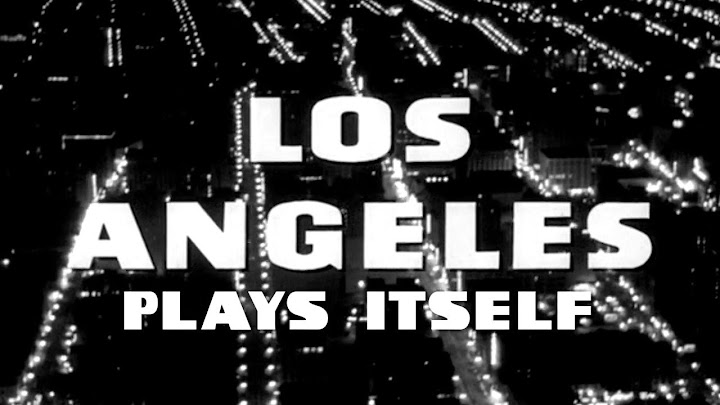
Currently available on Netflix streaming, this almost 3 hour documentary essay presents as both art exhibit and graduate course (it is written and narrated by the sleepy-voiced Thom Anderson, a filmmaker and film theory and history teacher at the California Institute of the Arts). Los Angeles Plays Itself is textually interesting, the visuals of the city’s depiction in film are always entertaining, and accompanied by Anderson’s incisive narration, often illuminating.
Anderson can also be very funny, in a dry “this is Carlton, your doorman” way. On a scene from Michael Mann’s Heat:
[In Heat, Neil McCauley (Robert DeNiro) is briefing two members of his gang. He tells them, “Saint Vincent Thomas Bridge, that’s escape route number one.“] Vincent Thomas was San Pedro’s representative in the state assembly for many years, but he hasn’t been canonized yet, not even in Pedro.
And on the perpetual destruction of LA in the movies:
Mike Davis has claimed that Hollywood takes a special pleasure in destroying Los Angeles, a guilty pleasure shared by most of its audience. The entire world seems to be rooting for Los Angeles to slide into the Pacific or be swallowed by the San Andreas fault. …In Independence Day, who could identify with the caricatured mob…dancing in idiot ecstasy…to greet the extraterrestrials? There is a comic undertone of ‘good riddance’ when kooks like these are vaporized by the earth’s latest ill-mannered guests. But to me the casual sacrifice of Paris in Armageddon seems even crasser. Are the French being singled out for punishment because they admire Jerry Lewis too much? Or because they have resisted Hollywood’s cultural imperialism too fervently?
Of course, if you let an academic talk long enough without interruption or query, he’ll eventually meander into overstatement and grandiosity, and as Anderson moves from LA’s history, architecture, sprawl and patterns in film to politics, race and class, we get poetic broadsides, against the cops and the modern Noah Crosses and skyscrapers. This is all part of the condescension of most any “true” city dweller who presumes to know the authentic heart that beats in his city, and for the most part, that’s part of Anderson’s charm. Anderson has a grievance, as he concedes at the outset: That’s another presumption of the movies: that everyone in Los Angeles is part of their industry or wants to be. Actually, only one in forty residents of Los Angeles County works in the entertainment industry. But the rest of us simply don’t exist. We might wonder if the movies have ever really depicted Los Angeles.
But doleful mouthfuls like “White America had declared a crisis of the black family as a cover for its campaign of incremental genocide against its expendable ex-slave population, rendered superfluous by immigrant labor power, so black film-makers responded by emphasizing families and children” are waiting at the end, so you have been warned.
Though it limps a little at the finish, I really dug this movie, and it is a must-see for any film buff.
I just saw this on the AFI big screen with Will and my nephew in from Spain, Julian. A great holiday classic.
John McClain (Bruce Willis), a NYC cop who is flying to LA to spend some time with his kids over Christmas, drops by his estranged wife’s (Bonnie Bedelia) holiday party in the gleaming high-rise, Nakatomi Plaza. Unfortunately, he arrives just when the party is crashed by a terrorist gang led by the slick and debonair Hans Gruber (Alan Rickman). The terrorists had the perfect plan, but they did not foresee a rogue cop picking them off one by one.
When I first saw Die Hard, I was impressed such an efficient, commercial, cop-against-the world shoot ’em up could be so deft and clever. Most contemporary blockbuster cop pictures were devoid of humor; featured laughable, deadly serious male leads spouting leaden dialogue and women relegated to looking 80s video hot; invariably starred Sylvester Stallone, Arnold Schwarzenegger or Steven Seagal; and sucked. The only outliers were vehicles for established comedians (Beverly Hills Cop) or buddy pics (48 Hours and Lethal Weapon).
Willis, in his first big role, is winning. When the terrorists strike, he is in his wife’s private office bathroom, shoeless and clad in pants and a wifebeater. He’s vulnerable, put-upon and even giddy, and his charm is infectious. He’s the perfect guide.
He’s assisted by an intricate, charming villain. Rickman eschews stock heavy, opting for an amused persona that hides a deeper ruthlessness :
The film also features numerous secondary characters who resonate even with limited screen time. Reginald VelJohnson is the patrolman first on the scene and McClain’s link via walkie-talkie to the activities on the ground, with a tragic backstory of his own; Alexander Gudonov is the number 2 for the terrorists, infuriated because McCalin has killed his brother; Bedelia becomes the de facto leader of the hostages and has a few nifty exchanges with Rickman; and William Atherton (the haughty EPA investigator in Ghostbusters) is a convincing slimy television reporter. Most notable is Hart Bochner, the coke-snorting LA cool cat who works for Bedelia. I always thought Bochner would be a big star and the scene where he tries to “negotiate” McClain’s surrender damn near steals the picture.
Finally, Jeb Stuart’s writing is fresh, cynical and all the more surprising given this was his first picture. Stuart writes for all characters, providing great, unobtrusive repartee.
A banana split, with two pounds of cane sugar dumped on top, followed by a generous ladling of chocolate syrup, dropped in a bucket of melted cotton candy and deep fried in maple butter, then placed on film. That is . . . Love Actually.
The only thing that recommends this monstrosity is Billy Bob Thornton playing an American president as an uncanny mix of Bill Clinton and George W. Bush. Even this brief treat is spoiled by his counterpart, British PM Hugh Grant, who apparently reverses relations with the U.S. solely because he caught Thornton feeling up his secretary.
It’s all too precious. Avoid the tooth decay and bellyache, even in the judgment altering season that is Christmas.
2022 Update: I took a few years off from my annual autopsy of this festering corpse, and lo and behold, the film celebrated a 20th anniversary. I must concede, it never occurred to me that this trite, candied, filmic effluvium could have been worse in an earlier incarnation, but it appears the editors exercised unknown restraint.
That cute kid who learned how to drum and fell in love? Liam Neeson’s darling little urchin? Turns out, as originally envisioned, he was a gymnast, and he was going ballet his way through the airport to greet his love.
This is akin to creating a highly toxic disease that infects the public but then announcing, “Well, before the lab leak, we did manage to contain the flesh-eating variant”.
Um . . . thanks?
Apparently, in test screenings, the mass retching created a significant liability issue, so they cut it.
Prior entries:
2015 Update: Look, this is a gruesome film, substituting true emotion and pathos with a staggering falsity. If you ever met anyone in your life anywhere near as quaint and darling as any of the characters in this bucket of marshmallow and melted gumdrops, it’s likely they are an enemy of the state infiltrating our ranks for a low purpose. Before you feel your heart swoon and your mouth say “awwwwwwww”, run. Run for your damned life.
2016 Update:
Think about how creepy it would be for a person who long-pined for you to show up at your door with cue cards (one of which has semi nude women on it) to reveal his long held love immediately after you have chosen another. Keira Knightley seems to think this is charming, but in point of fact, she should have called the cops. This weirdo is now going to do . . . what, exactly? Go off to Tahiti because mere proximity to his lost love is too much for him to handle? Go to his apartment thinking that his gambit may pay off, that Knightley might think to herself, “Hmmmmmm. He must really love me.” Hang around, quietly watching . . . waiting . . . hoping . . . tinkering with her husband’s brake lines.
This scene is emblematic of this stupid film because it trades a sentimental ball of goo moment for what should have been a larger and more generous gesture. The dude should have simply left Knightley to her new husband and their life, which would have been stoic and laudable.
But nooooooo. Let’s make this icky.
Married women, think of you, at home, newly betrothed for a few weeks, snuggling with your husband. Then, his best friend of decades comes to the door with cue cards and professes his long love for you. Now, remove the gloppy music, the cobblestones, and the holiday lights and Love Actually becomes . . . . Play Misty For Me? When the stalker says, “Enough. Enough now,” I sensed menace, crazy shit going on in his head like the dog haunting Son of Sam’s noggin. Had he gone back in the townhouse and killed them all, it still wouldn’t save this vile film, though it would have been an improvement.
Also, how dumb is the husband? The boom box is supposed to be a substitute for carolers, but it is a professional singer with some harmonists and an orchestra.
Sorry, Keira. The guy you chose is a moron and the one you did not is going to kill you.
Also, one of the loon’s cards says “And at Christmas, you tell the truth.”
Ludicrous. You no more tell the truth at Christmas than on Easter or Arbor Day.
2017 Update:
This year, let’s delve into this kid, so precocious, so darling, and just so articulate!
“Do you really want to know . . . even though you won’t be able to do anything to help . . . the truth is, actually, I’m in love?”
Couldn’t you just eat him . . . . . I mean, eat him up.
The only thing that could make this scene work is if a bunch of shady Eastern European thugs showed up, grabbed the boy, attempted to sell him into white slavery, and Liam Neeson started on the Taken series quite a bit earlier.
Then, this sweetums might know what is indeed worse than “the total agony of being in love.”
2018 Update:
Let’s talk about the secretary, Prime Minister Hugh Grant’s love interest. She is referred to as “chubby” by another aide and she herself explains that her boyfriend “said no one’d fancy a girl with thighs the size of tree trunks.”
First, I can’t believe this kind of fat shaming allows for enjoyment of this film by any decent person.
Second, I really don’t give a rip about fat shaming. But the woman is not in the slightest bit fat. It is a ridiculous conceit. It makes absolutely no sense. She is buxom, one of the few enjoyable aspects of this filmic turd pile.
So, the movie is abusive and retrograde, which I for one will not let stand even at the expense of your enjoyment. Perhaps worse, it doesn’t even know what a fat person looks like. Ridiculous.
2019 Update:
In this years’ entry, let us take up the Martin Freeman-Joanna Page story line. Apparently, these two meet while playing body doubles on the set of a porn flick. This seemed absurd, but I did my legwork. As confirmed by the screenwriterand much of the commentary, they are, indeed, supposed to be on the set of a porn flick.
I have learned about pornography solely for purposes of this review, and be it hardcore or arty soft core, one of the genre’s principal draws to a producer is the low to non-existent production costs.
Yet, by the looks of the sets and the crew and the fact that there are stand-ins for the actors who will be performing the actual sex act on camera, this appears to be a multi-million dollar production.
Worse, not only are Freeman and Page forced to endure an assistant ordering them to shift mechanical poses and pretend to be having sex, he has them do it in the nude, which would seem completely unnecessary, except, and this is a quote, “lighting and camera want to know when we will actually see the nipples”.
Apparently, the “real” actors are cooling their heels in the green room while the stand-ins work to make the shots just so.
So, for purposes of super cute chit-chat, we are presented with two of the most pathetic characters in film history. They won’t even be receiving wages for having actual sex on camera, but rather, the pay will be for standing in and simulating sex for other people who will be simulating or having sex on camera, i.e., the stars!
What could that amount be? A couple of quid?
This is a job . . . okay, it’s not a job, because this premise is so mind-boggling lazy and ridiculous, but were it a job, it is one for meth heads.
It’s difficult to resist a dissipated, alcoholic, and profane Billy Bob Thornton as a Santa Claus who works department stores to crack their safes, especially when he meets an eternally cheerful but clueless grade schooler (Brett Kelly) left alone with his addled grandmother (Cloris Leachman) in their tony Arizona suburban ranch home. In true Christmas spirit, Thornton discovers the boy is essentially alone and defenseless, moves right in, raids the liquor cabinet, and trysts with a slutty barkeep (Lauren Graham) who has a Santa fetish.
Santa is so bad he rips open the kid’s Advent calendar to get at some chocolates. He pisses himself on the job. He beats up children. He engages in sodomy in the dressing rooms of the Big & Tall Women’s section of the department store. He looks in the cherubic faces of all those blessed children who revere him and . . . well, see for yourselves.
Is there redemption for Bad Santa? Kind of. But Thornton is a character who could endure three Dickensian ghosts and conclude, “Eh. Fuck ’em.”
Bad Santa is the ultimate anti-Christmas flick and a holiday favorite. Thornton is brutally acerbic (especially when dealing with a host of bratty kids on his lap), Graham is indescribably hot, and John Ritter and Bernie Mac (as mall security and management) contribute significantly to the humor (Ritter’s repulsion/fascination with Bad Santa is inspired; what a loss he was).
I was alerted to this film by David Thomson’s tribute to its writer, R.I.P. Alan Sharp, a Writer Too Dark for Hollywood. Thomson credited two Sharp films, Ulzana’s Raid and Night Moves: “Neither of them was nominated for anything, and only Ulzana’s Raid did any business. But if you want to experience the richness of American films in the early 1970s, they are worth tracking down. You will be surprised how complex they are and how tense. They seem to understand movie narrative in a way so few films do today: He used mystery to draw audiences into his stories, trained them to answer the small puzzles, and then had them ready to grasp the implications he preferred not to underline. And both films are tough, bitter, and bleak, bearing the imprint of an unusual and talented outsider.”
Whenever we watch a movie from the 70s, my wife sighs and asks, “Is everybody going to die in this one?” Night Moves is indeed a dark film, but Thomson is also dead-on in identifying its allure. Gene Hackman plays a former pro football player turned private detective who is hired by an aging Hollywood not-quite-a-star (a dissipated but crafty Janet Ward) to find her wayward 16 year old daughter (Melanie Griffith, reprising her jailbait, tart role in The Drowning Pool, minus the malevolence). Griffith has taken flight, bouncing between movie sets in Arizona and her creepy stepfather’s (John Crawford) compound in the Florida Keys. In the meantime, Hackman discovers that his wife (Susan Clark) is having an affair, so he is in essence conducting two investigations, only one of which is really private. The picture is leisurely and intricate, until, as Thomson notes, a “deeply upsetting” end.
Hackman turns in an interesting version of the traditional private investigator, part canny but part limited. He is clever, but not the sharpest knife in the drawer. He’s also very human, a vulnerability. Along with Elliott Gould’s Phillip Marlowe in Robert Altman’s The Long Goodbye, Hackman’s p.i. is a marked and welcome departure from the type.
Sharp’s dialogue is noteworthy, especially in some of the exchanges between Hackman and Clark as they confront the state of their marriage and the import of her infidelity. Hackman is also given some wonderful lines:
Ward: Are you the kind of detective who, once you get on a case nothing can get you off it? Bribes, beatings, the allure of a woman…
Hackman: That was true in the old days. Before we had a union.
* * *
Paula: How do you resist Delly?
Hackman: Oh, I just think good, clean thoughts, like Thanksgiving, George Washington’s teeth.
* * *
Crawford: (on his nubile stepdaughter Griffith) You’ve seen her. God, there should be a law.
We were invited to the 50th birthday party of an old friend this weekend, and the theme was Animal House. In preparation of attending as Boon (Peter Riegert) and Katy (Karen Allen), my wife and I watched the movie to identify what they wore in the hopes of being identified as the characters. Our specific goal was delayed by our enjoyment of the movie, which neither of us had seen for twenty years or more. It is sharply written, consistently inventive and enhanced by dozens of astute comic performances. John Belushi’s physicality tends to get the lion’s share of accolades, but I’ve always been a bigger fan of Dean Wormer (John Vernon), who was chosen after Jack Webb turned the part down, and the pot-smoking Professor (Donald Sutherland), who took a $50,000 paycheck instead of the offer of 15% of the gross, a decision I’m certain haunts him to this day (the movie went on to gross $141 million). His plaintive plea to his class is still one of my favorite moments of the movie:
Perhaps the greatest joy in these repressed, politically charged times is its dogged insistence on political incorrectness. Today, there would be a line of $46-an-article on-line ‘zine shitheads excoriating the film for its casual racism, sexism, insensitivity to the mentally disabled, and homophobia. I can see the clickbait banners now:
“Animal House: The Genesis of the UVA Scandal”
“Nearly 40 Years Later, and We’re Still Laughing at Animal Cruelty”
An effective spy thriller, in keeping with the post-Watergate cynicism and paranoia of so many American films (The Parallax View, Executive Action, The Conversation, Winter Kills). Robert Redford is a lowly CIA analyst at a New York City agency front (a historical society) who comes back from lunch one day to find all of his co-workers gunned down. Redford goes on the run, commandeering Faye Dunaway, and as he flees the hitmen (led by Max Von Sydow) and negotiates with the Agency rep (Cliff Robertson), he woos Dunaway and uncovers the reason for the murders. Needless to say, that reason is of the times.
There are problems. Redford can be intense, but he cannot be harried or excitable. As such, he handles some pretty shocking developments in a discordantly world-weary way. As far as the plot, despite all the cloak-and-dagger, it’s very bare bones. The film is also horribly scored, sporting a 70s saxophone that makes the dullest love scene ridiculous. Redford and Dunaway don’t seem to be having sex so much as playing the “who blinks first” game.
Dunaway, however, is quite good, managing to convey a captive’s ability to bond with her captor, and as an Agency “contractor”, Von Sydow is understated and interesting. Robertson is also given respect, even though he’s ostensibly the government baddie. His speech to Redford at the end is a fair defense of the dirty tricks spy trade:
As Director Sydney Pollack noted about Robertson’s character, “I’m much more interested in the CIA guys who are trying to help us and do something [widely considered] immoral than I am about guys who are just immoral because they want to sell dope and make money. That’s boring to me. It’s much more complicated to say, here’s a bunch of guys whose job it is to protect us and they’re saying there’s no way we’re going to sell the fact that the Middle East [states] control the oil and if we don’t get control of the oil and they [seize its production], we’re going to end up with what we have now.” Now, juxtapose Pollack’s view of Robertson with Oliver Stone’s Wall Street creation, Gordon Gecko, who at the height of his megalomania, answers a question as to why he wants to wreck a company with, “Because it’s WRECKABLE!” and you’ll understand why that film travels so poorly.
Pollack also makes great use of grimy 70s New York City – the World Trade Center figures very prominently in the film. More Pollack: “I was looking for the logic of where the [Central Intelligence Agency (CIA)] might be [located]. I didn’t want to have a building that said CIA on it because I didn’t think that would exist. I figured they would want some kind of anonymity and that the best kind of anonymity are these two massive buildings with thousands of offices and you wouldn’t know who’s where.”
My reply: “Nothing is worse than that steaming turd. Osage is a standard, Southern shoutfest, with as much authenticity as Hee Haw. The Family Stone, however, is a pat-its-own-back paen to womyn, disabled homosexuals, showy profanity by people wearing flannel, and New England flintiness. The cancer ravaging Diane Keaton couldn’t come fast enough. I am pleased to say that its writer director didn’t get another project until 6 years after The Family Stone and that was a Selena Gomez joint. Justice.”



 Original review






 filmvetter