David Lynch’s masterpiece is Blue Velvet, but the film produces near physical discomfort, much like Darren Aronofsky pictures, so it serves as a poor exemplar of his work. Like Paul Thomas Anderson’s Magnolia, Lynch’s Mullholland Drive vied to be one of the finest first halves of a film ever made. Then, inevitably, it became laughably obtuse and the whole thing unraveled.
That was in 2001 and since then, it’s been all shorts and documentaries for Lynch. But before Mullholland Drive, Lynch directed his strongest film, a simple story about Alvin Straight (Richard Farnsworth) who takes his ride-on lawn mower to visit his dying brother (Straight’s eyes are poor and he cannot drive a car) in Mt. Zion, Wisconsin. The trip is 300 miles.
Lynch’s film is a testament to the small town communities of the Midwest. Straight encounters nothing but kindness, empathy and assistance, none of it treacly or condescending or self-congratulatory. As nicely put by Roger Ebert, “Lynch’s film is a lyrical beauty, and I cannot remember a picture more true to regular folk.”
There is a scene where Straight shares a beer with a man (Wiley Harker) in a bar. They acknowledge their World War II service and then go to a place that evokes the horror they both encountered. The scene is deeply delivered and is one of the most profoundly moving exchanges I’ve ever seen on film.
Farnsworth was deservedly nominated for an Academy Award for best actor. Sadly, he was suffering from terminal bone cancer during the shooting of this film and he took his own life a year later at his ranch in New Mexico. He could not have chosen a better epitaph than this film.
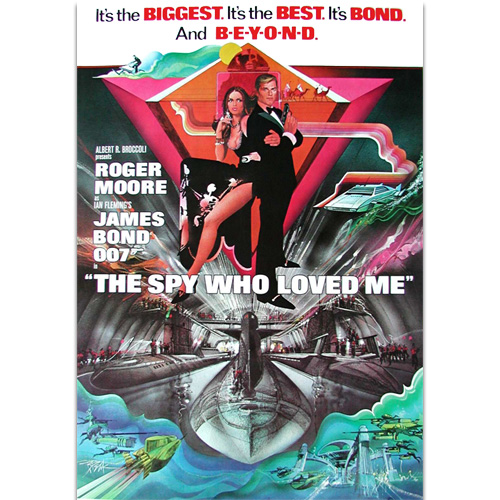
This is the second Bond film I saw in the theater, after Live and Let Die, and it is probably the last of the series that gave us a youthful Roger Moore. By the next installment, Moonraker, the lines had gotten deeper, the hair higher yet thinner, and the bones creakier.
Billionaire Kurt Jurgens (Karl Stromberg) seeks to start a nuclear war between the Soviet Union and the United States, so he can rule a post-apocalyptic world from the sea. Jurgens steals a Russian and American nuclear submarine to his purpose, and Bond and his female Russian counterpart Anya Amasova (Ringo Starr’s gorgeous but not particularly talented Barbara Bach) are dispatched to get to the bottom if it. Unbeknownst to Bond, in one of the few Bond ski sequences that work, he killed Amasova’s love, and she has vowed to kill Bond – when the mission is over.
Many of the hallmarks of a good Bond film are here – exotic locales (such as Asgard Peak in Austria; Egypt, including the Giza Necropolis, Great Pyramids and Great Sphinx; and the cliffs of Sardinia), a first-rate Bond song (“Nobody Does it Better”), and several beauties, including a favorite, the lethal helicopter pilot Caroline Munro-
The film also has an interesting and grandiose villain and a serviceable script. The action sequence when the Soviets and Americans join forces to take on Stromberg’s army is also very exciting and novel.
However, the warning signs for the series first appeared in The Spy Who Loved Me. The pun and snappy rejoinder quotient increased markedly. The use of the cheezy, roving sax to denote the funny or the fanny is prevalent. The introduction of the villain Jaws (Richard Kiel) pushed the story further, into slapstick.
There is simply too much of that and not enough of this:
(though, even here, a meaner Bond is compelled to drop, “You shot your bolt” into the action)
The changes, however, could in no way be challenged at the time. The film cost $14 million to make and grossed $185 million worldwide.
Matt Damon is a law student, loyal to a childhood pal (Edward Norton). They’re poker players, but guided by law professor Martin Landau and gal with the heart of gold Gretchen Moll (all grown up in HBO’s Boardwalk Empire), Damon tries to walk the straight and narrow.
But just when he thinks he’s out, he’s pulled back in! Norton gets indebted to a brutal, track suit wearing Russian mobster (John Malkovich) and he needs Damon to square him.
I’m a huge fan of Matt Damon, and consider him wildly underappreciated. He’s the engine of TheTalented Mr. Ripley and his villain in The Departed is the most interesting and challenging character in the picture. His grieving fathers in both Syriana and Contagion are deeply moving, as is his shell-shocked soldier in Courage Under Fire. I winced when I heard he was cast in the Glen Campbell role for The Coen Brothers’ True Grit, but I don’t know why. He was the perfect blend of haughty and out-of-his-depth.
But make him the hero and the feeling of somnabulence soon washes over you. His Good Will Hunting was the most boring of his pals, Bagger Vance moved golf on film from tiresome to interminable, his Jason Bourne had you stifling yawns even while he was snapping necks, and Eastwood’s Invictus showed he could be pedestrian with a South African accent.
Damon is a terrible choice for the hero in this picture. He’s dull, knows it, and eventually, just gives up. Damon’s blah performance is underscored by the fact that all the other characters are oozing and sweating and doing noir tough.
Thank God for Malkovich. He’s the only thing that save this hackneyed tripe, and the reason for both stars.
Th signature achievement of the reign of John Hughes. During his run, Hughes wrote and/or directed the following teen dramedies– Pretty in Pink, Sixteen Candles, The Breakfast Club, Weird Science, Ferris Bueller’s Day Off, Some Kind of Wonderful, Uncle Buck and Career Opportunities.
Hughes offered a certain corporatized schmaltz and sentiment, and there are worse Hollywood epitaphs. Hughes also provided a silly, devil-may-care ethos for affluent suburban high schoolers (Hughes grew up middle class in tony Grosse Pointe, Michigan) and he could deliver a bravura screwball scene, such as Ferris Bueller’s rock out during a Chicago parade or John Candy crashing a teen party in Uncle Buck. At the end of his films, a trite lesson was always learned, and opposites always came together for a hug of understanding.
Nestled in this treacle, however, was a bit of nastiness fully realized in The Breakfast Club. A group of kids – the geek (Anthony Michael Hall), the jock (Emilio Estevez), the weirdo (Ally Sheedy), the hood (Judd Nelson), and the “it” girl (Molly Ringwald) – all must spend a Saturday in detention together. It becomes a group therapy session, and the archetypes – initially hostile to each other – soon find solidarity in their hatred of the school administrator (Paul Gleason) and the fact that it appears they each have something in common – an oppression at the hands of their cretinous parents. Nelson is burned by cigarettes (given the school, one presumes Dunhills); Hall is so pushed to succeed academically he has contemplated suicide; Estevez is also driven by his overbearing father, and his torture is so great he actually starts to punch himself ; and Ringwald explains her homelife thusly when asked if she can go to a party:
CLAIRE I don’t know, my mom said I was [grounded] but my dad told me to just blow her off.
ANDREW Big party at Stubbies, parents are in Europe. Should be pretty wild…
CLAIRE Yeah?
ANDREW Yeah, can you go?
CLAIRE I doubt it…
ANDREW How come?
CLAIRE Well ’cause if I do what my mother tells me not to do, it’s because because my father says it’s okay. There’s like this whole big monster deal, it’s endless and it’s a total drag. It’s like any minute… divorce…
BENDER Who do you like better?
CLAIRE What?
BENDER You like your old man better than your mom?
CLAIRE They’re both strict.
BENDER No, I mean, if you had to choose between them.
CLAIRE I dunno, I’d probably go live with my brother. I mean, I don’t think either one of them gives a shit about me…it’s like they use me just to get back at each other.
Hall adds: “…I don’t like my parents either, I don’t…I don’t get along with them…their idea of parental compassion is just, you know, wacko!”
Then it is the jock’s turn: “Um, I’m here today…because uh, because my coach and my father don’t want me to blow my ride. See I get treated differently because uh, Coach thinks I’m a winner. So does my old man. I’m not a winner because I wanna be one… I’m a winner because I got strength and speed. Kinda like a race horse. That’s about how involved I am in what’s happening to me.”
Cue the tough, doing his own impression of his house: “(as his father) Stupid, worthless, no good, God damned, freeloading, son of a bitch, retarded, bigmouth, know it all, asshole, jerk! (as his mother) You forgot ugly, lazy and disrespectful.”
The jock rejoins, explaining that he taped a classmate’s ass together. Why? “I did it for my old man…I tortured this poor kid, because I wanted him to think that I was cool. He’s always going off about, you know, when he was in school… the wild things he used to do . . . it’s all because of me and my old man. Oh God, I fucking hate him! He’s like this…he’s like this mindless machine that I can’t even relate to anymore…’Andrew, you’ve got to be number one! I won’t tolerate any losers in this family…Your intensity is for shit! Win. Win! WIN!!!’ You son of a bitch! You know, sometimes, I wish my knee would give…and I wouldn’t be able to wrestle anymore. And he could forget all about me…”
Just to make sure we get the message, Gleason is the biggest prick in the world, an amalgamation of every insecure, bullying teacher in the continental United States.
There’s not a genuine moment in the picture nor a hint of deviation from its blame-shifting orthodoxy.
Hughes has always included some of this foolishness – the parents in Uncle Buck are too committed to their jobs, Alan Ruck’s father in Ferris Bueller’s Day Off cares more for his sports car than his son.
But The Breakfast Club’s attack on the cruel, neglectful parents is the primary theme of the picture and Hughes uses it to portray these five kids (three of whom do appear to be sh**heads of the highest order) as victims.
Look, children can be obnoxious, and teens doubly so, but there is perhaps nothing more unpleasant than encountering a self-pitying teen who bemoans his vaunted station just as he nears the age when lesser forebears were jumping into a hot LZ in Vietnam.
Hughes died recently of a heart attack. He was a bit of a recluse in his later years. I wonder if the stereotype of the suffering, whining rich kid he presented in The Breakfast Club contributed to his distress, either because he was prescient and had to live with it or he felt he had a hand in cementing the mold.
In a Vanity Fair piece after Hughes’s’ death, David Kamp wrote “As hoary as it sounds, The Breakfast Club spoke to a generation.”
Certain films transcend criticism because of the place they hold in the national consciousness. Saving Private Ryan is a forceful, indelible picture with opening and closing battle scenes so visceral I found myself ducking in the theater as a complete stranger in the seat next to me gripped my arm. Shorn of the opening Omaha beach sequence and the fight for the town of Ramell, the film is just north of pedestrian. Robert Rodat’s script is functional but hokey (the constant banter over Tom Hanks’ occupation is an example). The characters – the intellectual, the caring medic, the goombah, the Southern, bible-loving sniper, the New Yahker, the Jew – are unrealistic archetypes. The John Williams score is just so much syrup.
Who cares? The picture means more than its parts and speaks to a certain time and sacrifice. Every American high school kid should be forced to watch the damn thing the next time they bitch about the trials and tribulations of their lives.
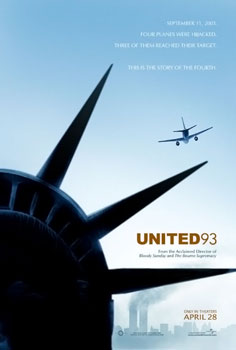
In many ways, 9-11 was much like the day American soldiers alit from their Higgins boats onto Omaha. We were wholly unprepared for the savagery of the attack, we reeled at its success, and then brave and innovative heroes, ordinary citizens all, adapted, driving one of the planes meant to decapitate the government into a field in Shanksville, saving the lives of hundred and perhaps thousands of others. Paul Greengrass’s film depicting that day, however, suffers no flaws and accordingly, does not need to transcend criticism.
Greengrass made his mark with a style blending documentary and drama in his depiction of a 1972 Irish civil rights protest march and subsequent massacre by British troops, Bloody Sunday. As in that film, in United 93, Greengrass keeps us just over the shoulders of the military authorities, the air traffic control personnel, and the passengers of United 93 as the horror of what is occurring dawns on them, paralysis sets in, and then the process of acceptance and adaptation commences. We’re there, but we are not, and we feel thankful for both the intimacy and the remove.
The casting is brilliant. A decision was made to use actors who are familiar but who are not stars. You know you’ve seen many of these people, but they do not bring any recognizable persona, so they feel real. For the passengers on the plane, Greengrass went out of his way to cast actors who looked like the person they were playing. Moreover, he wanted people who had a tie to the project. As explained by Greengrass, “What we did on this film was to gather together an extraordinary array of people wanting to get this film right, aircrew from United Airlines, pilots, the families of the people who were onboard, who gave us a sense of what their family member might have done given the type of person he or she was in any given situation; controllers and members of the military. We had a lot of expertise that in the end allows you to get a good sense of the general shape of events.”
Finally, Greengrass at no point indulges in communicating a larger message. In Saving Private Ryan, Spielberg, as always, just couldn’t trust his audience. He had to have Hanks tell Matt Damon “Earn it” even though the story was told skillfully enough to leave it unsaid. Greengrass is a neutral, not in the ideological struggle of 9-11, but in the explication of evaluating these people at this critical time. The result, for me, was a clearer vision of just how extraordinary the acts of heroism were.
Sylvester Stallone wrote this gem and wisely insisted on starring (possible replacing, if you can imagine, Ryan O’Neal, Burt Reynolds or Robert Redford), leading to many more Rocky movies, and some Rambos, and a dozen other mumbling portrayals. Say what you will about what it spawned, but Rocky is near flawless.
Rocky is a busted up club fighter living in the bleak hell that is mid 70s Philadelphia. He’s a sweet guy, but he is an admitted bum, getting a fight every few weeks and paying the rent by collecting for a local loan shark. We meet Rocky after a sixth round knockout of another bum nets him $40, and he’s just been unceremoniously evicted from his gym by its manager, Burgess Meredith. His best friend is a meat packing cretin (Burt Young) who lives with his paralyzingly shy sister (Talia Shire), who Rocky is sweet on. Rocky’s fortunes change, however, when the champion, a Muhammad Ali figure named Apollo Creed (Carl Weathers), has a ranked contender drop out from a well-promoted fight. Creed fixes on a gimmick – give a nobody – the “EYE-talion Stallion” – a shot at the title.
This is often heralded as the quintessential boxing movie, but boxing is secondary to a moving, beautiful love story between Shire and Stallone, and the portrayal of a Philadelphia so cruel and cold that Rocky seems like its only validation.
Shire is so withdrawn, a character taunts Rocky, suggesting she is “retarded.” She is not, but she is painfully muted. Rocky’s persistence, and the innate sweetness in him, pulls her out. The scenes of their first encounters, and particularly, the scene where he takes her on a first date, are realistic, poignant and heart wrenching. As they come together, you can see that each provides the other a confidence and support they’d never known. Stallone and Shire share a haunting chemistry of losers, and their story really is the movie.
As is the city. Director John Avildsen uses the gritty corners and grimy haunts of poor and working class Philly and the verisimilitude contributes heavily to the drama. Rocky lives in a hell, where folks sit on the cold streets, trash is strewn everywhere, and it is not enough to ignore someone – you must abuse them. So, Rocky’s loan shark boss has a driver who mocks Rocky mercilessly. When Rocky tries to tell a neighborhood girl to get off the streets or she’ll get a “rep,” she responds, “Screw you, creepo” and when he is kicked out of his gym, Burgess Meredith humiliates him publicly.
Of course, when Rocky gets his shot, Meredith, hat in hand, comes to help. The result is one of the most beautiful scenes in Hollywood history:
The picture received 10 Oscar nominations, including ones for Stallone, Shire and Meredith, and it deservedly won Best Picture.
The only fault is the fight itself, which is hampered by fighters who look buff and have some moves (Weathers simulates a nice stinging jab), but unrealistically degenerates into a clumsy brawl. While Avildsen does the best he can with the budget (a mere $1 million shot in less than a month), his interspersing of stock arena footage cannot save the fact that the Rocky-Apollo fight looks very small indeed, and you can see empty seats in the background of various shots of the fighters. Given the budget and the quick pace of filming, these weaknesses are easily overlooked.
There is no more overrated talent in Hollywood than Oliver Stone. His career is supported by the twin pillars of excess and machismo, encased in a childish political ideology that reveres Chavez and Castro but reviles Bush. Three of his films – U Turn, Alexander and W – are mind-numbingly awful, The Doors ends up, like its protagonist, a bloated mess, and even some of his more solid films (Platoon, Wall Street) age very poorly with the simplicity of their characters and binary nature of their struggles. Born on the Fourth of July has its moments, but it’s propelled by Tom Cruise’s sweat glands more than anything else. JFK and Nixon are better, but they are no more than historical cartoons and do not wear well with time either. And why Stone is lauded for the abattoir that is Natural Born Killers has always escaped me.
So, where can a garish, shallow auteur obsessed with manhood and devoid of nuance find his milieu? Professional football.
Al Pacino is the coach of the Miami Sharks, world-weary and past his glory (in Any Given Sunday, you win Pantheons, not Super Bowls, and Pacino has won 3). His mentor, the team owner, is dead, and the franchise is now run by the owner’s daughter, Cameron Diaz. His star quarterback, Dennis Quaid, is breaking down, and after a mid-season injury, Pacino must rely on a selfish, gifted third stringer (Jamie Foxx). Pacino must teach Foxx how to run the team, to leeeaaaaaddddddd, and in the end, how to become a better man. As he does it, a whirlwind of images (Lebaron, Lombardi, Tittle, Unitas) whoosh by, and then there is lightning and thunder claps. It’s pretty heady and kind of exciting if you don’t dwell on how stupid this all is.
Stone doesn’t give you much time to dwell because the picture moves like a freight train even while capably handling numerous subplots. There’s the star linebacker (Lawrence Taylor, who does a fine job), literally one hit away from paralysis, yet one tackle away from a $1 million bonus. There are the team doctors (James Woods and Matthew Modine) who square off because Woods lets the players play with dangerous injuries and Modine objects. There is Quaid and his driven wife (Lauren Holly) who will not give up her throne as the quarterback queen, even slapping Quaid when he suggests he might have to retire because of injury. LL Cool J is a the selfish RB, all about “getting mine” and Aaron Eckhart is the whiz kid offensive coordinator, stunted under the old school style of Pacino.
We get games in monsoons, whiz-bang on field collisions, gruesome injuries, frenzied and ferocious linemen, hot Miami chicks galore, perfect spirals, and more. There is also a hell of a pep talk by Pacino, alternately absurd and inspiring–
Beyond the speeches, there are nice exchanges in the script, such as this one between Foxx, who is just starting to show his chops, and Pacino, where Foxx explains the other side of the schmaltzy, “no I in TEAM” crapola
FOXX: You can feed the press that whole sacrifice and glory-of-the-game crap. But I been there. I seen a long line of coaches… with that same old bullshit halftime speech … You know it’s bullshit because it’s about the money. The TV contracts, fat-cat boosters in the skyboxes. Coaches trying to up their salaries. You looking for the next black stud to take it to the top 10. Get you in a bowl game. It’s the same way in the pros. Except in the pros, the field hands get paid.
PACINO: Don’t play that race card on me, kid. 25 years I work with men of your color.
FOXX: Maybe it’s not racism. Maybe it’s placism. Brother has to know his place. Right, boss?
PACINO: I don’t understand what you’re talking about. You don’t trust anybody because of what happened in college? You knew the rules. You were the one that broke them.
FOXX: How did I break them? How? I lost a million-dollar signing bonus because I took a $300 suit from a booster to go to a wedding. What’s a brother supposed to do in college? He ain’t got money. He wants to go out on a date. Wants to get some nice clothes. Everybody had their hands out but it was me they suspended. I dropped six rounds in the draft because of that. The coaches labeled me: “He’s trouble. He don’t wanna play ball.” You talk about sacrifice. I sacrificed $10 million because dumb rednecks like the coach in San Diego made me a cornerback because I got quick feet. He separated my shoulder tackling 250-pound motherfuckers. I don’t do that! I was a great football player. But nobody let my shoulder heal, and they traded me out of there.
PACINO: You go ahead. Blame everybody but yourself.
FOXX: Whatever.
PACINO: Because that’s what a leader’s about. Sacrifice. The times he’s gotta sacrifice because he’s gotta lead by example. Not by fear and not by self-pity.
FOXX: Who you think you’re talking to? Half my career is over and you want me on the bench.
So, I like this film very much, and I like it even more every time I see, which never happens with Oliver Stone flicks. That does not, however, mean it is a good film.
For example, Oliver Stone cannot write women who aren’t whores or connivers, but at least here, he concedes the point and just makes Diaz a mannish ballbreaker. Her character is the most macho one in the film, which is not a good thing.
Stone also could not or would not get the rights to use actual NFL franchises/logos. I’m sure the cost was prohibitive or perhaps the NFL didn’t really want its brand tarnished. But if you’re going to make up teams, the Dallas Knights need to have uniforms a little less ridiculous than this:
“I shall tackle thee, m’lady”.
Stone also casts himself as a sports announcer so he can say “Holy Cow!” or “What a play!” But Stone does not have “the voice” and he sounds like he’s eating sunflower seeds. It’s not as bad as Spike Lee playing a reporter in Summer of Sam but it is pretty bad.
The theme is also oppressive. Men and lost fathers are everywhere. Foxx is fatherless, Pacino lost his in WWII, Quaid is a little boy in Pacino’s hands, Diaz was the son her father never had. All of this is served in one big syrupy ladle.
Last, in the final game, a dude’s eyeball is knocked out of his head. Come on.
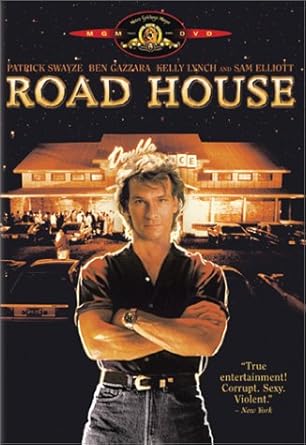
A small town is run by the ruthless Ben Gazarra, who shakes down the local businesses to support his decadent lifestyle. He lives in the gaudiest mansion, and he is surrounded by a thick, loyal squad of yokel goons. He also has a few 80s trashy blondes in his coterie, like Julie Michaels–
Interesting note on Julie. Roadhouse was her debut. In her subsequent roles, these were the names of her characters: Naran Anie, Professor, Professor (uncredited), Accident Victim, Accident Victim (uncredited), Sandy, Mom, French Patron (uncredited), California Blonde, California Blonde (uncredited), Pedestrian, Female Bar Patron #2, Barrista, Fashion Show Patron, Florist, Slutty Woman, Female Fan, Julie Mermaid mother, Harem Girl (uncredited), Groupie (uncredited), Female Club Goer, Maggie, Woman on Bike, Laundry Wife, Marilyn Monroe #2, Catherine Moore, Caitlin’s Sister, Frat Girl, Woman (uncredited), Vampire, Jane (uncredited), Catherine, Tami, Sillicate UC, Cage Dancer, Agent Elizabeth Marcus, Susan, Irene, Waitress, Waitress (uncredited), Amy Cutler, Freight Train, Susie Q, Cinnamon.
I digress.
One business won’t knuckle under to Gazarra – The Double Deuce. Instead, bar owner Kevin Tighe calls in a zen master bouncer with a degree in philosophy (not joking – the script references that the professional bouncer has a degree in philosophy from NYU). That bouncer is Dalton (Patrick Swayze) who stands up to Gazarra, calls in a bouncer compadre (Sam Elliott), cleans up the bar and the town and says all of the following:
“Pain don’t hurt.”
“Nobody ever wins a fight.”
“My way… or the highway.”
“All you have to do is follow three simple rules. One, never underestimate your opponent. Expect the unexpected. Two, take it outside. Never start anything inside the bar unless it’s absolutely necessary. And three, be nice.”
“Take the biggest guy in the world, shatter his knee and he’ll drop like a stone.”
“You’re too stupid to have a good time.”
“It’ll get worse before it gets better.”
Roadhouse also features Kelly Lynch, the emergency room physician who patches Dalton up.
The year this picture came out, she was in Drugstore Cowboy. I wonder which film she is most proud of? Regardless, I’ve had stitches like 5 times and there’s never a Kelly Lynch at the emergency room. Ever.
By now, Roadhouse has become a cult classic, but when I saw it, I knew it was something special taken at face value, no sniggering. To this day, I can’t stop watching it. It’s an awful film, and the inquiry should end there, but there is such earnestness in the effort that at 2 am, having just had 5 beers and a half bag of gummy bears, when Swayze says
“I want you to be nice until it’s time to not be nice.”
I’m like, “Hell, yea. Dalton. That’s some heavvy ass shi**!”
I’m not much for sports hokum. The elegiac bunk of The Natural, Field of Dreams, or even Any Given Sunday reveals more about the filmmakers’ insecurities than the game being played and the characters who play it. But even I am not immune from hokum anchored by Gene Hackman and based on the true story of the 1954 Indiana state high school basketball champions from tiny Milan.
Hackman is the new coach with a dark past, bringing a fundamental style of play and stubborn ways to a cloistered small town that does not want him. Barbara Hershey is the teacher leery of his influence. Their conversations about what constitutes success are smartly written (she loathes the small town, plans the escape of her students and views Hackman’s” hoop dreams” as an anchor keeping young men from getting out). Dennis Hopper is the alcoholic assistant coach, redeemed in the eyes of his player son as the team battles adversity. David beats Goliath, and the music swells along with the heart.
The performances are all strong, and the casting of the fresh-faced team is perfect. The boys, town and milieu feel 1950s, as does the play, and the boys can play. One only needs to watch the overrated White Men Can’t Jump to realize the foolishness of casting non-players; Woody Harrelson is passable, Wesley Snipes ludicrous. The film is also chock full of inspiring and exciting vignettes as the boys march forward to victory.
Hackman is commanding, in his sparring with Hershey, when he confronts the team’s star player, who is in the middle of a 1950s version of a holdout, and in his handling of the overbearing townsfolk. I also like his simple, homespun speeches:
Ah, Bobby Knight.
This one is better:
There are a few problems. The love affair between Hershey and Hackman seems both improbable and awkward. I no more want to see him kiss a younger woman than Tommy Lee Jones. The score is also very 80s, stirring but techno infused. But it’s still one of the better sports films made.
Barry Levinson’s 1982 classic about a bunch of young guys in 1959 Baltimore is not only a brilliant ensemble period film, but it heralded a new form of comedic art. The film is best explained in this Vanity Fair piece , which I highly recommend and which makes any substantive review on my part superfluous —










 filmvetter