
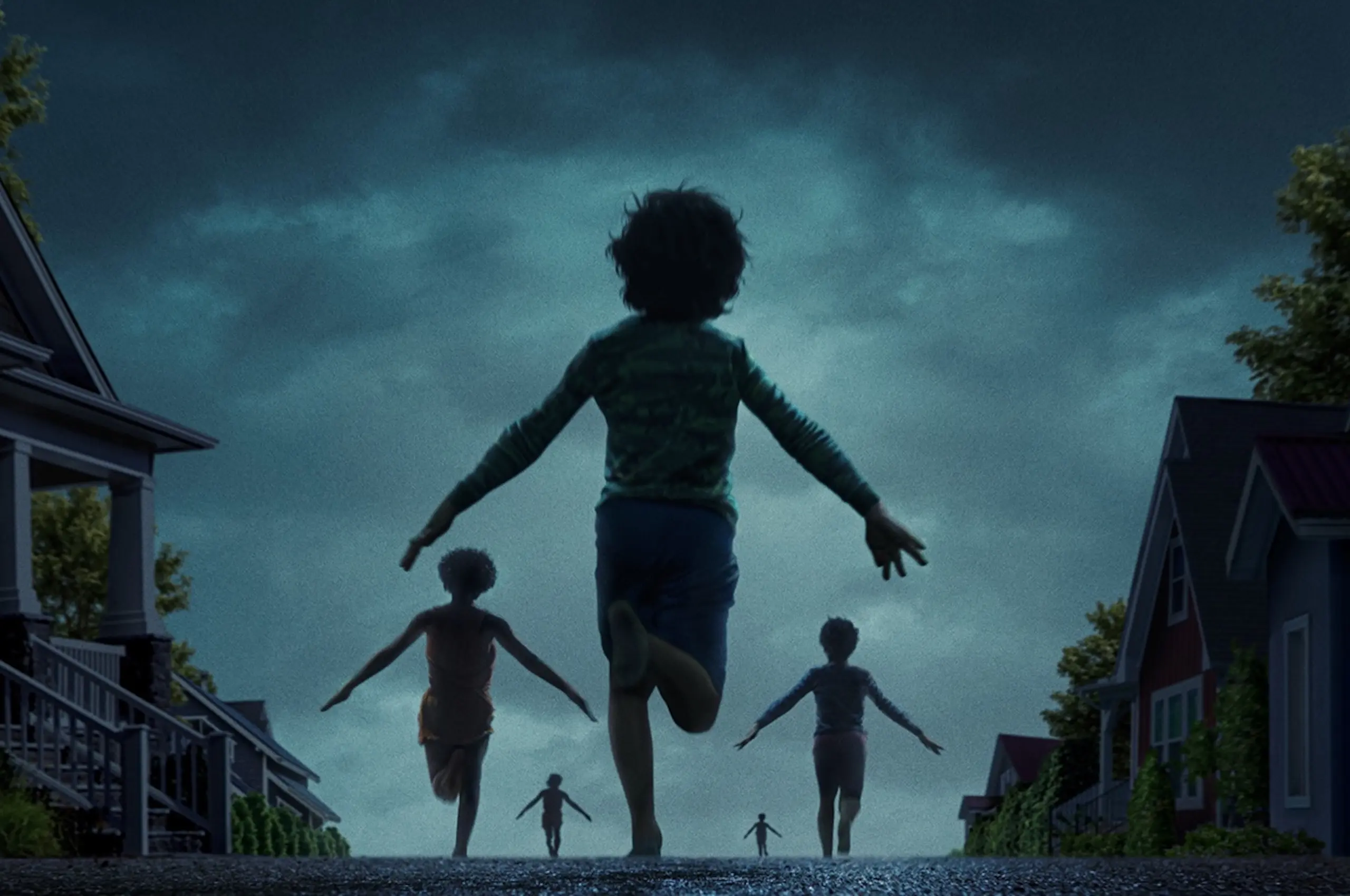
At the outset, you are entranced. Like a scary campfire story, a child’s voiceover explains the disappearance of a group of grade school children in a mid-size Pennsylvania town. One night, they alight from their beds simultaneously, leave their houses, and simply … disappear. All to George Harrison’s Beware of Darkness, a haunting, beautiful tune, pitch perfect to the moment, reminding you just how important good music is to a movie. It is one of the more impressive film openings I’ve seen.
As I mentioned in an earlier review, I suffered from night terrors as a child, which were, unsurprisingly, terrifying. But I also had spates of sleepwalking, and as I saw the children rise and go off into the night, it brought back the visceral feel I had of being that age and traipsing in bitter cold around the block, barefoot, impelled without any autonomy, until I simply drifted back in my house, or that of a neighbor, and went back to a bed, feet dirtied and maybe a bit bloodied, but otherwise not worse for wear.
The children here are worse for wear, and on that, I can say no more. But we learn their fates through an ingenious approach. Writer-director Zach Cregger (Barbarian) recapitulates the event through the lens of six people – the schoolteacher, a father of one of the children, the school principal, a town police officer, a homeless criminal/drug addict and the one child from the class who did not disappear, offering clues and different vantage points that enhance the story.
I was impressed by Barbarian, and as in that picture, Cregger captures the spooky qualities of the mundane. There, it was decrepit Detroit. Here, it is a hamlet in Pennsylvania, though it could be any town USA exurb. Without being showy, Cregger can make a convenience store, a non-descript alley or even gas station pumps vaguely threatening.
Cregger also has a way of writing like people speak. Stephen King film fare is generally situated in small town venues much like this, and almost always accompanied by dialogue so painfully obvious and hackneyed – be it from the town drunk or floozie or sadistic bully or chummy mayor – you shudder, not from fear, but embarrassment. Cregger is comfortable with the natural exchanges of colleagues, lovers, neighbors, and enemies. His dialogue between the principal and the teacher is an apt example, as he expresses his frustrations with and care for her, and she manipulates him all the same.
Nor has Cregger lost the sharp sense of humor from Barbarian, which is interwoven in the everyday patter of the characters. His final scene is a melange of unbridled terror and tension-cutting, roller coaster ride slapstick.
The performances are solid. Josh Brolin is moving as a bewildered father who yearns for his son and just can’t wrap his head around it. As the teacher, Julia Garner is unnerved yet refreshingly feisty, not just willing to lay down and be the town’s sacrificial lamb. She’s no angel either, a bit of an unlikeable pain in the ass, which adds heft to her persona. There is also a bravura turn from a near-unrecognizable Amy Madigan (kudos to me for sussing out that under quite heavy makeup, sure enough, that was Uncle Buck’s girlfriend, Chanise).
So, why the half point deduction?
I am not going to call the picture out on a Longlegs critique, a film that was all feel and little sense. Weapons does not strain credulity to the point of eye-rolling. For the most part, Cregger circles the squares, and he maintains such a taut, engrossing pace you don’t dwell on impracticalities. Nor is the town one where kids are disappearing on a regular basis, yet people keep populating it and settling down, as in King’s It. This is a one-time event.
That said, there is a glaring hole, and please stop here and return to read later if you intend to see the movie.
**SPOILERS”
It’s not just a few kids who go missing. It is 17, all from one classroom, in one night, at 2:17 a.m. When we arrive on the scene, the crime is still fresh, having occurred a mere month or two prior. While Cregger nods to a town in upset, as well as a comprehensive police investigation that, to date, has found nothing. this case would have been bigger than the Lindbergh kidnapping, and the den of the malefactor would have been torn to pieces in a New York minute. Even if nothing was found, the place would have been surveilled 24/7 by anyone from the feds to local p.d. to state police to investigators hired by the parents to the National Guard.
Cregger should have dropped the number to 3 or 4 kids, ala’ Picnic at Hanging Rock and extended the time period between the event and the resolution. A reward poster for a paltry $50,000, is a bad moment, but not as bad as when the weary police chief acts sympathetically but put out by Brolin’s badgering about the case.
Had Cregger set this film pre-internet, at a time of more rudimentary forensics and no Ring cameras, a lot of the film’s troubles are solved. But no one asked me.
Eh, ignore my kvetching. It’s a really great flick.

 filmvetter