
Archive

Monthly Archives: September 2012

I’ve had the misfortune of watching this movie twice (I endured it because I remembered a better film).  Mel Gibson had his own cut, which was better than that of director Brian Helgeland (screenwriter for LA Confidential), though still pretty bad. The picture is a loose remake of John Boorman’s 1967 Lee Marvin vehicle Point Blank. The story is uncomplicated. A crook (Gibson) pulls of a heist, is double-crossed by his girlfriend and partner and left for dead. He does not die, but returns, to collect his share of the money. It turns out his partner used that share to buy his way back into “the Syndicate,” so Gibson works his way up the chain, killing folks up a higher level of authority until he gets to the top. The original was arty, tough and noir, and Marvin’s anger convincingly propelled the simplistic plot, which culminated in a cool shoot-out in then-abandoned Alcatraz.

Gibson’s version exchanges San Francisco for Chicago, tough for brutal, and noir for ostensibly hip (which, as defined by Gibson, is taking every opportunity to smack women and crunch bones). While Gibson throws in a touch of humor in the plot, his performance is leaden. He emulates Robocop and The Terminator, not Marvin.

Gibson’s version ends better (he uses a kidnap of the top Syndicate man’s son to get at him, while Helgeland settles for a lame shoot-out on a Chicago train platform), but it’s a pointless endeavor. The only redeeming qualities are some wry performances as criminal lowlifes by Gregg Henry, James Coburn, William Devane, John Glover, David Paymer and Lucy Liu.


It ain’t nearly enough.
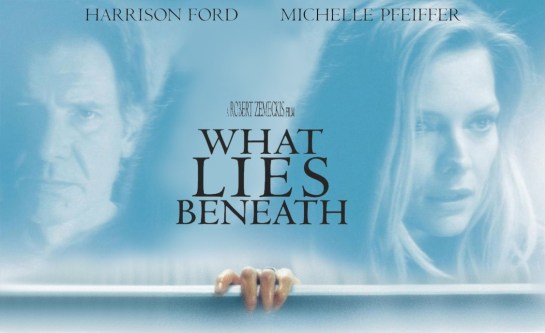
What Lies Beneath Was All Wrong. What Lies Beneath is the type of film… |  by Brett Seegmiller | Brett Seegmiller | Medium

Robert Zemeckis’ ghost story is both an homage to Hitchcock and a vehicle for the director’s visual audacity (or, if you’re harder on Zemeckis, gimmickry). There’s little new in this old-fashioned haunted house tale, but what is presented is solid and entertaining.

A beautiful, vulnerable Michele Pfeiffer lives with her researcher/scholar husband (Harrison Ford) in a New England college town, their home a picturesque waterfront exemplar from Architectural Digest.  Pfeiffer has just dropped her only child off at college and is in the midst of an empty nest crisis.  Worse, she’s recovering from a car accident a year prior and she believes her new neighbors’ marital woes have escalated to the husband killing the wife (she even believes she sees the husband disposing of the body, much as Jimmy Stewart saw Raymond Burr covering up his foul deed in Rear Window).  What better to harass this fragile woman than a spirit attempting to communicate with her?

Zemeckis does a nice job of interweaving a few plot lines, and he produces some genuinely creepy moments.  But the film has flaws.  First, Zemeckis so distrusts the audience’s ability to follow the plot he over-lingers to focus our attention on a fact or clue.   So, in his work, Ford is working with a drug that immobilizes while the subject maintains consciousness. I wonder if that will come into play later?  Second, Hitchcockian is one thing, but a replica is quite another. By the end of the film, the score is a mash of Bernard Hermann and the tribute so unrelenting, Mel Brooks’ High Anxiety comes to mind.  The movie is also overlong, piling reveal scenes on top of each other, replacing tension with exhaustion.

The virtues, however, outweigh the negatives.  The film mostly moves briskly, there are genuine scares, and the characters, while a tad humorless, are engaging.  Pfeiffer is an effective mix of emotional fragility and upper class angst, and Ford is a surprisingly sympathetic villain.  Indeed, Pfeiffer comes off as spoiled and becomes so unstable, you find yourself siding with the seemingly reasonable Ford, who fairly suggests his wife is punishing him in a passive aggressive manner with all the ghost nonsense.

Solid.

marjorie nugent

Richard Linklater offers the story of Bernie Tiede (Jack Black), a gay mortician who companions a significantly older woman, Marjorie Nugent (Shirley MacLaine) and then, in a fit of rage and exasperation at her domineering ways,  shoots her in the back and stuffs her in a freezer, pretending she is still alive (not ala’ Norman Bates).  Tiede is the town Robin Hood, the town being Carthage, Texas, and in many ways, Carthage is the star of the film.  Linklater uses very few professional actors, instead interspersing the dramatic narrative with interviews of real-life Carthage citizens, almost all of whom are squarely on the side of Tiede, and almost all of whom are hilarious.  To them, Nugent was a nasty, wicked old wretch and Bernie Tiede was the man who bought you a nice gift, sang the beautiful song that escorted a loved one to the hereafter, directed the town play or just gave you a nice wave everyday.  And he was driven to it.

Of course, in the presentation, Linklater neglects a few ugly details of the real life Tiede (not all of the vast sums he spent of Nugent’s wealth went to charity), but it appears the basic premise is true – Tiede was well-loved and Nugent well-hated (her own nephew observed, “‘Bernie’s not the first one who thought about killing her.  He’s just the first one who went through with it”).

Black is mesmerizing as Tiede, hilarious, hapless and harried, but uncontainably sweet and just a  little guilty (even before the murder).  MacLaine is effective as an old witch and Matthew McConaghey is amusing as the dogged D.A.  But the stars are the real people of Carthage, who Linklater neither mocks or mythologizes, wisely letting them be.

My only criticism is the choice to make Tiede so sympathetic.  Black does a great job in keeping him from being saccharine, with occasional flashes of guilty pleasure at his newly found wealth, but Linklater keeps away from any real dark heart, opting for a feel-good film.  Which is fine, but I think it could have remained feel-good and still been a little more revealing.

My boy read that The Expendables 2 had gotten decent reviews, we both appreciate a good shoot ’em up, and The Expendables was available streaming on Netflix.  We made it about 30 minutes in to this star-studded, macho story of a group of mercenaries bound together by brawn, honor, anabolic steroids, and in some cases (leader Sylvester Stallone, rival Arnold Schwarzennegger, and tattoo artist/operation facilitator Mickey Rourke), plastic surgery. 

We couldn’t understand Stallone, Rourke or Schwarzenegger half the time, the action was unimaginative, and the banter was either painful (Randy Coutre of the UFC is given lines instead of grunts, and the results are not pretty) or uncomfortably homoerotic.  This not-safe-for-work clip begs the question – are these guys gonna’ fight or kiss?

But what do we know?  Domestic and foreign, it grossed a quarter of a billion dollars.

Like Any Given Sunday, a bad movie that is occasionally engaging but makes you feel guilty for being engaged, Oliver Stone’s The Doors is indulgent, dizzying and vapid. The caricature of James Morrison invades Val Kilmer, who gives an embarrassing, showy performance.  Kilmer’s idea of Morrison is little more than a faraway stare and a lycanthropic lope.  So perpetual is Kilmer’s saunter that he presents less Lizard King, more inebriated catwalk model.

The film almost stops dead in its tracks a third in with a ridiculous overlong band “trip” to the desert for some peyote and pretentious native American b.s. The Doors emerge from this interminable detour performing a live version of a song as silly and overlong as the movie, “The End.”  All time taken away from the only story you want to see about a marginal rock talent: rise to fame, drugs, booze, chicks, and then, crash and burn.

Stone is so enamored of his subject he not only photographs him lovingly, he actually takes the singer’s poetry seriously.  Morrison is such an obvious talent Stone felt he could dispense with any back story for him.  We don’t know much about his early life (except he once saw a dead Indian by the road during a family trip) because Stone is in such a hurry to show us this avant garde pioneer, a guy who riffed “mother, I want to f### you” right into the director’s heart.

We get a few fun moments, snapshots of nostalgia from the 60s, like the Ed Sullivan performance.  But even that has to be gussied up and romanticized. The Doors were asked to forego the line “girl we couldn’t get much higher” from their hit, “Light my Fire.” They happily did so in rehearsal, but during a lethargic live performance, Morrison forgot and sang it.   Not good enough for Stone.  In the film,  Kilmer lectures the band on kowtowing to “the Man” and then belts it out as a taunt just to show those suits what for. Then he starts hip swiveling, sending lily-livered execs into apoplexy.

As Morrison descends into the fat, bloated bore he would become, visions of a dour Indian pop up.  In the desert.  During gigs.  Even before meeting Andy Warhol (portrayed by Marty McFly’s father).  When unintentionally funny imagery isn’t on screen, the picture is a crashing bore.  Morrison always was a pompous dick and a medium talent at best.  He never really merited the Stone treatment.  Or maybe that is exactly what he deserved.