Archive

Monthly Archives: February 2012

A Simple Plan | Rotten Tomatoes

Sam Raimi’s Fargo without the sweep, innovation or strong characterizations.  It settles for snow and violence.

Three men, two of them brothers (Bill Paxton, Billy Bob Thornton) find money. They try to keep it. Things go terribly wrong.

Thornton was deservedly nominated for best supporting actor. He plays an alternatively canny and dimwitted local yokel who unravels as the heat increases. Thornton captures perfectly the essence of the childlike, simple brother who stays home to drink with his dog, immersed in something beyond his capabilities by his smarter, greedier brother (Paxton).

Unfortunately, Raimi’s direction is workmanlike and forgettable. In the end, however, the script sinks the ship. Paxton is dumber than a hound’s tooth. Worse, he is singularly uninteresting and he is the protagonist we are forced to follow, more so than Thornton.

Bridget Fonda plays his greedy wife, a transformation that takes her over in a millisecond.  In fact, it would be hard to cast two thinner actors than Paxton and Fonda.  Perhaps this was the strategy, to show everyday folks turned to greedy dullards, but dullards are dullards.

The plan simply wasn’t simple enough for these snoozers.

Coen brothers confirm Fargo is a true story after all, or at least based on  some | The Independent | The Independent

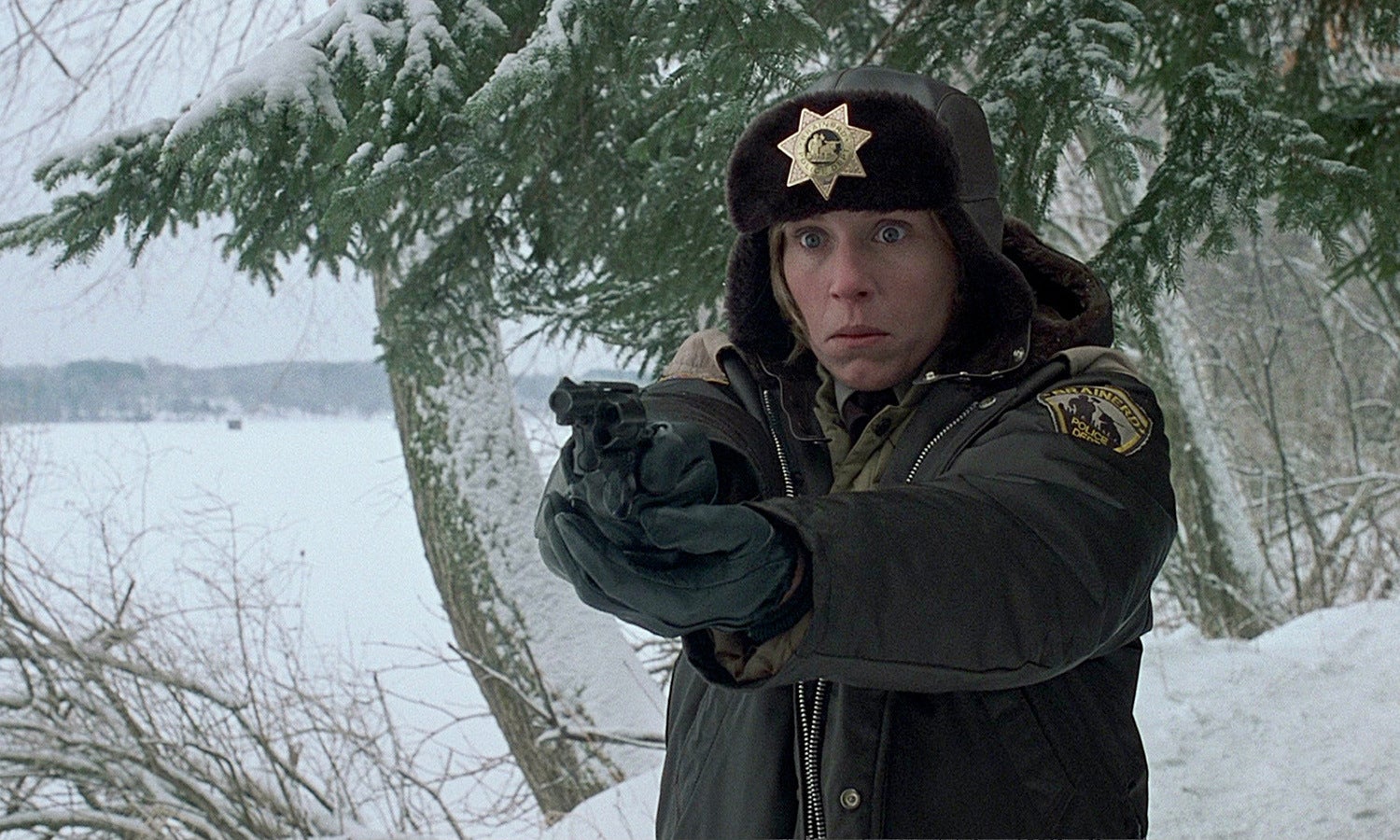
One of the best crime movies ever made, deservedly on AFI’s list of the top 100 films (no. 84). This is the Coen film that brought flesh-and-blood characters and a cinematic theme eclipsing their technical skills.

Fargo is about American crime. The ridiculous crime you read about in newspaper blurbs. The Coens offer a rich explanation behind “Man Found Shredded in Wood Chipper” or “Couple Carves Fetus out of Young Woman.” But while the story is mythic (aided by Carter Burwell’s memorably dark score), the characters are not mythical. William H. Macy is a scared, little man who wants to make his mark, gets in hock, and cooks up a scheme to have his wife kidnapped and ransomed. The kidnappers (Steve Buscemi and Peter Stormare) are ignorant and brutal, sharp, cunning animals who subsist on the reticence of victims to respond. That they will resort to violence is never in doubt. They are criminal through-and-through, of the type depicted in In Cold Blood or One False Move or, for a truer example, in occasional “Real Live Video” shows. The killers in Fargo remind me of a true video I saw of a carjacking, which was filmed from inside the car. The “carjackee” is an undercover cop, and he tries to calm the carjacker down to give the police time to swoop in. The carjacker will not be assuaged.  He is a vicious animal, constantly pointing his gun at the undercover cop, threatening to blow his head off. Up until the moment the police swoop in and disarm him, the criminal is a beast. Immediately upon being disarmed, however, the carjacker is all, “It’s cool, it’s cool.” He’s smiling. He’s reasonable. He’s a completely different person, almost in a prep mode to appear more deferential and misunderstood.

Here, the Coens show something rare in crime films – they show the killers in everyday, mundane life, as driving companions, as drinking buddies, as guys picking up chicks at a bar, or holed up watching TV and waiting for the money. Then, after we laugh at or with them and become more comfortable with their demonstrated incompetence, the directors show us their vicious sociopathy. Quickly, their first instinct when pressured is to kill, and they do it without remorse or reflection. They eventually turn on each other, and it is Macy who let loose these furies through his mind-numbing weakness.

Their foil is Frances McDormand, a pregnant sheriff who has a simple uncomplicated sensitivity and a very clear, tough line of right-and-wrong. She still doesn’t understand Stormare, who, at the end, sits forlornly in her squad car:  “There’s more to life than a little money, ya know. Don’tcha know that? And here ya are. And it’s a beautiful day. Well. I just don’t understand it.”  That’s enough for her.

What McDormand exudes, unlike the tortured Sheriff played by Tommy Lee Jones in the Coens’ bookend film No Country for Old Men,  is that she really doesn’t care to understand it. She’s not interested in giving a Stormare the time to think about his motives, his beginnings, his modified persona as a captured animal. He’s an animal, she knows it, and she moves on.

In this way, I also think Fargo is a uniquely American movie, a window to a culture that champions individual rights yet accepts the death penalty. That’s nifty work, one that keeps you interested in the criminals, but does not elicit anything more than the most base sympathies (though it is hard not to feel somewhat bad for the hapless Buscemi as he tries to hide money with a bullet in his face).

Forgetting Sarah Marshall harmonizes the best of The 40 Year Old Virgin and Knocked Up while jettisoning some of the excesses of the latter.  Jason Segal retreats to Hawaii to get over being dumped by his girlfriend, Sarah, who just happnes to be vacationing at the same resort with her new flame, Brit rock star Aldous Snow (Russell Brand).   All the characters are a scream, from Paul Rudd’s crunchy surf instructor to Bill Hader’s supportive friend, but this is Brand’s movie and he absolutrely kills in every scene.  He’s so good that when he’s not in a scene, the movie can drag a bit.

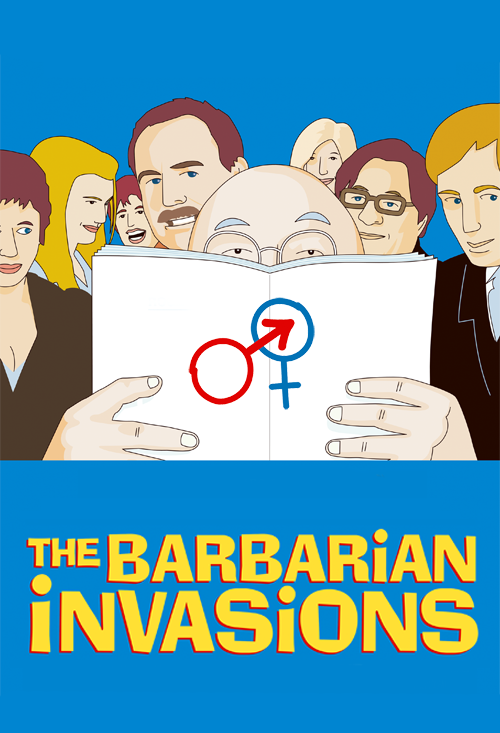
The Barbarian Invasions ("Les Invasions Barbares") - Official Site - Miramax

The story of a sensualist, leftist, Canadian professor who abandoned his family. He lays dying in the misery that is a hospital in the Canadian health system (“I voted for Medicare, and I’ll accept the consequences,” he declares). His money-trading capitalist son flies from London to ease his father’s death, bribing the inefficient hospital staff (while one floor is Calcutta, the one below is empty), its corrupt union, and anyone else who can make his father more comfortable. The son gathers the father’s friends and procures him heroin for pain medication. He does it without a whisper of his method, and the father feels free to casually dismiss his child’s success.

In the midst, planes strike the World Trade Center and a television commentator proclaims that it is the first of the barbarian invasions.

Why this image in what is otherwise an affecting and funny family drama? Because the film has more than political overtones and jabs.  David Edelstein writes that the director’s first film, The Decline of the American Empire (1986) suffered from “neocon gloating.”  I haven’t seen it, but The Barbarian Invasions plays as a wholesale assault (by velvet glove) on the excesses of modern liberalism. Socialized medicine is a hell. The union is a crime syndicate. Sexual expression and lack of fidelity breed disaffected children (the London son was estranged, as was his sister, who is away on a boat in the Pacific, and the daughter of a another sexual libertine is a heroin addict who does not speak to her mother). The father’s professor friend boasts of his trophy wife, but that trophy shows its sharp stripes when she angrily objects to the lending of their cabin for the father’s last dying days because it was made part hers after her endless suffering “at the Ikea.”

Yet, when death knocks, the family, such as it is, coalesces, almost in spite of the blows it has taken through the years. Family is family, the bedrock, and there is refreshingly not one, “You weren’t there for us, Daddy!!!!!” extended rant, though an American equivalent would have ten such scenes. Once, upon arriving from London, the sons snaps. It is portrayed as his weakness, and it lasts the 5 seconds he needs to compose himself in front of his ill father (even then, he does not know the father is dying).

Two vignettes are the heart of the film.  First, the father’s coterie are all academics, and they reminisce at how many “isms” they embraced and discarded. The father then tells the story of his trip to China, where he relayed his respect of the Cultural Revolution to a Chinese academic he hoped to bed. She froze, and the father recounts how she relayed the deaths and tortures suffered by her family in that glorious revolution. 

Second, the son’s wife, an art dealer, is sent to a church to inspect religious artifacts.  She declines (the Americans have taken all the good stuff) and a forlorn priest motions to figurines of Mary, Peter, and Christ, in a dusty, cobwebbed basement, asking “So, this is all worthless?”

Capitalism, however, is by no means faultless. The son buys everything, including the attendance of his father’s former students to pay their respects. But the film is political, a strong denunciation, not just of the excesses of modernism, but of leftist, Western liberalism.  And even if you don’t get that message (I can’t imagine the Academy, which nominated the picture for Best Foreign Film, did), it still triumphs as a beautiful story of family and friends re-converging for a humane goodbye to a flawed man.

Babel.  A self-important message picture, the message being, “If you are an illegal alien, you shouldn’t take your employer’s kids into the Mexican desert” or “If you’re having trouble with your wife, don’t think a tour bus trip through hot and unpleasant Morocco will help matters” or “You are so hot when you pee in a bucket.”   The picture is boring and over-hyped, ostensibly about big issues, and therefore, the Oscar nomination is explained.

The Wrestler.  Depressing and not really much above a standard “I’m just a broke down piece of meat so I need to re engage with my daughter and dance with the stripper with a heart of gold” tale.  It’s gritty, bloody and dark, but not really all that interesting.  Darren Aronofsky (Requiem for a Dream, Black Swan) has carved a real niche’ of making viewers physically uncomfortable.   That said, Mickey Rourke is excellent, and his performance was rightly lauded. He does the little things well.

Sean Penn notwithstanding (it’s a genuine and moving performance), I don’t think it is a good sign when you begin to hope for the assassination just to break the monotony of The Life of Christ in the Castro.  Harvey Milk was a much more fascinating and human figure.  He deserved better than this gauzy, hackneyed, preachy tribute.  And why they gave a best supporting actor nod to Josh Brolin for his portrayal of assassin Dan White is a mystery.  Brolin was very brief on screen and when he appeared, he essentially played like a man with a migraine.

Treasures from the Yale Film Archive: Slumdog Millionaire | Yale Library

Director Danny Boyle finds the best use of his frenetic style (Trainspotting, Millions and 21 Days Later) as he navigates the lives of three Indian “slumdogs” (poor, homeless children) through adulthood, all accompanied by the remembrances of one who has won India’s “Who Wants To be a Millionaire?”  He is suspected as a cheat and to the police investigator, for each question, he recounts a vignette that explains his ability to answer. The picture is vibrant, thrilling and wildly romantic and at the end, the audience where I saw it cheered enthusiastically at the screen.  Rightfully so.


It’s hard to explain the kind of bad that Appaloosa is, but it is cemented at the end of the film, during the credits.  First, we get a nifty Tom Petty song.  Then, a warbling, low, off-key Johnny Cash rip-off sung by none other than Appaloosa star, writer and director Ed Harris.  Much is explained.

Harris has essentially made Kevin Costner’s Open Range, but a very bad version (and Open Range ain’t no masterpiece).  Whereas Costner and Robert Duvall were authentic and had chemistry, Harris and his partner, Viggo Mortenson, are all about studied cool (Harris actually tells Mortenson that he is not as fast as Harris because he is “emotional”).  Whereas Open Range sported an appropriately weather-beaten and weary Annette Bening as the love interest, in Appaloosa, we get Renee Zelwegger, who is quirky and hopelessly out-of-place.  Whereas the villain in Open Range was the scene-chewing, vicious and bloody Irish cattle baron played by Michael Gambon, in Appaloosa, we get Jeremy Irons, who is of indeterminate origin, and who is a little more convincing as a gun hand than Don Knotts.  Finally, Appaloosa is chock-full-of anachronistic dialogue, and much of the time, it is just plain boring.  Whereas, Open Range managed to redeem some of its faults with crisp and thrilling scenes, such as the final shootout.